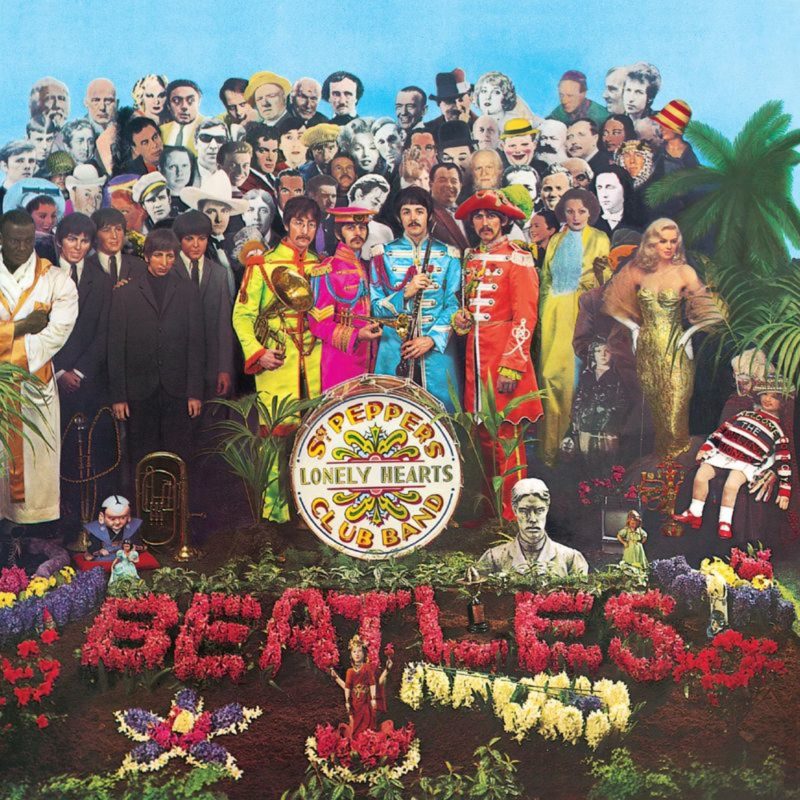
The album that made the album as an art form into a public event. 129 days at Abbey Road, the most ambitious cover in pop history, the first single-LP album to take six months to record, and the most-famous record of the 1960s, for better and for slightly worse, fifty-eight years on.
- Released
- May 26, 1967 (UK Parlophone PMC 7027 mono / PCS 7027 stereo) · June 2, 1967 (US Capitol MAS-2653)
- Label
- Parlophone (UK) · Capitol (US)
- Producer(s)
- George Martin
- Runtime
- 39:36
- Chart peak (US)
- #1 (Billboard 200), 15 weeks at the top
- Chart peak (UK)
- #1 (Record Retailer), 23 weeks at the top
- Certifications
- 11× Platinum (RIAA); estimated 32M+ units worldwide; the bestselling album of the 1960s
- Awards & honours
- 4 Grammy Awards including Album of the Year (1968), first rock album in the category; Library of Congress National Recording Registry (2003); the Mt. Rushmore of 1960s rock
The most-influential rock album ever made, and also, increasingly, in the contemporary reassessment, the least-imitated. The Beatles entered Abbey Road in November 1966 with the radical thesis that the next album would be a single conceptual event. They left in April 1967 having made the album, the cover, and the genre we now call rock-as-art.
Sgt. Pepper is the Rosetta Stone of rock criticism: every argument about what a 'rock album' is supposed to be has, since 1967, been a re-argument with Sgt. Pepper. The band that made it understood this in real time. Lennon had said, weeks before sessions began, that he wanted the next album to be 'unlike anything we've ever done.' McCartney had returned from a 1966 trip to America with the idea that the Beatles could project themselves as a fictional band, that they could 'be' someone else for an album, and that the someone else would liberate them from the public expectations of being themselves. Harrison had spent the summer in India studying sitar with Ravi Shankar. Ringo, by his own later admission, was learning chess during much of the recording. All four had grown long mustaches in the autumn of 1966. The mustaches were a deliberate signal: this would be a different Beatles.
The sessions began on November 24, 1966, three months after the band's last concert at Candlestick Park. They had not performed live in five months and had no intention of returning to live performance. The first songs they cut were 'Strawberry Fields Forever' (Lennon, the most ambitious single track he had recorded to that point, multiple takes spliced together at different tape speeds), 'When I'm Sixty-Four' (McCartney's vaudeville exercise written when he was sixteen), and 'Penny Lane' (McCartney's response to Lennon's Strawberry Fields). Brian Epstein, the band's manager, persuaded EMI in February 1967 to release Strawberry Fields and Penny Lane as a double-A-side single rather than hold them for the album. The decision is generally considered the worst Epstein ever made, both songs are masterpieces, both were originally intended for Sgt. Pepper, and the album would be a stronger record with them.
What followed is the most-documented studio process in pop history. 129 days of recording. £25,000 in studio time (more than Help!, Rubber Soul, and Revolver combined). George Martin and Geoff Emerick inventing techniques on the fly, the 40-piece orchestra on 'A Day in the Life' instructed to play, over 24 bars, from the lowest note on their instrument to the highest, with no coordination between players. The recursive structure of 'A Day in the Life,' where Lennon's first verses and McCartney's middle section (which began as a separate song) were stitched together with a 24-bar crescendo on each side. The Indian classical ensemble on 'Within You Without You' (the album's only Harrison song, recorded with no other Beatles present). The wax-cylinder calliope sound on 'Mr. Kite!' (Martin had Emerick chop a Victorian fairground organ recording into one-inch pieces and reassemble them at random). The reverse-tape splice at the end of side two, a circular groove that, on the original UK LP, plays a meaningless five-second loop forever until you lift the needle.
The album's argument is that the studio is a stage and the band on it is whoever they decide to be. The Sgt. Pepper band is a fiction the Beatles inhabit for 39 minutes; the Beatles, as their actual selves, do not appear until the album is over. The opening track ('Sgt. Pepper's Lonely Hearts Club Band') introduces the fictional band. The second track ('With a Little Help from My Friends') is the fictional band's drummer (Billy Shears, played by Ringo) being introduced. The remaining ten songs are framed as the fictional band's set. The penultimate track ('Sgt. Pepper's Lonely Hearts Club Band [Reprise]') is the band saying goodbye. 'A Day in the Life,' the album's final track, breaks the frame, the Beatles return as themselves, and the album closes with a single piano chord sustained for 53 seconds, the longest sustained chord in pop. The chord was struck by McCartney, Lennon, Martin, and Mal Evans simultaneously on three pianos and one harmonium.
The cover by Peter Blake and Jann Haworth is the most-photographed album cover in pop history. The Beatles in Sgt. Pepper-uniform military pseudo-Edwardian outfits stand in front of a flower-arranged grave (the dirt with 'Beatles' spelled in flowers), surrounded by cardboard cutouts of 60 historical figures chosen by the four Beatles individually. Lennon had asked for Jesus and Hitler; both were removed at EMI's insistence. The cutouts that survived include Bob Dylan, Marlon Brando, Marilyn Monroe, Edgar Allan Poe, Lewis Carroll, Carl Jung, Aldous Huxley, Sri Yukteswar Giri (Harrison's choice), Mae West (who initially refused permission and was talked into it via a personal letter from Lennon), Karl Marx, Oscar Wilde, and W.C. Fields. The cover took 14 days to assemble and cost approximately £2,800, more than most album covers cost over a five-year span at that point.
What Sgt. Pepper proved is that an album could be a public event in the same way a film could be. The release of Sgt. Pepper on June 1, 1967 (the UK release date; US was June 2) was treated by the press as a cultural moment rather than a music release. Time magazine put the band on the cover. Reviews described the album in terms previously reserved for novels and classical compositions. The album entered the UK chart at #1 and held the position for 23 weeks; the US chart for 15 weeks. The album is generally considered the moment 'rock' became 'art rock', the moment the form was allowed to take itself seriously without irony.
The reassessment that has been going on since the early 2000s is the question of whether Sgt. Pepper was, in fact, the right ambition. Revolver (1966) had achieved more compressed innovation in less time. Pet Sounds (1966) had achieved more emotional coherence. Forever Changes (1967) by Love would, within months of Sgt. Pepper, achieve more lyrical ambition. Sgt. Pepper is, in 2026, the most over-imitated and least-imitated album in rock, over-imitated in the sense that every band of the late 1960s tried to make their Sgt. Pepper (most failed); under-imitated in the sense that contemporary critics, looking back, increasingly identify Revolver and Abbey Road as the Beatles records most influential on the current state of pop. Sgt. Pepper is, somehow, both the most-famous and the most-questioned Beatles album.
Sgt. Pepper belongs at #18 because of what it proved was possible and because of what it inaugurated. The album made the concept of the 'concept album' a public idea. It established that the studio is a stage. It demonstrated that an album cover could be its own art object. It made rock criticism take rock seriously. The reason it isn't higher is that the actual songs are slightly less consistently great than the records above it. Side one is a parade of brilliant five-out-of-five tracks; side two has tracks ('Within You Without You,' 'Good Morning Good Morning') that have aged unevenly and a closing track ('A Day in the Life') that is among the five greatest songs in pop. The album is unbalanced, front-loaded with hits, structurally ambitious in the middle, closing with a masterpiece. Revolver, ten months earlier, was more consistent. Abbey Road, two years later, was more cohesive. Sgt. Pepper is the most-famous of the three; whether it is the best is the question rock criticism has been asking since 2003. The answer is increasingly: no. But the question wouldn't exist without Sgt. Pepper having framed it.
Pressing guide — the one to own
Original 1967 UK mono pressing, Parlophone PMC 7027, with the yellow-and-black Parlophone label, the gatefold sleeve, and the printed cardboard cut-out insert (moustache, sergeant stripes, badges, stand-up and picture card). Matrix XEX 637-1 / XEX 638-1. The cut-out insert is the element most often lost, so complete-with-cut-outs copies trade at a substantial multiple over those missing it. The mono is the mix the Beatles and George Martin worked on directly and is the collector's reference.