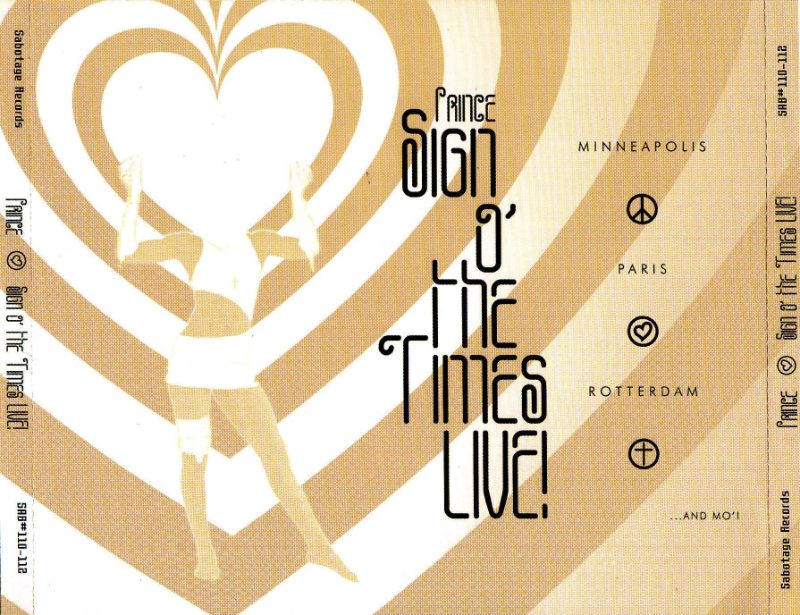
Prince in 1986, after canceling the Black Album and dismantling the Revolution, made a 79-minute double LP at Paisley Park. The album many fans consider his masterpiece.
- Released
- March 31, 1987
- Label
- Paisley Park / Warner Bros.
- Producer(s)
- Prince
- Runtime
- 79:54 (16 tracks across 2 LPs)
- Chart peak (US)
- #6 (Billboard 200)
- Chart peak (UK)
- #4 (Record Retailer)
- Certifications
- 3× Platinum (RIAA); 5M+ units globally
- Awards & honours
- Library of Congress National Recording Registry (2010); ranked #11 on Rolling Stone's 500 Greatest Albums (2020)
Eighteen months of recording at home in Chanhassen, Minnesota and at Sunset Sound in Los Angeles, with three planned projects collapsed into one double LP. Sixteen tracks across 80 minutes. The album that is consistently named Prince's most complete artistic statement and the deliberate compression of what would have been a triple LP, an alter-ego concept album, and a Revolution farewell into a single document made by a twenty-eight-year-old working primarily alone.
By autumn 1986 Prince had spent five years as the most commercially dominant Black auteur in popular music. Purple Rain (1984) had sold over 20 million copies and produced two US #1 singles. Around the World in a Day (1985) had reached US #1. Parade (1986) had been the Revolution's most genre-experimental statement and had produced the US #1 'Kiss.' Prince was 28, at the peak of his Warner Bros. contractual leverage, and approaching the moment at which his three planned next projects all simultaneously hit the studio. The Dream Factory project, a double-LP follow-up to Parade with the Revolution band, was nearly complete. The Camille project, a solo album entirely in Prince's pitched-up female alter ego, was in active recording. The Crystal Ball project, a planned three-LP box set assembling the strongest material from Dream Factory and other unreleased sessions, was Prince's preferred Warner Bros. negotiation. Warner Bros. wanted a single conventional LP.
The October 1986 dissolution of the Revolution was the catalyst. Wendy Melvoin and Lisa Coleman, the band's principal collaborators since 1982, had been increasingly alienated from Prince's controlling production style; the post-Parade tour had been their last together. Prince fired the band in October 1986 (Melvoin and Coleman first; the rest of the band shortly after) and returned to the solo-multi-instrumentalist approach of his earliest records. Sign O' the Times is therefore the first major Prince album recorded primarily by Prince alone since 1981's Controversy. The deliberate retreat into solo production gave the album its specific stylistic range; no band agreement was required to record an album that crossed funk, psychedelic rock, jazz, ballad, and gospel within sixteen tracks.
Recording took place across multiple studios. Prince's home studio at Galpin Boulevard in Chanhassen, Minnesota was the primary location through autumn 1986 and early 1987. Sunset Sound in Hollywood handled the Los Angeles sessions from December 1986 through February 1987. Some material on the final album was sourced from earlier sessions, 'Strange Relationship' dates back to 1983, 'It's Gonna Be a Beautiful Night' was recorded live at the Théâtre Élysée Montmartre in Paris on June 25, 1986 during the Parade tour. The album's deliberate stylistic compression reflects this assembly process: tracks from different periods, intended for different projects, brought together into a single sequence.
Warner Bros. forced the final compression in January 1987. Prince had submitted a triple-LP master (the Crystal Ball configuration) for approval. Warner Bros. executives Mo Ostin and Lenny Waronker insisted on a double LP at most; commercial expectations for a triple-LP set by a single artist weren't viable in the post-Thriller market. Prince's eventual compromise was the sixteen-track double LP that would become Sign O' the Times, combining material originally intended for Dream Factory, Camille, and Crystal Ball into one project. The Camille project, entirely sung in Prince's pitched-up female persona, was scrapped, though several Camille tracks ('If I Was Your Girlfriend,' 'Strange Relationship,' 'Housequake') made the final cut and Prince's altered-pitch vocal performance survives across the album. The compression became the album's structural argument: deliberate stylistic range from track to track as the document of three planned projects compressed into one.
The album's sixteen tracks are deliberately varied. 'Sign O' the Times', the title track and first single, released February 18, 1987, addresses AIDS, Reagan-era political collapse, and inner-city violence in 3 minutes of minimalist drum-machine-and-vocal arrangement; it reached US #3 and is one of the most explicitly political tracks Prince ever released. 'Play in the Sunshine' is psychedelic guitar rock. 'Housequake' (a Camille-pitched track) is dance-funk. 'The Ballad of Dorothy Parker' is one of Prince's most-celebrated quieter songs. 'Starfish and Coffee' is a Susannah Melvoin co-write (Wendy's twin sister, briefly engaged to Prince during the sessions). 'Slow Love' is a Carole Davis co-write with Prince's romantic-ballad approach. 'I Could Never Take the Place of Your Man' is rock-pop in the Prince auteur mode. The album's range, pop, funk, psychedelic, jazz, gospel, ballad, within a single sequence is the document of compressed planning.
The album was released on March 30, 1987 and peaked at US #6, UK #4. First-year sales were approximately 3.2 million. The four singles ('Sign O' the Times' US #3, 'If I Was Your Girlfriend' US #67, 'U Got the Look' US #2 with Sheena Easton, 'I Could Never Take the Place of Your Man' US #10) charted at varying levels. Critical response was immediately strong; Rolling Stone, the New York Times, and Robert Christgau in the Village Voice gave the album their highest critical marks. The album's reputation has compounded continuously since 1987 and is now consistently named Prince's most complete artistic statement.
Sign O' the Times belongs at #39 because it is the album in which Prince delivered the complete-range R&B-rock-funk-pop statement that his preceding albums had been building toward and his subsequent ones would never quite reach again. The deliberate dissolution of the Revolution, the compression of three planned albums into one, the solo recording approach, all combined into a record that documents an artist working at the absolute peak of compositional and production confidence. The album closed the great 1980s Prince run; the subsequent Lovesexy (1988) and Black Album (recorded 1987 but pulled from release and unreleased until 1994) would not match the scope. Critics now consistently name Sign O' the Times the best Prince album of his career; in 1987 it was understood as one of his best. The intervening decades have only increased the consensus.
Pressing guide — the one to own
1987 US first pressing, Paisley Park / Warner Bros. 25577-1 (two-LP gatefold). Look for the matrix etchings 25577-A / B / C / D, hand-etched at Warner Bros. Burbank by Bernie Grundman. The earliest US pressings have a slightly different inner-sleeve printing, full lyric sheet on a higher gauge paper, than subsequent mid-1987 reprints. The original gatefold sleeve features the photograph of Prince in front of the deliberately stylized 'Sign O' the Times' title-card neon sign.