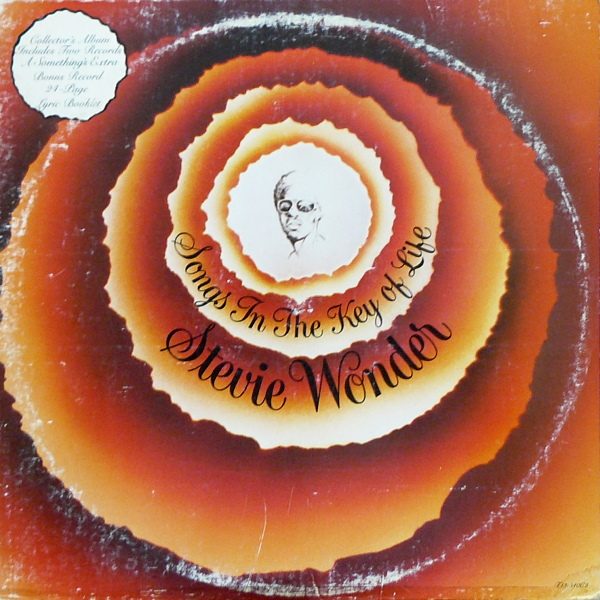
Stevie Wonder at twenty-six, three years past Innervisions and a year past the car accident that nearly killed him, signed the largest recording contract in history and used it to make a 104-minute double LP plus a 4-song bonus EP. The album he'd been threatening to make for two years. The album Motown thought he might never finish.
- Released
- September 28, 1976
- Label
- Tamla / Motown
- Producer(s)
- Stevie Wonder
- Runtime
- 104:32 (double LP + 4-song bonus EP, 21 tracks)
- Chart peak (US)
- #1 (Billboard 200, 14 weeks) · #1 (Top Soul Albums, 13 weeks)
- Chart peak (UK)
- #2 (Record Retailer)
- Certifications
- Diamond (RIAA, 10× Platinum, 2005); estimated 17M+ units globally
- Awards & honours
- Grammy Album of the Year (1977); Grammy Best R&B Vocal Performance, Male; Grammy Best Producer; Library of Congress National Recording Registry (2002); ranked #4 on Rolling Stone's 500 Greatest Albums (2020)
Two-plus years of recording, twenty-one songs, ninety-seven session musicians credited on the sleeve, a 24-page booklet of lyrics and dedications, and a £13 million Motown contract Wonder had signed in late 1975, at the time the largest in recording history. The album Stevie Wonder made when no one could tell him no.
By the spring of 1974, Stevie Wonder had decided to retire. He was 24. He had survived a car accident the previous August that should have killed him. He had won the Album of the Year Grammy for Innervisions in February, the youngest solo artist ever to receive the award. He had completed Fulfillingness' First Finale, which would win him the Album of the Year Grammy again in 1975, and which had been recorded largely during his recovery. He had been making records continuously since he was eleven years old. He was tired, religiously curious, increasingly skeptical of the music business, and convinced that he should leave Detroit, leave Los Angeles, and move to Ghana to teach music to children in a village school.
Berry Gordy spent eighteen months talking him out of it. The negotiations resulted, in August 1975, in a seven-year, seven-album contract worth £13 million plus 20% royalties, at the time the largest recording contract in history. The contract was generous on royalties; it was extraordinary on creative control. Wonder retained ownership of his masters, full producer rights on all recordings, the right to record anywhere with anyone, and an unlimited recording budget. He had been working toward this leverage since the renegotiation that produced Innervisions in 1972; the 1975 contract was, in his hands, a license to make whatever he wanted.
What he wanted was a 104-minute double LP plus a 4-song bonus EP. The album took two years to make. Motown printed 'We're Almost Finished' bumper stickers as a running internal joke through 1975 and 1976. The actual recording involved one hundred and thirty session musicians across seven studios over twenty-six months. Crystal Sound in Hollywood was the primary base. The Record Plant in LA, the Record Plant in NY, Hit Factory, Air Studios in London, and three other rooms hosted overflow sessions. Wonder employed two engineers full-time (Gary Olazabal and John Fischbach) and a rotating staff of assistants. He recorded ninety-six different songs across the period; twenty-one made the album.
What he was trying to make, as he told interviewers in the early stages, was a complete statement on what 1976 felt like, Black America, Bicentennial America, the world after Vietnam and Watergate, the family he was building, the music he loved, the loss he had survived, the future he was prepared to imagine. He named the project Songs in the Key of Life. He intended the title literally: the album would be in the key of life, would orient itself around life rather than around a single style or theme. The genres on the finished record reflect this: 'Love's in Need of Love Today' is gospel; 'Have a Talk with God' is theological pop; 'Village Ghetto Land' is a Bach-style baroque piece played on synthesizer; 'Contusion' is jazz fusion; 'Sir Duke' is Duke Ellington–style big-band jazz; 'I Wish' is funk; 'Pastime Paradise' is orchestral with Hare Krishna choir; 'Joy Inside My Tears' is soul ballad; 'Black Man' is funk-rock history lesson; 'Ngiculela / Es Una Historia / I Am Singing' is sung in Zulu, Spanish, and English; 'If It's Magic' is harp solo with single vocal; 'As' is jazz fusion ballad; 'Another Star' is salsa-pop. Then the bonus EP: 'Saturn,' 'Ebony Eyes,' 'All Day Sucker,' 'Easy Goin' Evening.' The album doesn't have a single sonic identity; it has the breadth of a survey course.
It is also the most prepared album in Wonder's catalogue. Where Innervisions was made quickly with Margouleff and Cecil's TONTO as the dominant instrument, Songs in the Key of Life is made slowly with a much larger band. The Wonderlove backing group, Wonder's longtime touring vocalists, including Minnie Riperton (until her departure for solo career in 1974), Deniece Williams, Susaye Greene, Madelaine Smith, anchors the vocal arrangements. Nathan Watts plays bass; Greg Phillinganes plays clavinet and electric piano; Mike Sembello plays guitar. Herbie Hancock plays Fender Rhodes on 'As', one of the great session contributions to a Wonder album. George Benson plays guitar on 'Another Star.' The album credits ninety-seven session musicians by name.
It is also the album on which Wonder's politics fully integrated with his songwriting. 'Pastime Paradise' is the album's most political song, a portrait of American society as a place obsessed with its own grief, sung against an orchestral arrangement that lifts in stages from minor-key sorrow into a Hare Krishna choir mantra into a Gospel choir resolution. The song is 6 minutes long. It uses no fewer than four distinct vocal ensembles. Coolio sampled the strings figure for 'Gangsta's Paradise' twenty years later; the original is more harmonically complex than the sample suggests. 'Village Ghetto Land' is a baroque four-part synthesizer arrangement underneath a documentary lyric about urban poverty. 'Black Man' is a seven-minute funk-history lesson naming individual American Black figures, from Sojourner Truth to Crispus Attucks, and asking the listener to recognize the contributions the country had erased. None of these songs is comfortable. All of them are also, somehow, irresistible.
Released September 28, 1976, Songs in the Key of Life debuted at #1 on the Billboard 200, only the third album in history (after Elton John's Captain Fantastic and the Beatles' Abbey Road in re-entry) to do so. It held #1 for fourteen consecutive weeks. It won the Album of the Year Grammy in February 1977, Wonder's third in four years (joined by Paul Simon's Still Crazy After All These Years; Simon famously joked at the ceremony that he wanted to thank Stevie Wonder for not making an album that year). Sales reached one million in the first month. The album has now sold more than seventeen million copies worldwide and was inducted into the Library of Congress National Recording Registry in 2002.
Songs in the Key of Life belongs at #13 because it is the album on which a singular artist with complete creative control, an unlimited budget, two and a half years of studio time, and the most talented session-musician roster anyone could assemble produced a 104-minute statement about the meaning of being alive in 1976. It is the longest album on this list. It is one of the longest commercially-successful pop records ever released. It is also, somehow, an album most fans can listen to in full without checking the time. The genre-jumping never feels self-indulgent; the length never feels indulgent. Wonder gave himself permission to make the largest possible statement and then made it. The album is the proof that scale, in pop music, can still be coherent. Without it there is no Beyoncé's Lemonade as a 'visual album event,' no Kendrick's To Pimp a Butterfly as a 79-minute statement, no Frank Ocean's Channel Orange as a thematically-knit suite. The road from Stevie Wonder's £13 million signing to every subsequent ambitious double-LP-as-event runs through this record.
Pressing guide — the one to own
Original 1976 US first pressing, Tamla T13-340C2, a double LP plus the four-song bonus 7-inch EP, housed in a gatefold sleeve with a 24-page booklet of lyrics, dedications and credits. The booklet and the bonus EP are the collector's markers; both are routinely lost or damaged, so complete copies command a premium. The bonus EP carries its own matrix in the T13-340 EP 2649S / 2650S family rather than a separate catalog prefix. Clean, complete original pressings with the booklet intact trade strongly on the secondary market.