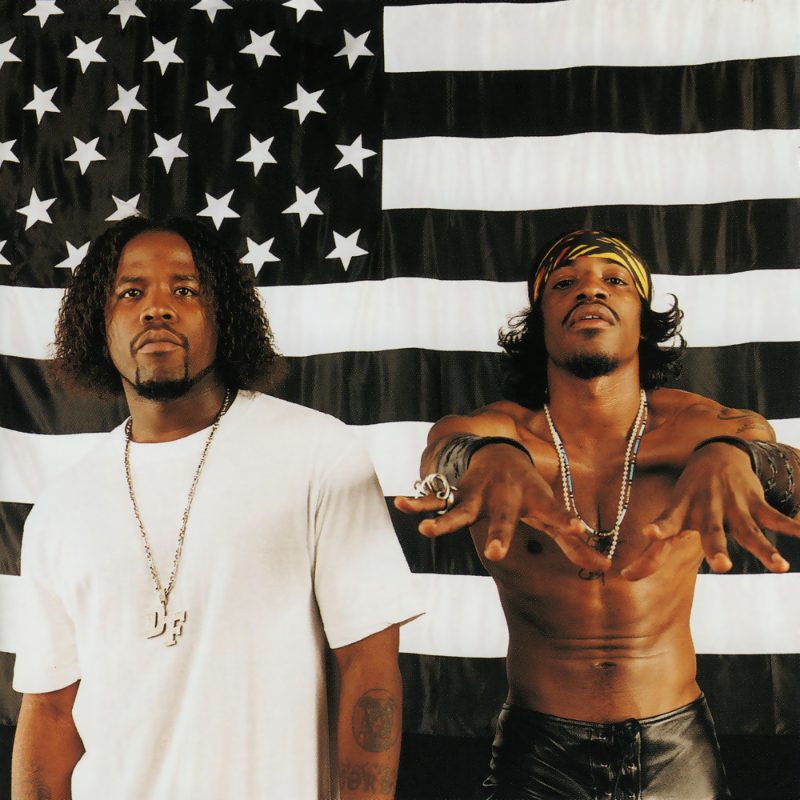
Twenty-four tracks in 73 minutes. Recorded across roughly eighteen months at OutKast's Stankonia Studios in Atlanta with OutKast, Organized Noize, and Earthtone III co-producing. OutKast's fourth LP, Big Boi and André 3000 at their commercial-and-critical peak, released by LaFace / Arista in October 2000. The album that pushed Aquemini's genre-omnivorous template to maximalist commercial-pop scale. Diamond US.
- Released
- October 31, 2000
- Label
- LaFace Records / Arista Records (US, 26072)
- Producer(s)
- OutKast · Mr. DJ · Earthtone III
- Runtime
- 73:00 (24 tracks)
- Chart peak (US)
- #2 (Billboard 200); #1 (Top R&B/Hip-Hop)
- Chart peak (UK)
- #10 (UK Albums Chart)
- Certifications
- 4× Platinum (RIAA, 2003)
- Awards & honours
- Grammy Album of the Year nomination (2002); Grammy Best Rap Album (2002); ranked #64 on Rolling Stone's 500 Greatest Albums (2020)
Twenty-four tracks in 73 minutes. Recorded across approximately eighteen months at OutKast's Stankonia Studios in Atlanta with OutKast and Organized Noize co-producing. OutKast's fourth LP, Big Boi and André 3000 at their commercial-and-critical peak, released by LaFace / Arista in October 2000. The album that converted Aquemini's genre-omnivorous template into maximalist commercial-pop scale and inaugurated the deliberately fragmented commercial hip-hop vocabulary every subsequent ambitious Southern-rap LP has worked within. Diamond US.
OutKast in early 1999 were two years past Aquemini's commercial breakthrough (September 1998, US #2, 2× Platinum) and at a structural creative-and-commercial peak. The duo had purchased the Bobby Brown studio in Atlanta in 1998 and renamed it Stankonia, the converted facility became the duo's primary creative workspace across the subsequent decade. The Stankonia LP was conceived as a deliberate maximalist statement: more tracks, more genre experimentation, more commercial-pop ambition than any previous OutKast LP.
Sessions began at Stankonia Studios in late 1998 and continued through summer 2000, approximately eighteen months. OutKast self-produced approximately half the tracks; Organized Noize (Rico Wade, Sleepy Brown, Ray Murray) co-produced the remainder. Earthtone III, the OutKast in-house production team of Big Boi, André, and David 'Mr. DJ' Sheats, handled additional production work. Substantial guest contributions: Goodie Mob, Erykah Badu, Cee-Lo Green, B-Real (Cypress Hill), Slick Rick.
The album's twenty-four tracks across 73 minutes are sequenced as a deliberately fragmented document. Short skits ('Drinkin' Again,' 'Kim & Cookie,' 'D.F.,' 'We Luv Deez Hoes') alternate with full tracks; uptempo dance-floor tracks ('B.O.B.,' 'So Fresh, So Clean,' 'Ms. Jackson') alternate with slower introspective material ('Toilet Tisha,' 'Stanklove'); André and Big Boi's stylistic divergence, first formalized on Aquemini, continues to define the album's vocal-and-production heterogeneity.
'B.O.B. (Bombs Over Baghdad)', the album's lead single, released September 2000, was the album's central artistic decision. The 155 BPM tempo (substantially faster than commercial hip-hop conventional tempos), the deliberately drum-and-bass-influenced rhythm, the gospel-choir bridge, all combined to produce a single that radio programmers didn't know how to play. The song reached US #69 but its cultural-critical impact substantially exceeded its chart position; the post-9/11 reception context after September 2001 retroactively elevated the song's political-cultural standing.
LaFace released the album on October 31, 2000. First-week sales were 525,000 SoundScan units; US #2 debut. 'Ms. Jackson' (released as second single in October 2000) reached US #1 in February 2001, OutKast's first US #1 single. 'So Fresh, So Clean' followed as third single, reaching US #30. RIAA Platinum within 6 weeks; 4× Platinum within twelve months; Diamond (10× Platinum) certification in 2024.
Critical reception was extraordinary and unanimous. Pitchfork's Sam Ubl gave the album 9.5/10; Rolling Stone's Touré gave it five stars; The Source 5/5 mics. The 2001 Grammy ceremony delivered three wins: Best Rap Album, Best Rap Performance by a Duo or Group ('Ms. Jackson'), and Best Rap Performance by a Duo or Group ('Forgot About Dre,' with Dr. Dre, featured-vocal contribution).
Stankonia belongs at #73 because it is the album that converted Aquemini's genre-omnivorous template into maximalist commercial-pop scale and inaugurated the deliberately fragmented commercial hip-hop vocabulary every subsequent ambitious Southern-rap LP has worked within. Every subsequent Speakerboxxx/The Love Below (2003, Diamond), Idlewild (2006), Kanye West's Late Registration-and-Graduation-era catalogue, Tyler the Creator's Flower Boy / IGOR, T.I.'s Trap Muzik-and-beyond catalogue runs on the proof Stankonia delivered. The 2024 RIAA Diamond certification confirms the canonical-text commercial-pop status.
Pressing guide — the one to own
2000 US first pressing, LaFace / Arista 07822-26072-1 (2× LP gatefold).