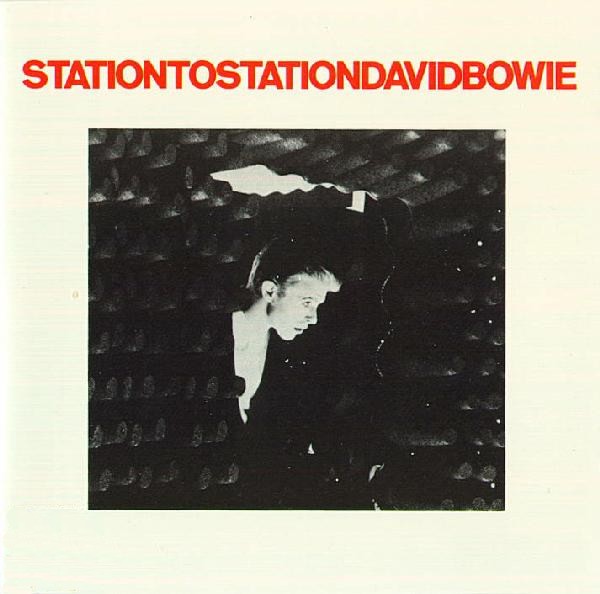
Six tracks in 38 minutes. Recorded across roughly 3 weeks at Cherokee Studios in Los Angeles in October and November 1975 by a band assembled from Carlos Alomar's rhythm section, Springsteen's pianist Roy Bittan, and Earl Slick's lead guitar. Bowie has said in print he doesn't remember making the album. The record that introduced the Thin White Duke persona, the krautrock-funk hybrid that would carry into Berlin, and the open six-minute title-track suite that became the template for every long-form rock song of the next decade.
- Released
- January 23, 1976
- Label
- RCA Victor (US, APL1-1327) · RCA Victor (UK, RS 1010)
- Producer(s)
- David Bowie · Harry Maslin
- Runtime
- 37:55 (6 tracks)
- Chart peak (US)
- #3 (Billboard 200)
- Chart peak (UK)
- #5 (UK Albums Chart)
- Certifications
- Platinum (RIAA, 1976); Gold (BPI, 1976)
- Awards & honours
- Ranked #324 on Rolling Stone's 500 Greatest Albums (2020); Grammy Hall of Fame (2016); ranked in the NME's Top 50 Bowie tracks list with 'Station to Station' at #3
Six tracks in 38 minutes. Recorded across roughly 3 weeks at Cherokee Studios in Los Angeles in October and November 1975 by a band assembled from Carlos Alomar's rhythm section, Springsteen's pianist Roy Bittan, and Earl Slick's lead guitar. Bowie has said in interviews and his subsequent autobiographical writing that he doesn't remember making the album, the Los Angeles cocaine year of which Station to Station is the principal document was, by his own account, a period of memory loss. The record that introduced the Thin White Duke persona, the krautrock-funk hybrid that would carry into Berlin, and the open six-minute title-track suite that became the template for every long-form rock song of the next decade.
David Bowie in autumn 1975 was twenty-eight years old, three years past Ziggy Stardust, two years past Aladdin Sane, one year past Diamond Dogs, and seven months past Young Americans, the soul-pop record that had been his US commercial breakthrough. He had been living in Los Angeles since the spring, subletting a series of houses in the Beverly Hills and Bel Air areas, and had developed a sustained cocaine habit that he has described in subsequent interviews as 'the worst year of my life.' He was also working on the script for Nicolas Roeg's 'The Man Who Fell to Earth,' shooting that film in New Mexico through July and August 1975, and was developing the visual and conceptual vocabulary of what would become the Thin White Duke, the alabaster-pale, slick-suited, ostentatiously emotionless character who would carry the Station to Station tour through spring 1976.
Recording began at Cherokee Studios on La Brea Avenue in early October 1975. The studio had been Bowie's pick for its location (Hollywood) and for its house engineers (Harry Maslin, who would become Bowie's co-producer, and engineer Jeffrey Workman). The band was assembled around Carlos Alomar, the Puerto Rican rhythm guitarist Bowie had hired for the Young Americans sessions earlier that year. Alomar brought his Young Americans rhythm section, bassist George Murray, drummer Dennis Davis, and recommended that Bowie hire Earl Slick (the lead guitarist from the Diamond Dogs tour) and a New York keyboardist Bowie didn't yet know: Roy Bittan, Springsteen's pianist from the just-released Born to Run, whom Alomar had heard on East Coast session work earlier in the year. Bowie agreed; Bittan was booked for ten days in late October to play piano on every track of the new record.
The sessions ran roughly 3 weeks across October and into mid-November. Bowie's working method was extreme even by his own previous standards. He would arrive at Cherokee around 4 PM with rough ideas, work through the night with the band, and return to whichever house he was renting at dawn. Cocaine consumption was, by everyone present's subsequent account, continuous. He was reportedly subsisting on a diet of red and green peppers, milk, and very little else; he weighed roughly 95 pounds when the photograph that would become the album's back cover was taken in mid-October. Maslin has said in print that Bowie did not always remember what had been recorded the previous night and that the producer's role through much of the sessions was to play back tapes that morning and walk Bowie through what existed.
What the band tracked, despite the conditions, was extraordinary. The title-track suite, 10 minutes, two distinct sections, an industrial-krautrock intro of train-sound feedback over Davis's motorik drumming for 4 minutes, breaking into a six-minute Alomar funk groove, was a structural move no Bowie record had previously attempted and no rock record of 1975-76 was attempting at the time. The track was recorded across three nights of overdubs; the seam at 4:22 (where Bittan's piano enters and the song's character changes) was the result of multiple takes spliced together by Maslin. Bowie has said the song is partly about the European train tradition (a tradition deep in krautrock, Kraftwerk in particular) and partly about the Kabbalistic Tree of Life (the 'stations' of the title refer to Sephirot as much as to railway platforms). The Thin White Duke is introduced in the second-section lyric.
The album's other five tracks compress the ten-minute title track's range. 'Golden Years' (the pre-album single released November 1975, US #10, UK #8) is the album's pop-funk anchor, originally written for Elvis Presley, who declined to record it, and given to Bowie's band to track instead. 'Word on a Wing,' a six-minute Roy Bittan-piano-led ballad, is what Bowie has called 'my most direct prayer', written during the Los Angeles year as 'an appeal to whoever might be listening.' 'TVC15' (side two opener) is a rockabilly-funk hybrid about an Iggy Pop hallucination: a television that swallowed his girlfriend. 'Stay' is the most-overtly funk track on the album, Earl Slick and Carlos Alomar's twin-guitar interplay carrying its middle 3 minutes. 'Wild Is the Wind' is a cover of the 1957 Dimitri Tiomkin song; Bowie's vocal is widely considered one of his most-controlled performances.
RCA released the album on January 23, 1976 with substantial marketing. 'Golden Years' had already been on the charts for 10 weeks; the album peaked at US #3 within 5 weeks of release and UK #5. The Isolar Tour (sometimes called the Thin White Duke Tour) began February 2, 1976 in Vancouver and ran through May; the tour staging, stark white backdrops, Bowie in a sharply-tailored European suit, deliberate emotional restraint throughout the performance, became one of the most-imitated rock-tour productions of the period. The tour also coincided with a series of incidents that have shadowed the album's reception: a March 1976 interview in which Bowie made remarks supportive of fascism (later retracted); the 'Bowie salute' at Victoria Station in May 1976 (Bowie returning to London from the European leg); and the broader 'Thin White Duke as fascist ironic-or-not' discourse that consumed the rock press through that summer.
Station to Station belongs at #54 because it is the album that simultaneously introduced the krautrock-funk hybrid that would define late-1970s art-rock, established the long-form rock song-as-suite template (the title track's ten-minute two-section structure), and provided the bridge between Bowie's Young Americans-era soul phase and the Berlin trilogy (Low, Heroes, Lodger) that would follow over the next three years. The Thin White Duke persona that the album launched has been the most-imitated rock-star visual presentation of its specific kind; every subsequent ostentatiously-formal, deliberately-restrained rock-star presentation, the Bryan Ferry of the late-1970s Roxy Music years, Suede's Brett Anderson in 1993, Pulp's Jarvis Cocker through Different Class, Arctic Monkeys' Tranquility Base Hotel-era Alex Turner, is downstream of decisions Bowie made in the Cherokee Studios mirror in November 1975. The album's late-period critical re-evaluation (Pitchfork ranked it Bowie's third-best LP in their 2016 obituary career retrospective, ahead of Hunky Dory and Aladdin Sane) confirms a position the music itself had held since the late 1970s.
Pressing guide — the one to own
Original 1976 US first pressing, RCA Victor APL1-1327 (matrix APL1-1327-A/B), single sleeve with the cropped black-and-white Steve Schapiro still from 'The Man Who Fell to Earth.' Crucially the US first-press label is tan, not orange, this was the first Bowie RCA US album with no orange-label issue. The lacquers were cut by Allen Zentz in Hollywood, not Greg Calbi, so disregard any 'GC' runout. Confirm the plain APL1-1327 catalogue number (no AFL1/AQL1 sticker); plant codes 'H' (Hollywood) or 'I' (Indianapolis) appear in the runout, and earliest copies shipped with a 'Golden Years' hype sticker. A common major-label LP, typically around £15-£40.