
№ 34 of 100
Tapestry
Tapestry by Carole King (1971), № 34 in The Lead-In’s 100 greatest albums. Carole King moves from writing other people's hits to writing songs for herself. The whole singer-songwriter decade begins on this piano.
Tapestry by Carole King (1971), № 34 in The Lead-In’s 100 greatest albums. Carole King moves from writing other people's hits to writing songs for herself. The whole singer-songwriter decade begins on this piano.
Carole King at twenty-nine, after a decade as a Brill Building songwriter for other artists, made her own singer-songwriter LP. The album that defined the early-1970s singer-songwriter era. Released February 10, 1971.
3 weeks at A&M Studios in Los Angeles with Lou Adler producing. Twelve tracks across 45 minutes. The album that turned Carole King, twenty-nine years old, a decade into the Brill Building songwriting partnership with her ex-husband Gerry Goffin, and three years into her own attempt at a solo career, into the bestselling female recording artist of the 1970s, and the foundational text for the entire decade of LA singer-songwriter records that followed.
Carole King had been writing hit songs since she was 18. With her husband Gerry Goffin, she had written 'Will You Love Me Tomorrow' (Shirelles, 1960), 'The Loco-Motion' (Little Eva, 1962), 'Up on the Roof' (Drifters, 1962), 'One Fine Day' (Chiffons, 1963), 'I'm into Something Good' (Earl-Jean, 1964) and 'Natural Woman' (Aretha Franklin, 1967). The Goffin-King songwriting partnership at the Brill Building in midtown Manhattan had been one of the central engines of early-1960s American pop. The partnership had ended with the marriage in 1968; King had moved to Los Angeles, formed the trio City with bassist Charles Larkey (her second husband) and guitarist Daniel Kortchmar, and recorded one album as City, Now That Everything's Been Said (1968), that sold almost nothing. By 1970 King was 28, divorced, raising two daughters, and convinced her career as a performing artist was effectively over.
James Taylor's Sweet Baby James (February 1970) changed the calculation. King had known Taylor through the New York folk scene and the Apple Records circle; Taylor's commercial breakthrough that spring, and his explicit citation of King as one of his songwriting heroes, created the conditions under which King could imagine a solo singer-songwriter album succeeding. King recorded her solo debut Writer (May 1970) for Lou Adler's Ode Records with minimal commercial response (peaked at US #84). Adler proposed a second album immediately. The sessions for what became Tapestry began at A&M Studios in Los Angeles in January 1971.
Recording was unusually quick. The album was tracked in approximately 3 weeks across January 1971 with engineer Hank Cicalo. Lou Adler produced; Cicalo engineered; the session musicians were a tight core, Charles Larkey on bass (King's husband), Joel O'Brien on drums, Danny Kortchmar on guitar, Curtis Amy on saxophone (his work on 'It's Too Late' would become one of the album's defining instrumental moments). James Taylor played acoustic guitar on three tracks and contributed backing vocals on two more; Joni Mitchell sang the famous double backing vocal on 'Will You Love Me Tomorrow.' The deliberate spareness, King's piano as the album's primary instrument, with the rhythm section supporting rather than competing, was both an aesthetic choice and a privacy strategy. King didn't want a large session band intervening between her songs and her listeners.
The album's first single, 'It's Too Late' (with 'I Feel the Earth Move' as B-side, but DJs played both equally), was released in April 1971. The single reached US #1 in June 1971, where it stayed for 5 weeks. The album, released in February 1971, took until late June to reach US #1; once there, it stayed for fifteen consecutive weeks, the longest run by any female solo artist's album in chart history to that point. Tapestry spent over 300 weeks on the Billboard 200, sold 25 million copies worldwide, and remained the bestselling album by a woman until Whitney Houston's debut in 1985. The single 'You've Got a Friend' (written by King but recorded by James Taylor on his Mud Slide Slim album, released April 1971) hit US #1 in July 1971, King and Taylor had effectively a two-album lock on the top of the chart through the summer.
King's specific contribution to the singer-songwriter form was the songwriter-as-performer position. Where Joni Mitchell's Blue (released June 1971, four months after Tapestry) operated as confession, King's Tapestry operated as reclamation, she was performing songs she had already given to other artists ('Will You Love Me Tomorrow,' 'You've Got a Friend,' 'A Natural Woman') in versions that argued the songwriter, not the performer, was the song's primary author. The 'Will You Love Me Tomorrow' on Tapestry is slower and more reflective than the Shirelles' 1960 hit; King's 'A Natural Woman' is unable to match Aretha Franklin's 1967 version (and King has been gracious about this) but is structured to make the songwriter's authorship audible. The position has been the foundational argument for every subsequent generation of singer-songwriters who write their own material; before Tapestry, the songwriter-as-primary-performer mode was a folk-music marginal position. After Tapestry, it became the mainstream.
Tapestry won four Grammy Awards in March 1972 at the 14th Grammy ceremony, Album of the Year, Record of the Year ('It's Too Late'), Song of the Year ('You've Got a Friend'), and Best Pop Vocal Performance, Female. The four-Grammy sweep made King the first solo artist to win all three of the major Grammys, Album, Record, and Song, at a single ceremony. The achievement has been matched twice since (by Christopher Cross in 1981 and Adele in 2012) but never exceeded. The Library of Congress added Tapestry to the National Recording Registry in 2003.
Tapestry belongs at #34 because it is the album that established the female singer-songwriter as a sustained commercial possibility, a position that didn't exist before 1971 and has been continuously occupied since. King's specific approach (piano-first composition, recording with one engineer and minimal session-band intervention, lyrical address from a thirty-year-old's perspective rather than a twenty-year-old's, songs that operate as personal essays rather than confession or anthem) was followed by every generation of female singer-songwriters since, Carly Simon, Linda Ronstadt, Tori Amos, Sarah McLachlan, Norah Jones, Phoebe Bridgers, Sufjan Stevens reading King through Mitchell. The 1971 sales were extraordinary; the album's reputation has compounded for fifty-three years. It is now consistently named among the greatest records ever made; it sold respectably when it appeared and outsold every album by a woman until 1985. The long compound interest of artistic seriousness has rarely been better demonstrated.
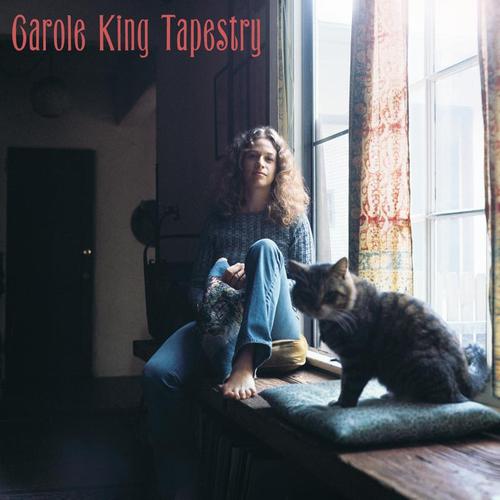
1971 US first pressing, Ode Records SP 77009 (also catalogued as Ode 70008 on initial label runs before Ode standardized to the SP catalogue) with the famous Jim McCrary photograph of King at her Laurel Canyon window with the tapestry. Look for the gatefold sleeve with the printed inner that includes Joni Mitchell credit (first pressings omit this; the 1972 reprint corrected it). Matrix etchings: SP 77009-A1 / B1, hand-etched. The earliest pressings have a slightly heavier gauge of vinyl (140g) than later run-on pressings (120g).
© The Lead-In · an independent, reader-supported music publication.