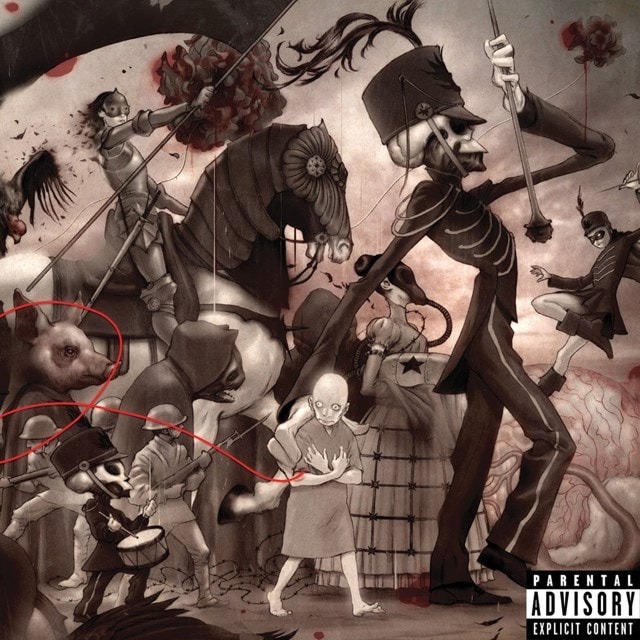
Thirteen tracks and a hidden coda, recorded over roughly four months in a reputedly haunted Los Angeles mansion with Rob Cavallo producing. A full rock opera about a dying man whose death arrives in the shape of his happiest memory, a parade. The album that took the most-mocked genre of the mid-2000s and aimed it at Queen, Pink Floyd, and the stadium, and produced a generation's defining singalong in 'Welcome to the Black Parade.'
- Released
- October 23, 2006 (UK) / October 24, 2006 (US)
- Label
- Reprise (US)
- Producer(s)
- Rob Cavallo · My Chemical Romance
- Runtime
- 51:54 (13 tracks + hidden track 'Blood')
- Chart peak (US)
- #2 (Billboard 200, November 2006)
- Chart peak (UK)
- #1
- Certifications
- Platinum (RIAA, US); 3× Platinum (BPI, UK)
- Awards & honours
- Multiple Kerrang! and NME awards; 'Welcome to the Black Parade' a UK #1 single; routinely topped 'greatest emo / 2000s rock album' lists
Thirteen tracks and a hidden coda, recorded over roughly four months at the Paramour Mansion, a reputedly haunted estate in Los Angeles, and Eldorado Recording Studios, with Rob Cavallo producing. My Chemical Romance's third album and their bid for permanence: a full concept record, a rock opera about a dying man called the Patient, built on the scale of Queen and the gloom of Pink Floyd. It made the most-derided genre of the moment attempt something operatic, and produced in 'Welcome to the Black Parade' one of the last true generation-defining rock anthems.
My Chemical Romance in 2005 were a New Jersey post-hardcore band who had outgrown the scene that made them. Their second album, Three Cheers for Sweet Revenge (2004), had gone platinum on the strength of 'Helena' and the Warped Tour ecosystem, and frontman Gerard Way, who has said he formed the band after watching the World Trade Center fall in 2001 and deciding to do something that mattered, was determined that the third record wouldn't be another collection of singles. The plan was audacious to the point of recklessness: a concept album, a rock opera, a record that would either make the band a Queen-scale institution or end them as overreachers.
They recorded at the Paramour Mansion, a sprawling, decaying estate in the Silver Lake hills of Los Angeles with a reputation for being haunted, living in the building through the sessions in early-to-mid 2006. Producer Rob Cavallo, who had made Green Day's Dookie and the American Idiot rock opera the year before, was the deliberate choice: the man who had just proved a punk band could make a capital-A concept record and have it top the charts. The mansion's atmosphere became part of the album's making; the band have described sleeplessness, illness, and genuine unease, and drummer Bob Bryar sustained injuries during the period that fed into the album's mythology.
The concept is a death. The album follows the Patient, a dying man, as death comes to collect him, not as a horror but as a parade, drawing on a memory his father gave him as a child, that death would arrive in the form of his happiest day. The band invented an alter ego to perform it: 'The Black Parade,' a spectral marching band in funeral-military dress, complete with its own staging and uniforms, so that the album and its tour were performed by the fictional band rather than by My Chemical Romance. It is glam-rock theatre in the lineage of Ziggy Stardust, the persona as the point.
Three Cheers had been a great singles band's record. The Black Parade is the sound of a band refusing to be a singles band, staking everything on the album as a single forty-minute argument, on theatre over authenticity, on Queen and Liza Minnelli over the Warped Tour. It is emo's bid to be taken as seriously as the records it grew up worshipping, and the remarkable thing is how often it earns the comparison.
Musically the album is a magpie's rock opera. 'Welcome to the Black Parade' moves from a single piano note through a Floyd-scale slow march into a full-throttle anthem inside 5 minutes; 'Mama' is cabaret-metal with Liza Minnelli singing the part of a wartime mother; 'Cancer' is two and a half minutes of voice, piano, and strings with no irony left in it; 'Teenagers' is a Slade glam stomp that sounds like it wandered in from another record. Rob Cavallo's production is maximal and bright, stacked guitars, layered vocals, theatrical dynamics, and Ray Toro's lead playing gives the bombast genuine craft underneath the costume.
'Welcome to the Black Parade' is the song the album is organised around and the reason it is remembered. Its structure, the lone held piano 'G,' the slow build, the key change, the marching crescendo, is a piece of deliberate stadium architecture, and it worked beyond any reasonable expectation: a UK #1, a permanent festival singalong, and, two decades on, an internet shorthand where a single piano note triggers mass recognition. It is one of the last rock songs to achieve genuinely universal generational saturation before streaming fragmented the monoculture that made such songs possible.
Reprise released the album on October 23, 2006 in the UK and a day later in the US. It debuted at US #2 and UK #1, going platinum in the States and multi-platinum in Britain. The reception split exactly along the fault line the band had bet on: to its champions it was the genre's Sgt. Pepper, ambition finally matched to scale; to its detractors it was overwrought emo theatre, and the album's success helped trigger the mid-2000s 'emo' moral panic, particularly in the British press. Both readings are responses to the same quality, the album's total commitment to bigness and feeling, with the irony dial turned almost all the way down.
The Black Parade belongs at #95 because it is the record on which a maligned genre reached for the canon and, more often than not, touched it. Its commercial scale (US #2, UK #1, platinum and beyond), its single's permanence ('Welcome to the Black Parade' as one of the era's last universal anthems), and its sheer ambition (a Queen-scale rock opera made by a band the culture had decided not to take seriously) make it the high-water mark of 2000s emo and one of the most influential rock albums of its decade. Every theatrical, concept-driven, unashamedly emotional rock record that followed, and the entire afterlife of the scene as a serious object of study and devotion, runs through this album.
Pressing guide — the one to own
The original vinyl appeared in 2007 on Reprise, a year after the October 2006 CD, as a double-LP gatefold (catalogue 44427-1) with side D laser-etched and a US first run reported at around 3,000 copies, which is why clean originals command a premium. The other collector centrepiece is the 2016 10th-anniversary 'The Black Parade / Living with Ghosts' set with its bonus disc of demos. Note the picture disc is a later 2018 pressing, not a 2006-era item. Confirm an original 2007 Reprise pressing over the many later standard repressings.