
№ 64 of 100
The Chronic
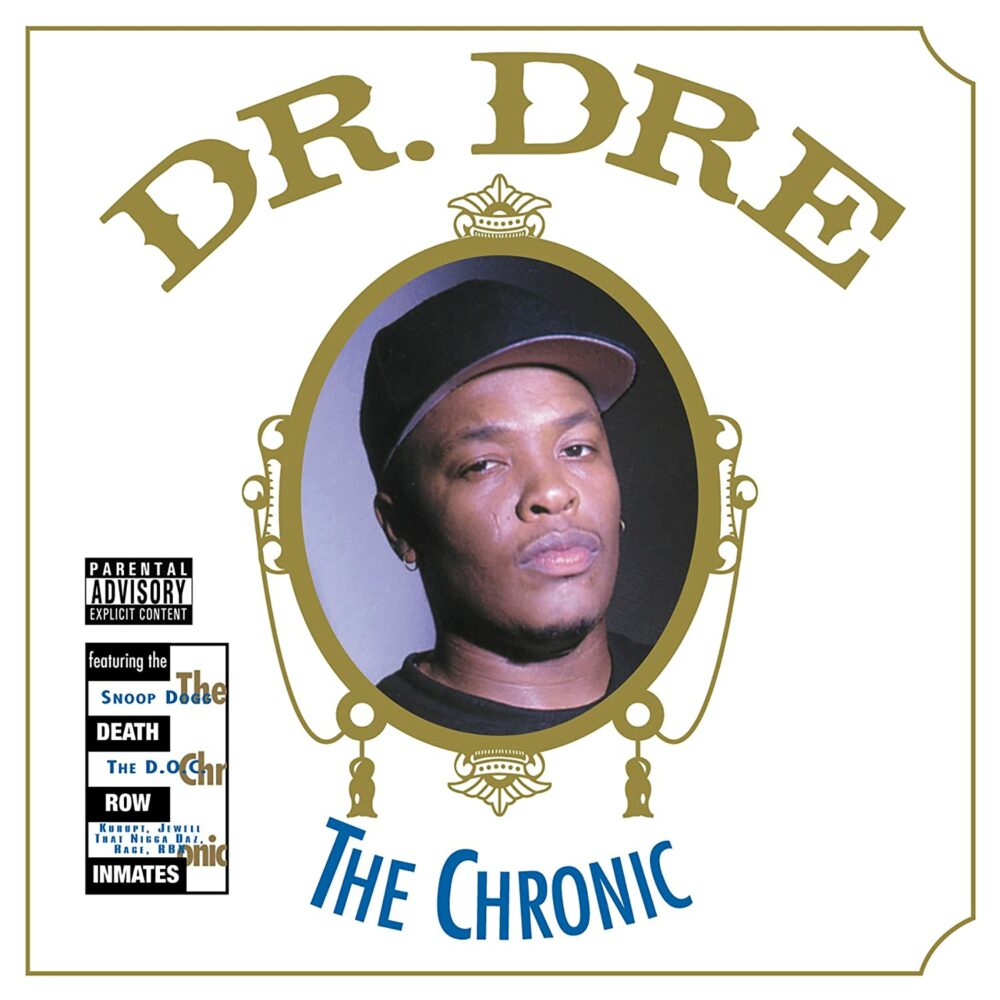
The Chronic by Dr. Dre (1992), № 64 in The Lead-In’s 100 greatest albums. Dr. Dre records the album that legalizes G-funk in his Studio City garage. The era starts here and so does Snoop's career.
The Chronic by Dr. Dre (1992), № 64 in The Lead-In’s 100 greatest albums. Dr. Dre records the album that legalizes G-funk in his Studio City garage. The era starts here and so does Snoop's career.
Sixteen tracks in 63 minutes. Recorded across approximately ten months at Death Row Studios in Beverly Hills and Larrabee Studios in North Hollywood with Dr. Dre producing the entire album. The debut LP from the recently-formed Death Row Records, featuring Snoop Doggy Dogg, Daz Dillinger, Kurupt, the Lady of Rage, and Warren G. The album that consolidated G-funk as a commercial genre, introduced Snoop Dogg to the world, and established the West Coast hip-hop production vocabulary that would dominate mainstream hip-hop through the mid-1990s.
Sixteen tracks in 63 minutes. Recorded across approximately ten months at Death Row Studios in Beverly Hills and Larrabee Studios in North Hollywood with Dr. Dre producing the entire album. The debut LP from the recently-formed Death Row Records, featuring Snoop Doggy Dogg, Daz Dillinger, Kurupt, the Lady of Rage, and Warren G. The album that consolidated G-funk as a commercial genre, introduced Snoop Dogg to the world, and established the West Coast hip-hop production vocabulary that would dominate mainstream hip-hop through the mid-1990s.
Dr. Dre in spring 1992 was twenty-seven years old, recently departed from N.W.A and Ruthless Records under acrimonious legal circumstances, and beginning the most-significant business arrangement of his career. He had left N.W.A in March 1991 over royalty disputes with Eazy-E and manager Jerry Heller; the resulting Ruthless lawsuit had been settled in late 1991. In spring 1992, Dre had partnered with Marion 'Suge' Knight to form Death Row Records, a new independent label structured around Dre's production work. The label was distributed by Interscope Records (Jimmy Iovine's recently-founded subsidiary of Atlantic Records); the deal allowed creative control while Interscope provided major-label distribution.
Recording for The Chronic began at Death Row Studios in Beverly Hills (a converted residence Knight had purchased for the label) in spring 1992 and ran through autumn at multiple facilities including Larrabee Studios in North Hollywood. Dre's working method was specific: he would build instrumental beds at Death Row Studios using a combination of live musicians (the deliberately-funk band assembled around bassist Colin Wolfe and keyboardist Ricky Rouse) and sample sources from his extensive Parliament-Funkadelic library, then bring the completed beds to the vocal sessions for the deliberately-rotating roster of Death Row MCs.
The album's defining production decision was Dre's deliberately-funk-sample-heavy approach combined with the deliberately-live-musician instrumental beds. The Parliament-Funkadelic sample bed on 'Let Me Ride' (built on 'Mothership Connection'), the Leon Haywood sample on 'Nuthin' but a G Thang,' and the Donny Hathaway sample on 'Lil' Ghetto Boy' became the founding texts of G-funk as a commercial genre. The deliberately-mellow, deliberately-melodic, deliberately-mid-tempo aesthetic that emerged was structurally distinct from contemporaneous East Coast hardcore hip-hop (Public Enemy, Boogie Down Productions, Eric B. & Rakim) and from contemporaneous Bay Area hip-hop (E-40, Too Short). The G-funk genre that The Chronic consolidated would dominate mainstream hip-hop through the mid-1990s.
The album's most-significant individual contribution was the introduction of Snoop Doggy Dogg. Snoop, a Long Beach-born rapper whose demo Dre had heard through a Death Row contact in autumn 1991, contributed to ten of the album's sixteen tracks. His deliberately-slow, deliberately-melodic vocal delivery and his deliberately-laid-back lyrical persona contrasted with contemporaneous East Coast vocal approaches; the Snoop vocal vocabulary became the most-imitated West Coast vocal style of the mid-1990s. The album's commercial success directly enabled Snoop's solo debut Doggystyle (November 1993, US #1), which would be one of the largest-selling rap albums of all time.
Death Row Interscope released the album on December 15, 1992 with substantial promotional support. The album debuted at US #3 on the Billboard 200 with 250,000 first-week SoundScan units; 'Nuthin' but a G Thang' (released as the second single in January 1993) peaked at US #2 (held off #1 by Whitney Houston's 'I Will Always Love You'). 'Let Me Ride' (third single) peaked at US #34. By summer 1993 the album had been certified Platinum by the RIAA; by spring 1994 it had reached 3× Platinum. The album's commercial trajectory transformed Death Row Records from a recently-formed indie label into the dominant West Coast hip-hop force; the subsequent Death Row LPs (Snoop's Doggystyle 1993, Tupac's All Eyez on Me 1996) would consolidate the position.
The Chronic belongs at #64 because it is the album that consolidated G-funk as a commercial genre, introduced Snoop Dogg to the world, and established the West Coast hip-hop production vocabulary that would dominate mainstream hip-hop through the mid-1990s. Dre's deliberately-funk-sample-heavy production discipline became the foundational template for West Coast hip-hop; the Snoop Doggy Dogg vocal vocabulary became the most-imitated West Coast vocal style; the Death Row Records business arrangement became the template for mid-1990s independent-distributed hip-hop labels. The album's specific contribution to hip-hop's mid-1990s development, the G-funk genre consolidation, the Snoop introduction, the Death Row roster approach, the deliberately-cinematic narrative aesthetic, set the template that has continued through the present. The Library of Congress National Recording Registry induction in 2019 confirms a position the music itself had secured by 1995.
Original 1992 US pressing on Death Row / Interscope, manufactured and distributed by Priority Records: the LP is P1 57128 and the CD is P2 57128 (both 1992, not a separate 1993 vinyl release). Mastered by Bernie Grundman at Bernie Grundman Mastering, Hollywood. The original vinyl was pressed by Rainbo Records, with runout matrices in the S-27216 / S-27217 series. These Priority catalog numbers plus that matrix series are the reliable first-press identifiers; a genuine 30th-anniversary reissue would be 2022, not 2020.
© The Lead-In · an independent, reader-supported music publication.