
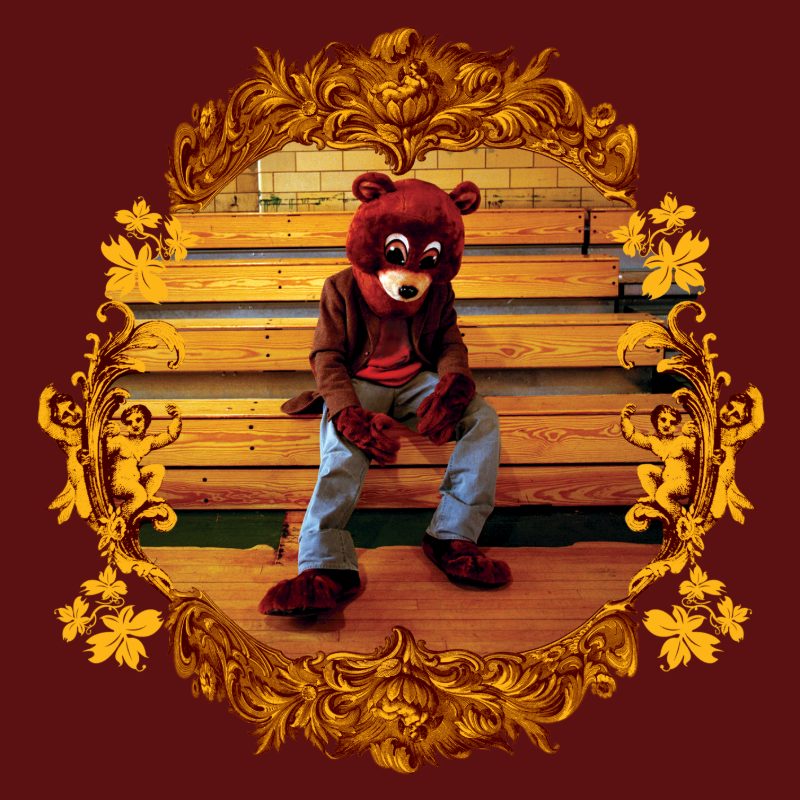
№ 86 of 100
The College Dropout
The College Dropout by Kanye West (2004), № 86 in The Lead-In’s 100 greatest albums. Discovery is the record people who don't think they like electronic music turn out to like.
The College Dropout by Kanye West (2004), № 86 in The Lead-In’s 100 greatest albums. Discovery is the record people who don't think they like electronic music turn out to like.
Twenty-one tracks in 76 minutes. Recorded across approximately four years (2000-2003) at multiple studios in Chicago, New York, and Los Angeles with Kanye West producing all but one track and Roc-A-Fella issuing under Jay-Z's auspices after years of label resistance. The album that converted a Chicago-born in-house producer with a chipmunk-soul sample aesthetic into a generational solo artist, and proved that backpack-rap subject matter (consumer anxiety, education skepticism, Christian doubt) could deliver a 4× Platinum debut.
Twenty-one tracks in 76 minutes. Recorded across approximately four years at multiple studios in Chicago, New York, and Los Angeles with Kanye West producing all but one track. Released by Roc-A-Fella after Jay-Z spent years overruling Damon Dash's and Roc-A-Fella's resistance to West as a solo artist. The album that converted a Chicago-born in-house producer with a chipmunk-soul sample aesthetic into a generational solo voice, and proved that backpack-rap subject matter (consumer anxiety, education skepticism, Christian doubt) could deliver a 4× Platinum debut and ten Grammy nominations.
Kanye West in mid-2002 was twenty-five years old, a Chicago-raised son of a poet-and-photojournalist mother (Donda West) and a Black Panther-activist father (Ray West), three years into a Roc-A-Fella production deal that had given him the production credits on Jay-Z's The Blueprint (2001), six tracks including 'Izzo (H.O.V.A.),' 'Heart of the City,' and 'Takeover.' The Blueprint had launched West's production career into the upper tier of mainstream hip-hop. His own MC ambitions had been resisted by Roc-A-Fella co-founder Damon Dash, who considered West insufficiently street-credible to carry a solo Roc-A-Fella release. Jay-Z was the internal advocate; the lobbying took two years.
October 23, 2002, West fell asleep at the wheel driving home from a Los Angeles recording session around 3:00 AM. He collided with another vehicle on the Wilshire Boulevard offramp from the 405 freeway. His jaw was shattered in three places; he required reconstructive surgery and several weeks with his jaw wired shut. The accident became the album's central biographical event. 2 weeks after the surgery, with his jaw still wired, West entered Record Plant in Los Angeles and recorded 'Through the Wire' in a single afternoon, rapping through clenched teeth over a pitch-shifted Chaka Khan 'Through the Fire' sample. The track was the album's lead single and its origin narrative.
Recording extended from approximately late 2000 through late 2003, across multiple studios: Sony Studios and Right Track in New York, Record Plant and the Enterprise in Los Angeles, Chicago Recording Company and Soundscape in Chicago. The production team was small, West, Brian 'All Day' Miller, and a rotating cast of session musicians. The chipmunk-soul technique (pitch-shifting vintage soul samples up an octave to produce a sped-up vocal hook) was West's signature production move; the album consolidated it as the dominant commercial hip-hop production aesthetic of 2003-2006.
The conceptual frame of The College Dropout, the title, the cover bear character, the recurring skits about a graduation ceremony, is the album's central organizing argument. West had attended Chicago State University for one semester in 1998-1999 before dropping out to pursue music; his mother Donda was an English professor at Chicago State. The album's education-skepticism vocabulary is a deliberate inversion of the Black-uplift-through-college narrative West had grown up inside. The title is a confession framed as a manifesto.
The twenty-one tracks across 76 minutes are sequenced with deliberate alternation between conceptual narrative tracks ('We Don't Care,' 'All Falls Down,' 'Jesus Walks,' 'Family Business'), comedic skits, and feature-heavy collaboration tracks ('Never Let Me Down' with Jay-Z, 'Get Em High' with Talib Kweli and Common, 'Two Words' with Mos Def and Freeway, 'Slow Jamz' with Twista and Jamie Foxx). The Christian-faith vocabulary on 'Jesus Walks' was deliberately positioned by West as a deliberate commercial-mainstream gesture, he predicted in interviews that radio wouldn't play the song because of its religious content, and that the controversy itself would drive single sales.
Roc-A-Fella released the album on February 10, 2004 after multiple delays through 2003, the original target had been August 2003 but mixing extended into November and December. First-week sales were 441,000 SoundScan units; the album debuted at US #2, held off the top spot by Norah Jones's Feels Like Home. By Christmas 2004 the album had certified 2× Platinum; by 2014 it reached 4× Platinum. 'Slow Jamz' (US #1), 'All Falls Down' (US #7), and 'Jesus Walks' (US #11) all charted in the Top-15. Ten Grammy nominations followed in early 2005; West won three including Best Rap Album and Best Rap Song for 'Jesus Walks.'
The album's cultural reception in 2004-2005 was unusually unified, critical praise (Pitchfork 9.7/10, The Source 4.5/5, Rolling Stone 4/5, Robert Christgau A) ran parallel to commercial success. West's subsequent catalogue (Late Registration 2005, Graduation 2007, 808s & Heartbreak 2008, My Beautiful Dark Twisted Fantasy 2010) extended the trajectory the album had inaugurated. The Roc-A-Fella deal that had been contested in 2001-2002 was vindicated by the commercial outcome, Jay-Z's internal advocacy for West proved decisive.
The College Dropout belongs at #84 because it is the album that consolidated chipmunk-soul as the dominant commercial hip-hop production aesthetic of the mid-2000s and demonstrated that backpack-rap subject matter could deliver platinum-level commercial outcomes without compromise. Every commercially-positioned conscious-rap album of the subsequent two decades, Drake's Take Care (2011), J. Cole's catalogue, Big Sean's Hall of Fame, Chance the Rapper's Coloring Book (2016), Kendrick Lamar's To Pimp a Butterfly (2015), is downstream of decisions West made on this LP about subject matter, production aesthetic, and feature curation. The 4× Platinum certification, ten Grammy nominations, and Rolling Stone #74 placement ratify the position. The album also produced the public persona, Kanye-as-cultural-figure, whose subsequent trajectory has remained the central question of mainstream hip-hop for two decades.
Original 2004 US 2xLP on Roc-A-Fella Records, catalog B0002030-01 (the often-cited "B0001873" does not exist, and Def Jam is not a credited label on the disc). It ships with a lyrics-and-credits insert; the Dropout Bear artwork was art-directed and designed by the studio Native (Eric Duvauchelle and others), not Morning Breath. Mastered by Eddy Schreyer at Oasis Mastering, with "MASTERDISK" stamped in the runouts. No pink or Target-exclusive colored variant exists — every pressing is black vinyl. Clean originals trade roughly $25–60.
© The Lead-In · an independent, reader-supported music publication.