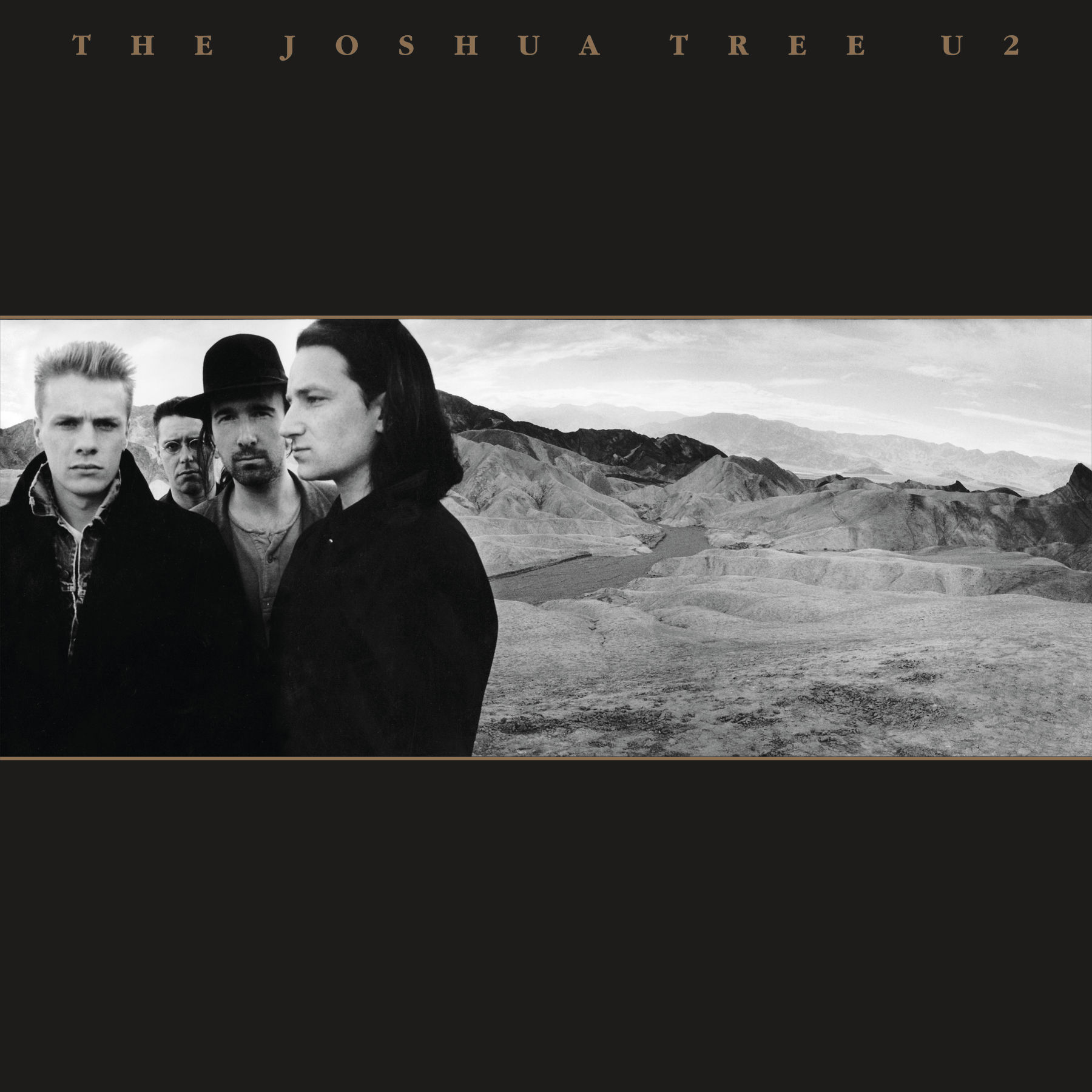
U2's fifth album. Brian Eno and Daniel Lanois co-producing. Released March 9, 1987. The album that made U2 the biggest band in the world.
- Released
- March 9, 1987
- Label
- Island Records
- Producer(s)
- Brian Eno · Daniel Lanois
- Runtime
- 50:09 (11 tracks)
- Chart peak (US)
- #1 (Billboard 200, 9 weeks)
- Chart peak (UK)
- #1 (Record Retailer, 2 weeks)
- Certifications
- Diamond, 10× Platinum (RIAA); 25M+ units globally
- Awards & honours
- Grammy Album of the Year (1988); Library of Congress National Recording Registry (2014); ranked #135 on Rolling Stone's 500 Greatest Albums (2020)
Eight months at Danesmoate House in Dublin with Brian Eno and Daniel Lanois co-producing. Eleven tracks across 50 minutes. The album that turned U2, four Irish post-punk musicians who had spent the early 1980s building a regional following, into the largest active rock band on Earth, the album that produced three consecutive US #1 singles, and the album that established the deliberate American-mythology approach that would define rock's late-1980s commercial peak.
U2 had been recording since 1980. Boy (October 1980), October (October 1981), War (February 1983), Under a Blood Red Sky (live, November 1983), The Unforgettable Fire (October 1984), five albums in five years, with the band's commercial profile growing steadily through Europe and reaching modest US chart positions. The Unforgettable Fire, produced by Brian Eno and Daniel Lanois, the band's first major creative partnership outside Steve Lillywhite's punk-rock production approach, had moved U2 from post-punk into a more ambient, sound-design-oriented mode that would shape the next decade. The 1985 Live Aid concert in July 1985 had been U2's commercial breakthrough moment in the US; Bono's extended walk into the Wembley crowd during 'Bad' had given the band its largest single American television audience to that point. By spring 1986 the band was ready to record an album that would consolidate the post-Live Aid position.
The Joshua Tree's specific American focus was Bono's project. Bono had spent the previous two years touring the United States extensively (the band had played approximately 100 US dates between Unforgettable Fire's October 1984 release and the spring 1986 sessions), reading Flannery O'Connor and James Baldwin, traveling through the American South with Amnesty International on the Conspiracy of Hope tour (June 1986), and visiting El Salvador and Nicaragua with the Sanctuary Movement that summer. The Sanctuary Movement, the Christian church network that smuggled Central American refugees fleeing US-funded death squads, gave Bono the direct exposure to the post-Vietnam American foreign-policy violence that would inform 'Bullet the Blue Sky.' The album's central preoccupations (the spiritual emptiness of late-Reagan America, the legacy of the civil rights movement, the cost of US Central American policy) were sourced from these specific 1985-86 American trips.
Recording began at Danesmoate House, a converted Georgian mansion in Rathfarnham, south of Dublin, in summer 1986. The house had been rented by the band for the year; sessions were conducted in the building's main music room with a 24-track mobile recording rig. Daniel Lanois has described the Danesmoate sessions as deliberately domestic in feel: band members lived at the house during recording, with meals taken communally, and recording sessions often extending late into the night. Brian Eno was Eno's typical itinerant role, visiting the project periodically rather than living at Danesmoate full-time, but his contributions to specific tracks (the ambient textures on 'Where the Streets Have No Name,' the deliberate sound-design approach on 'With or Without You') were central. Steve Lillywhite, the band's earlier producer, returned to handle final mixing of selected tracks in early 1987.
The album's eleven tracks divided into deliberate categories. The opening three tracks, 'Where the Streets Have No Name,' 'I Still Haven't Found What I'm Looking For,' 'With or Without You', were the album's intended commercial centerpiece; all three would be released as singles and all three would reach US #1 (the only Top 10 hit for the band's commercial peak). 'Bullet the Blue Sky' is the album's explicit political track, addressing US-funded Central American violence directly. 'Running to Stand Still' is the heroin-addiction portrait. 'Red Hill Mining Town' addresses British miners' strike-related working-class collapse. 'In God's Country' is the deliberate American-landscape meditation. 'Trip Through Your Wires' is the album's most uptempo track. 'One Tree Hill' is the elegy for Greg Carroll (the band's young Maori roadie who had died in a Dublin motorcycle accident on July 3, 1986; the song addresses him directly). 'Exit' is the deliberately dark closing track addressing American gun violence. 'Mothers of the Disappeared' is the deliberate Argentine-context closing meditation.
The deliberate cover photography established the album's American-landscape mythology. Anton Corbijn, the Dutch photographer who had been shooting U2 publicity images since 1982, photographed the band in California's Death Valley and Mojave Desert across one week in December 1986. The cover image features the four band members posed in front of a single Joshua tree at Sunrise Rock in the Mojave Desert (not actually Joshua Tree National Park, despite the album's title). The deliberate American-landscape iconography, the band as Western pilgrims in the American desert, was Bono and Corbijn's specific decision to frame U2's relationship to the American mythos. The interior gatefold photography included additional desert imagery shot during the same week.
The album was released on March 9, 1987, coordinated with the band's appearance on the cover of Time magazine. The simultaneous Time cover and album release was a deliberate Atlantic Records / Time coordination; the band was named 'Rock's Hottest Ticket.' The album entered the Billboard 200 at US #7, climbed to #1 by April 1987, and stayed at #1 for nine consecutive weeks. 'With or Without You' became the band's first US #1 single in May 1987. 'I Still Haven't Found What I'm Looking For' followed as the second US #1 single in August. 'Where the Streets Have No Name' reached US #13 (the highest charting non-#1 of the three principal singles). The album sold 25 million copies worldwide and remained the band's best-selling LP. Album of the Year at the 1988 Grammys ratified the institutional position.
The Joshua Tree belongs at #44 because it is the album in which U2 successfully translated their Irish post-punk concerns into a sustained critique of late-Reagan America. The 1986 research trips, the Eno-and-Lanois production, the deliberate album-as-statement framing, all combined into one of the rare commercially dominant rock albums that was also intellectually serious. The album's specific late-Reagan moment, Iran-Contra, the Sanctuary Movement, the post-civil-rights disenchantment with American self-image, was the moment the band had been preparing to address for years. They got the moment right. The album's continued relevance four decades later is a function of that moment's themes not having been resolved. The Joshua Tree Tour, extending from April 1987 through December 1987, was the highest-grossing rock tour of 1987 and established U2's position as the largest active rock band on Earth, a position they would hold for at least the next decade. The 2017 30th Anniversary tour played 51 dates and grossed £317 million, demonstrating the album's continued cultural standing thirty years after its release.
Pressing guide — the one to own
1987 UK first pressing, Island U2 6 with the original Anton Corbijn Mojave Desert cover photograph and the embossed-and-textured outer sleeve (Island designed the outer sleeve with a deliberate cardboard-and-cloth texture meant to evoke American Western iconography). Look for the matrix etchings U2 6-A1 / B1, hand-etched at the Townhouse Studios mastering facility by John Dent. The original UK pressings include the gatefold inner with the Carroll dedication and the additional Corbijn desert photographs.