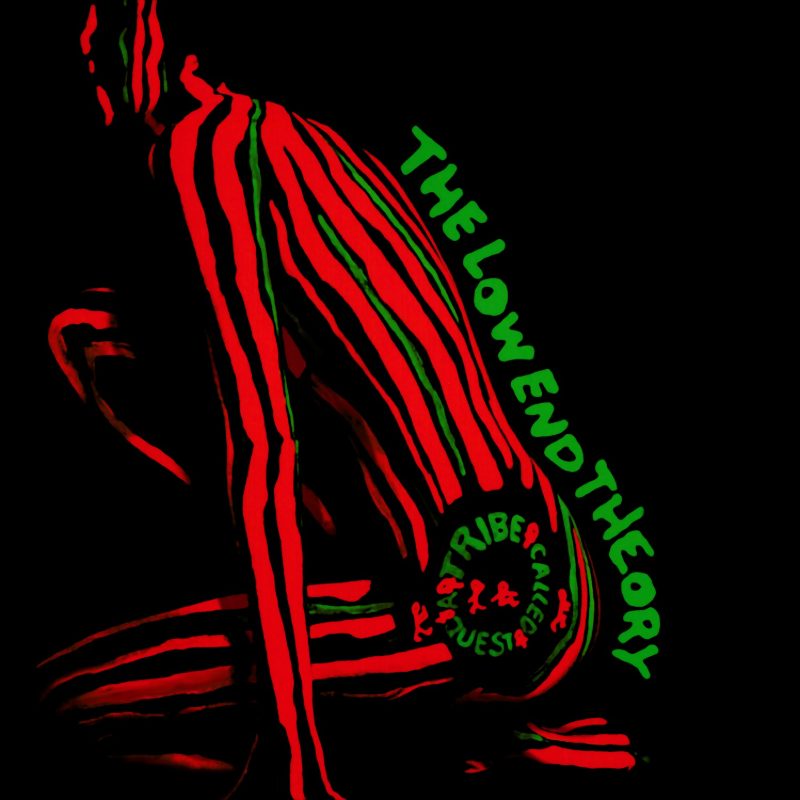
Fourteen tracks in 48 minutes. Recorded across approximately six months at Battery Studios in Manhattan with Bob Power engineering, A Tribe Called Quest self-producing the majority of tracks, and Skeff Anselm co-producing. The Queens duo's second LP, Q-Tip and Phife Dawg's commercial breakthrough, with Ron Carter contributing upright bass on 'Verses from the Abstract' and Busta Rhymes delivering the career-launching closing verse on 'Scenario.' The album that converted underground hip-hop's jazz-sample vocabulary into a sustained commercial form and inaugurated the Native Tongues' canonical-text era.
- Released
- September 24, 1991
- Label
- Jive Records (US, 1418-1)
- Producer(s)
- A Tribe Called Quest (Q-Tip executive) · Skeff Anselm · Bob Power (engineering)
- Runtime
- 48:09 (14 tracks)
- Chart peak (US)
- #45 (Billboard 200)
- Chart peak (UK)
- #58
- Certifications
- Platinum (RIAA, 1995); 2× Platinum (RIAA, 2017)
- Awards & honours
- Ranked #43 on Rolling Stone's 500 Greatest Albums (2020); The Source 5/5 (1992); routinely cited as the canonical jazz-rap LP and one of the most influential hip-hop LPs of the 1990s
Fourteen tracks in 48 minutes. Recorded across approximately six months at Battery Studios in Manhattan with Bob Power engineering, A Tribe Called Quest self-producing the majority of tracks, and Skeff Anselm co-producing. The Queens duo's second LP, Q-Tip and Phife Dawg's commercial breakthrough, with Ron Carter contributing upright bass on 'Verses from the Abstract' and Busta Rhymes delivering the career-launching closing verse on 'Scenario.' The album that converted underground hip-hop's jazz-sample vocabulary into a sustained commercial form and inaugurated the Native Tongues' canonical-text era.
A Tribe Called Quest in spring 1991 was a Queens-based duo with two studio albums to that point. Kamaal Ibn John Fareed (Q-Tip) and Malik Taylor (Phife Dawg) had grown up together in Linden Boulevard, St. Albans, Queens; they had attended Murry Bergtraum High School in Manhattan together with Jonathan Davis (Jarobi White) and Ali Shaheed Muhammad. The four-member configuration had released People's Instinctive Travels and the Paths of Rhythm in April 1990, the debut LP was praised by underground hip-hop press but had not broken commercially. Jive Records had retained the option for a second LP; the label's commercial expectations were modest.
By summer 1991 Jarobi White had largely withdrawn from active participation; he was effectively a non-recording member by the time of the Low End Theory sessions. The Tribe was functionally Q-Tip, Phife Dawg, and Ali Shaheed Muhammad as DJ and co-producer. Phife's role in the second LP was substantially larger than on the debut, where People's Instinctive Travels had been substantially a Q-Tip LP with Phife guesting; The Low End Theory was conceived as a Q-Tip-and-Phife co-led record.
Bob Power had been Tribe's engineering collaborator since People's Instinctive Travels; the Battery Studios working relationship was already established. Power's specific contribution to The Low End Theory was the bass-foregrounded mix. Q-Tip wanted the album's bass to be the central dynamic element, the title 'Low End Theory' referenced the bass-foregrounded approach explicitly. Power's mixing decisions across the album give the bass substantially more presence in the mix than was standard for 1991 commercial hip-hop.
The album's central artistic decision was the deliberate jazz-sample foundation. Q-Tip's sample selections traced a specific jazz lineage: Art Blakey, Lou Donaldson, Donald Byrd, Cal Tjader, Jimmy McGriff, Minnie Riperton's jazz-soul vocabulary, Ron Carter's upright-bass presence. The album is not the first jazz-influenced hip-hop LP (Stetsasonic's 1988 'Talkin' All That Jazz' had been earlier; Gang Starr's 1989-1991 catalogue was contemporary). The Low End Theory is the album that consolidated jazz-rap as a sustained commercial form. Every subsequent jazz-influenced hip-hop record, from Digable Planets' 1993 Reachin' to Robert Glasper's catalogue to Kendrick Lamar's To Pimp a Butterfly, descends from the proof Tribe delivered.
Sessions ran from approximately March through August 1991 at Battery Studios on West 44th Street. Q-Tip self-produced the majority of tracks; Skeff Anselm co-produced 'Excursions,' 'Buggin' Out,' and 'Vibes and Stuff.' The session-musician contributions were unusual for early-1990s hip-hop: Ron Carter on upright bass for 'Verses from the Abstract' (the bass legend's only major hip-hop LP appearance to that point); Vinia Mojica on backing vocals for several tracks; and the Leaders of the New School trio (Charlie Brown, Dinco D, Busta Rhymes) for the album-closing 'Scenario.'
The Busta Rhymes 'Scenario' verse was tracked in a single session at Battery in summer 1991. Rhymes had been the youngest member of Leaders of the New School; his 'I'm the rrrrrrrrah / Like a dungeon dragon' verse was reportedly improvised across several takes. The verse launched Rhymes's solo career and became one of the most-quoted hip-hop closing verses of the 1990s. The Hype Williams-directed video (released January 1992) was MTV-rotated for six months and converted both Tribe and Busta into mainstream commercial-rap figures.
Jive released the album on September 24, 1991. First-week sales were modest (approximately 23,000 SoundScan units); critical reception was unanimous. The Source gave the album 5/5 mics (the magazine's highest rating); the Village Voice's Robert Christgau gave it A+; subsequent critical reception consolidated the album's standing as the canonical jazz-rap LP. RIAA Gold certification came in November 1992, fourteen months after release. Platinum followed in 1995. 2× Platinum in 2017.
The Low End Theory belongs at #90 because it is the album that converted underground hip-hop's jazz-sample vocabulary into a sustained commercial form and inaugurated the Native Tongues' canonical-text era. Every jazz-influenced hip-hop record of the subsequent three decades runs on the proof Tribe delivered. Phife Dawg's March 22, 2016 death triggered a sustained catalogue surge that ratified the album's canonical-text status. The Rolling Stone 2020 ranking at #43 is the institutional confirmation. The album's continuing streaming presence (~5.8M monthly Spotify in 2026) demonstrates the canonical reach.
Pressing guide — the one to own
Original 1991 US pressing, Jive 1418-1, the LP cut by Tom Coyne at DMS in New York (his 'TC' cut, not the 2022 Ryan Smith/Sterling Sound reissue). The cover, the silhouetted female nude in fluorescent red and green on black, is a Zombart design (artwork by Jean Kelly, photo by Joe Grant), not a 'Joe Buckingham' piece. Production is by the group with Bob Power engineering and mixing. Clean first-press originals on the early Jive labels are the target; the album has since been reissued many times on double-LP.