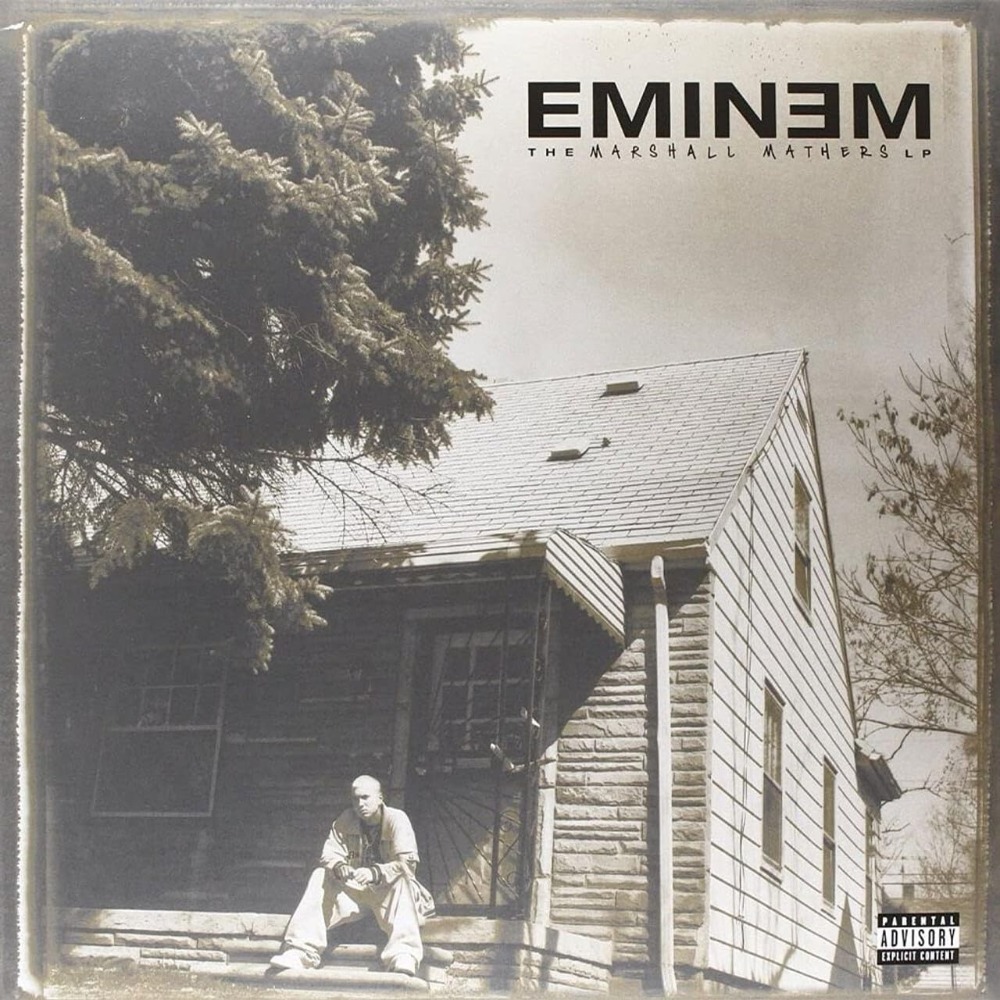
Eighteen tracks across 72 minutes, recorded in roughly 10 weeks between Detroit's 54 Sound and Dr. Dre's Los Angeles rooms. The follow-up to The Slim Shady LP, and the record on which a white rapper from a trailer-adjacent stretch of Warren, Michigan became the most-scrutinised, most-litigated, and most technically dazzling voice in American music, selling 1.76 million copies in its first week and forcing a national argument about what pop was now allowed to say.
- Released
- May 23, 2000
- Label
- Web / Aftermath / Interscope (US, 490 629)
- Producer(s)
- Dr. Dre · Eminem · Mel-Man · The 45 King · Bass Brothers
- Runtime
- 72:04 (18 tracks)
- Chart peak (US)
- #1 (Billboard 200, June 2000)
- Chart peak (UK)
- #1
- Certifications
- Diamond (RIAA, 10×+ Platinum, US)
- Awards & honours
- Grammy, Best Rap Album (2001); Album of the Year nominee (2001); ranked among Rolling Stone's 500 Greatest Albums; widely cited as the best-selling rap album of its era
Eighteen tracks across 72 minutes, cut in roughly 10 weeks between Detroit's 54 Sound and Dr. Dre's Los Angeles studios. The second major-label Eminem album, and the one that turned the cartoon provocateur of The Slim Shady LP into something more dangerous and more durable: a writer of genuine technical command using a fractured set of personas to say the things American pop had decided it could no longer say out loud. It sold 1.76 million copies in seven days, the fastest start for a solo artist to that point, and spent the rest of the year as the country's argument with itself.
Marshall Mathers in early 2000 was 27, eleven months past a debut that had sold four million copies, and famous in a way he had not planned for and didn't control. The Slim Shady LP (February 1999) had been a Dr. Dre co-sign that worked too well: it minted a character, Slim Shady, the id with a chainsaw, and the character had eaten the man. He was newly wealthy, newly surveilled, in a collapsing marriage to Kim Scott and a custody arrangement over their daughter Hailie, and the subject of a moral-panic discourse that treated his lyrics as instructions. The follow-up had to do three contradictory things at once: top the debut commercially, answer the panic, and separate the author from the mask the debut had built.
Recording ran from roughly December 1999 to March 2000, split between 54 Sound in Ferndale, just outside Detroit, the studio run by Mark and Jeff Bass, the brothers who had recorded Eminem before Dre and produced a third of this album as the Bass Brothers, and Dr. Dre's rooms in Los Angeles, including the Mix Room in Burbank. The division of labour is audible. Dre and his partner Mel-Man supply the album's brightest, most radio-shaped tracks ('Kill You,' 'The Real Slim Shady,' 'Bitch Please II'); the Bass Brothers supply its rawest and most personal ('Marshall Mathers,' 'Kim,' 'Criminal'). The 45 King contributed one beat, 'Stan,' that would outlast everything around it.
The album's structural innovation is the three-name system. Marshall Mathers is the man; Eminem is the rapper; Slim Shady is the persona who says the unsayable. The record keeps the three deliberately unstable, sliding between them inside a single verse, so that no statement can be safely assigned. 'Criminal' opens by naming the device outright, daring the listener to mistake the persona for the author, and 'Marshall Mathers,' the title track, is the one place the masks drop and a plain acoustic loop carries the album's most undefended writing. The technique is not an evasion; it is the subject. The album is about the impossibility of telling the performer from the performance once the performance has sold four million copies.
The Slim Shady LP had been a debut's dare. The Marshall Mathers LP is what happens when the dare lands, when the joke is now a business, the business is now a moral panic, and the panic is now the material. Eminem's specific achievement was to make the surveillance itself the album's engine: every nervous executive, worried manager, and outraged senator is written into the record as a character, until the listener cannot tell whether they are hearing an artist or the noise around him.
The writing is the reason it survives the controversy. Eminem's command of internal rhyme, multisyllabic chains, and rhythmic placement, the way he lands a stressed syllable a hair behind the beat and then sprints to catch it, reset the bar for technical rapping in 2000 and has not been fully matched since. 'Kill You' and 'I'm Back' are clinics in compression; 'Stan' is a clinic in restraint, four verses of escalating dread carried by a near-conversational cadence over a borrowed pop loop. Whatever one makes of the content, the craft is not in dispute, and the craft is what kept the record on critics' lists long after the panic moved on.
The content is genuinely ugly in places, and the album doesn't pretend otherwise. 'Kim' is a six-minute screamed murder fantasy aimed at the mother of his child; the Ken Kaniff skits and a recurring vein of homophobic and misogynist language drew sustained, specific criticism, most prominently from GLAAD. The album's defenders argued for persona, irony, and the long history of horrorcore and transgressive art; its critics argued that the persona defence is exactly what every such record claims, and that a ten-million-selling album doesn't get to disclaim its own reach. Both arguments are real. The record is the place American culture had that fight in 2000, and it didn't resolve it.
Interscope released the album on May 23, 2000. It debuted at US #1 with 1.76 million copies in its first week, at the time the fastest-selling album by a solo artist in SoundScan history and the fastest-selling rap album ever. 'The Real Slim Shady,' added late as the pop single, became inescapable; 'Stan,' built on Dido's 'Thank You,' became the cultural artefact. The album went on to Diamond certification in the US and tens of millions worldwide. It won the 2001 Grammy for Best Rap Album and was nominated for Album of the Year, a nomination that itself became a referendum, with Eminem performing 'Stan' alongside Elton John at the ceremony while GLAAD protested outside.
The Marshall Mathers LP belongs at #80 because it is the record on which hip-hop's technical ceiling and pop's content boundary were tested in the same eighteen tracks, by the same voice, in the same year. Its commercial scale (1.76 million in week one, Diamond in the US, the best-selling rap album of its moment) proved that the most-scrutinised record in the country could also be the most-bought. Its craft (the rhyme architecture, the persona system, the writing on 'Stan' and 'Marshall Mathers') is the reason it outlived its scandal. And its argument, about authorship, persona, responsibility, and what a pop record is permitted to say, is one the culture is still, twenty-five years on, conducting.
Pressing guide — the one to own
Original 2000 US pressing on Aftermath Entertainment / Interscope (with Shady Records credited), catalog 490 629-1, a double LP issued in modest numbers when vinyl was a near-dead retail format, which is why clean originals command a premium. The explicit-version 2xLP with the porch-steps cover and original inner sleeves is the target; a separate clean/edited retail variant also circulated and is worth less to collectors. Later 180g reissues (notably 2008 and 2013, plus a 2025 25th-anniversary edition) keep entry-level copies accessible, so confirm an original 2000 pressing.