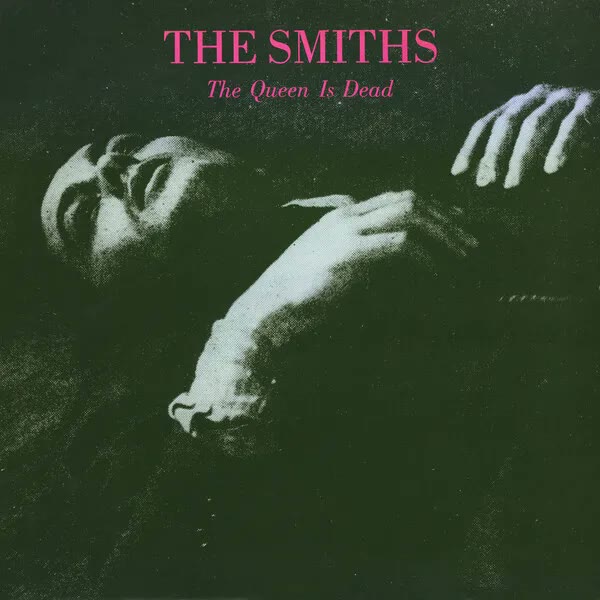
Ten tracks in 37 minutes. Recorded across November 1985 through April 1986 at Jacobs Studios in Surrey and RAK Studios in London with Stephen Street engineering and Johnny Marr and Morrissey co-producing. Released on Rough Trade as the third Smiths LP and the album that consolidated Morrissey and Marr's working partnership at its commercial and creative peak. The record that turned a regional UK indie band into the defining British guitar-pop act of the decade and provided the template every subsequent British indie-rock LP has worked within.
- Released
- June 16, 1986
- Label
- Rough Trade (UK, ROUGH 96) · Sire/Warner Bros. (US, 25426-1)
- Producer(s)
- Johnny Marr · Morrissey
- Runtime
- 37:09 (10 tracks)
- Chart peak (US)
- #70 (Billboard 200)
- Chart peak (UK)
- #2 (UK Albums Chart, held off by Genesis's 'Invisible Touch')
- Certifications
- Gold (BPI, 1986); Silver (BPI, 1986); eventually Platinum in 1992
- Awards & honours
- Ranked #113 on Rolling Stone's 500 Greatest Albums (2020); NME Album of the Year (1986); ranked #1 on multiple 'Greatest British Album' polls; Grammy Hall of Fame (2017)
Ten tracks in 37 minutes. Recorded across November 1985 through April 1986 at Jacobs Studios in Surrey and RAK Studios in London with Stephen Street engineering. The third Smiths LP and the album that consolidated Morrissey and Marr's working partnership at its commercial and creative peak. The record that turned a regional UK indie band into the defining British guitar-pop act of the decade, and provided the template every subsequent British indie-rock LP has worked within.
The Smiths in autumn 1985 were three years into their commercial career and at the inflection point that would define what kind of band they had become. The two previous LPs, 'The Smiths' (February 1984) and 'Meat Is Murder' (February 1985), had both reached the UK Top 5 and had established the band as the leading British guitar-pop act of the 1980s. Johnny Marr was twenty-two years old; Morrissey was 26; bassist Andy Rourke was 21; drummer Mike Joyce was 22. They had toured continuously since spring 1983 and were exhausted. Marr in particular had been simultaneously writing for the Smiths, producing other Rough Trade acts (specifically the Pretenders' brief Rough Trade contract), and dealing with sustained marijuana consumption that he has subsequently described as 'something close to an addiction.' The plan for the third LP was that it would be the band's most-commercial work to that point, a record that would establish them as a major-label-readiness act and provide the financial security for the next decade.
Recording began at Jacobs Studios in Farnham, Surrey in November 1985 with engineer Stephen Street (who had engineered Meat Is Murder and would become the album's co-producer alongside Marr and Morrissey). The studio was Marr's choice; the converted-residence facility had a reputation for sustained-session work that the band's intensive recording schedule required. Sessions ran daily for approximately 6 weeks through Christmas; the band returned to RAK Studios in London for further sessions across January and February 1986. The recording approach was specific to the Smiths' working method: Marr and Stephen Street would build the production beds (Marr's guitar overdubs were the central architectural decision on every track), then Rourke and Joyce would record their parts, then Morrissey would arrive for his vocal session and track in one to three takes. Marr has said in subsequent interviews that the Morrissey vocal sessions were 'extraordinary', the lyrics had been written on the band's previous tour and were largely finished when Morrissey arrived at the studio; the vocals were tracked quickly and rarely overdubbed.
The album's twelve recording weeks produced fourteen finished tracks. The band's final selection of ten tracks for the album was made in February 1986 at Stephen Street's mixing sessions; four tracks ('Rubber Ring,' 'Asleep,' 'Unloveable,' and one unreleased) were either held back for subsequent singles or shelved. The sequencing decision (title track as opener; 'There Is a Light That Never Goes Out' as track nine, not the closer) was made by Marr and Morrissey at a Surrey hotel in March 1986; Marr has said the sequencing was the album's hardest single decision. 'Some Girls Are Bigger Than Others' was selected as the closer because the band wanted to end the album on a deliberately understated note after 'There Is a Light's emotional peak.
What the album delivers is the most-coherent statement of Marr's guitar architecture and Morrissey's lyrical voice across the Smiths' four-album studio catalogue. The Marr arrangements range from the wah-pedal-treated title track (6 minutes; the band's longest song to that point) through the music-hall waltz of 'Vicar in a Tutu' to the twelve-string Rickenbacker chord pattern of 'There Is a Light That Never Goes Out.' Morrissey's lyric voice ranges from the satirical (the title track's political satire of Thatcher-era monarchy; 'Frankly, Mr. Shankly's musical-hall satire of Rough Trade) through the romantic ('There Is a Light's most-quoted couplet about dying by your love's side) to the deliberately confrontational ('Bigmouth Strikes Again's self-aware celebrity-satire). The album does what every great Smiths LP does: it presents Marr's guitar architecture and Morrissey's lyric voice as a fully-integrated single artistic statement.
Rough Trade released the album on June 16, 1986 with substantial promotional support. The album debuted at UK #2 (held off the top spot by Genesis's 'Invisible Touch') and stayed on the UK chart for 22 weeks. 'The Boy with the Thorn in His Side' had been released as the pre-album single in May; 'Bigmouth Strikes Again' followed in May 1986 as the second single. 'There Is a Light That Never Goes Out' wasn't released as a single until October 1992 (six years later) when Warner Bros' UK office released a Smiths-catalogue single cycle. The album's US release on Sire/Warner Bros. in late June 1986 reached US #70, the highest US chart position for any Smiths LP at the time. By the end of 1986, the album had been certified Gold by the BPI (UK 100,000 units shipped) and had sold approximately 250,000 units across territories.
The Queen Is Dead is the Smiths' commercial peak as a working band. The band's subsequent LP, 'Strangeways, Here We Come' (September 1987), was completed under conditions of mutual hostility between Morrissey and Marr; the band broke up officially in October 1987 (5 weeks after Strangeways' release) and have not reunited. Marr has said in subsequent interviews that the Queen Is Dead sessions are 'the last time the four of us were a functioning band.' The album's specific commercial trajectory, UK #2, US #70, BPI Gold within six months, eventual BPI Platinum in 1992, and its sustained critical reputation (NME Album of the Year 1986, ranked #1 on multiple Greatest British Album polls, Grammy Hall of Fame 2017) make it the Smiths' canonical document and one of the foundational texts of British indie-rock for the next three decades.
The Queen Is Dead belongs at #56 because it is the album that consolidated Morrissey and Marr's working partnership at its commercial and creative peak and provided the template every subsequent British indie-rock LP has worked within. Every Britpop-era LP that draws on the 1986 Smiths vocabulary, Suede's first three LPs, Pulp's Different Class, the Auteurs' New Wave, Belle and Sebastian's first decade, Travis's early records, Coldplay's debut, the entire post-Smiths sound that emerged in the mid-1990s, traces partly to decisions Marr and Morrissey made at Jacobs Studios in autumn and winter 1985-86. Marr's specific guitar architecture (twelve-string Rickenbacker, wah-pedal-treated electric, sustained clean chords) has been the most-imitated guitar vocabulary in British rock since the album's release; Morrissey's lyric voice has been the most-imitated vocal-and-lyric vocabulary in indie pop. The album's commercial trajectory is consistent: continuous catalogue presence since 1986, no out-of-print period, persistent critical canonization, sustained streaming numbers.
Pressing guide — the one to own
Original 1986 UK first pressing, Rough Trade ROUGH 96, in a gatefold sleeve with a printed inner; the cover is a still of Alain Delon from the 1964 film 'L'Insoumis.' The reliable first-press markers are the hand-etched deadwax messages, 'FEAR OF MANCHESTER' on side A and 'THEM WAS ROTTEN DAYS' on side B, around a 'ROUGH 96 A1 / B1' matrix. Two legitimate 1986 plant variants exist: MPO copies end the runout '...MPO,' EMI copies carry a 'U' suffix. The US issue was on Sire (9 25426-1), pressed by SRC. Collector lore attributes the UK mastering to Tim Young at the Townhouse, but this is not a credited fact. Clean originals trade around £60-£120.