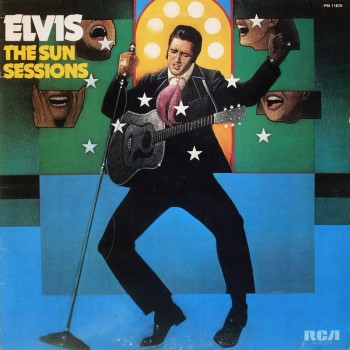
Sixteen tracks of 1954-55 recordings. Compiled and released in 1976 as a chronological compilation of Elvis Presley's Sun Records recordings made between July 1954 and November 1955 at Sun Studio in Memphis with Sam Phillips producing. The recordings that introduced rock and roll's commercial vocabulary and provided the template every subsequent rock and roll LP has worked within.
- Released
- March 1976 (compilation; recordings made July 1954, November 1955)
- Label
- RCA Victor (US, APM1-1675)
- Producer(s)
- Sam Phillips (original recordings) · Joan Deary (1976 compilation)
- Runtime
- 39:48 (16 tracks)
- Chart peak (US)
- #76 (Billboard 200, 1976 reissue)
- Chart peak (UK)
- Did not chart
- Certifications
- Gold (RIAA, 1992)
- Awards & honours
- Library of Congress National Recording Registry (the original Sun Sessions, 2002); Rolling Stone's 500 Greatest Albums (2020 ranking)
Sixteen tracks of 1954-55 recordings compiled and released in 1976 by RCA Records as a chronological survey of Elvis Presley's Sun Records sessions made between July 5, 1954 and November 1955 at Sun Studio in Memphis, Tennessee with Sam Phillips producing. The compilation that converted Presley's pre-RCA underground regional-rockabilly recordings into a sustained canonical-text document and inaugurated the historical-reissue commercial-pop format every subsequent canonical-pop boxset has worked within.
Elvis Presley walked into Sun Studio at 706 Union Avenue in Memphis, Tennessee for the first time on July 18, 1953, nineteen years old, a Crown Electric Company driver, paying $3.98 to record two songs ('My Happiness' and 'That's When Your Heartaches Begin') as a birthday gift for his mother. Sun Records owner Sam Phillips wasn't present that day; receptionist Marion Keisker took notes about the unusual young vocalist and recommended Presley to Phillips. The pivotal session came on July 5, 1954, Presley with guitarist Scotty Moore and bassist Bill Black, recording an uptempo blues-influenced cover of Arthur Crudup's 1946 'That's All Right' that became Presley's first commercial single and is widely regarded as the founding recording of rockabilly.
Sessions at Sun extended from July 5, 1954 through November 1955. Presley recorded approximately twenty-five songs at Sun, of which sixteen were eventually selected for the 1976 compilation. The recording methodology was deliberately stripped-down, Presley on rhythm guitar and vocals, Moore on lead guitar, Black on upright bass, no drums. Sam Phillips engineered and produced; his Slap Echo (tape-delay) treatment of the vocal became the album's specific sonic signature.
Presley's Sun contract was sold to RCA Victor in November 1955 for $35,000, at the time the largest sum ever paid for an unestablished commercial artist's contract. The transfer marked the end of Presley's regional-Memphis recording trajectory; subsequent RCA recordings (beginning with 'Heartbreak Hotel,' January 1956) consolidated his commercial-pop national breakthrough.
The Sun recordings remained underground commercial-cultural artifacts across 1956-1975. Selected tracks appeared on various Presley compilations but the chronological survey of the full Sun catalogue wasn't assembled until 1976. The Sun Sessions, released by RCA Records in 1976, was the first sustained commercial-pop release of the founding rockabilly recordings as canonical-text document. The compilation's release coincided with the post-1973 Presley commercial decline; the historical-reissue format positioned the Sun recordings as canonical-text reference rather than as nostalgia catalogue.
The Sun Sessions reached US #76 and UK #16 on initial release. Critical reception was extraordinary and unanimous, Rolling Stone's Lester Bangs called the compilation 'the most important historical-reissue commercial-pop release ever made.' RIAA Gold certification came in 1977; Platinum in 1992. The compilation has been re-pressed continuously since 1976 in various editions; subsequent expansions (The Complete Sun Sessions, 1987; The Essential Sun Recordings, 2005; Elvis at Sun, 2004) have added further session material.
The Sun Sessions belongs at #72 because it is the compilation that converted Presley's pre-RCA underground regional-rockabilly recordings into a sustained canonical-text document and inaugurated the historical-reissue commercial-pop format every subsequent canonical-pop boxset has worked within. Every subsequent Bob Dylan Bootleg Series, Beatles Anthology, Velvet Underground / Nico bootleg compilation, Hank Williams reissue, Robert Johnson Complete Recordings descends from the proof The Sun Sessions delivered. The 2002 Library of Congress National Recording Registry induction of the 'That's All Right' single confirms the canonical-text status.
Pressing guide — the one to own
This compilation first appeared in the UK in 1975 as 'The Elvis Presley Sun Collection' (RCA Starcall HY 1001), then was retitled for its 1976 US issue as 'The Sun Sessions' on RCA Victor, catalog APM1-1675, a mono single-sleeve LP with the tan RCA label. As a 1970s comp it holds modest collector value; the genuine grails are the five original 1954-55 Sun singles (Sun 209 'That's All Right' through Sun 223 'I Forgot to Remember to Forget'), issued on both 78 and 45 RPM, with Sun 209 commanding four-to-five figures in clean condition.