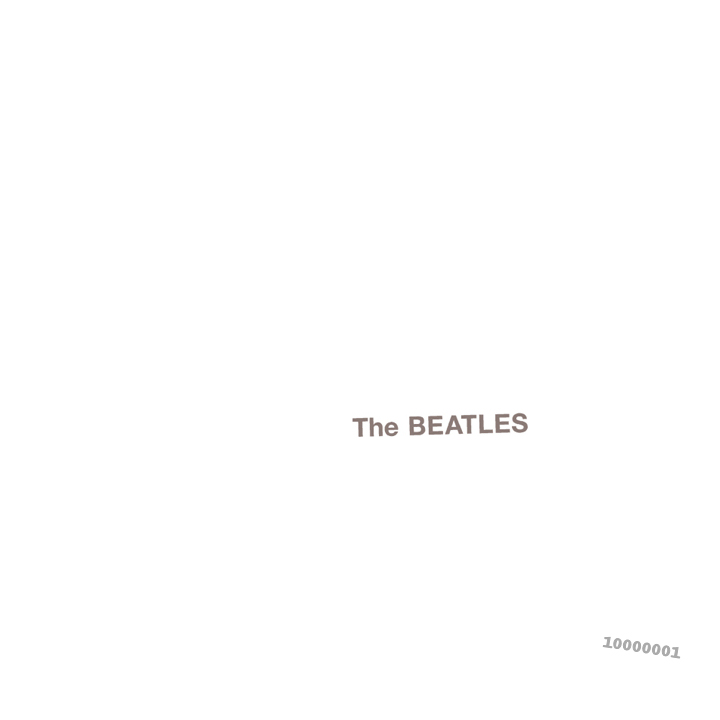
The Beatles' double LP. Recorded at Abbey Road across summer 1968 with the band fragmenting. Released November 22, 1968.
- Released
- November 22, 1968
- Label
- Apple (UK) · Capitol (US)
- Producer(s)
- George Martin
- Runtime
- 93:33 (30 tracks across 2 LPs)
- Chart peak (US)
- #1 (Billboard 200, 9 weeks)
- Chart peak (UK)
- #1 (Record Retailer, 7 weeks)
- Certifications
- 24× Platinum (RIAA, double LP); 30M+ units globally
- Awards & honours
- Library of Congress National Recording Registry (2000); ranked #29 on Rolling Stone's 500 Greatest Albums (2020)
Five months at EMI Studios in St. John's Wood and at Trident Studios in Soho with George Martin as principal producer. Thirty tracks across 93 minutes spread over two LPs. The album that the Beatles deliberately built as a deliberately uneven, sprawling double LP after returning from their Maharishi Mahesh Yogi retreat in Rishikesh, the album whose internal tensions became its primary structural feature, and the album that contained more songs than any prior single Beatles release.
The Beatles had returned to England in April 1968 from a six-week meditation retreat at the Maharishi Mahesh Yogi's ashram in Rishikesh, north of Delhi. The retreat had been productive in writing terms, the four members had written approximately forty songs across the 6 weeks, far more than any previous comparable period. The retreat had also been contentious: John Lennon's increasing disillusionment with the Maharishi (eventually compounded by allegations Lennon believed about the guru's sexual behavior toward female participants) had soured the experience; Paul McCartney's deeper engagement with the meditation practice continued through the year; Ringo Starr had left the retreat early citing food and family concerns; George Harrison's deeper engagement with Indian classical music had been the retreat's primary spiritual outcome. The band returned to London with a substantial body of written material and increasingly different artistic positions on what to do with it.
Recording began at EMI Studios (later Abbey Road Studios) on May 30, 1968. George Martin was the credited producer; engineer Geoff Emerick had been the band's principal engineer since 1966's Revolver. The sessions were notoriously difficult from the start. Yoko Ono, Lennon's new romantic partner since November 1966 and his constant studio companion from May 1968 onward, was present at the sessions, a departure from the band's previous studio practice that visibly strained McCartney and the others. Ringo Starr briefly quit the band on August 22, 1968 during the recording of 'Back in the U.S.S.R.' (McCartney played the drums on the released track); Starr returned after a two-week sabbatical. George Harrison quit briefly during the January 1969 Get Back sessions (which followed The White Album) and would quit again in 1970 before the band's formal dissolution. Geoff Emerick walked out of the sessions in July 1968; engineer Ken Scott (who had been Trident's principal engineer) replaced him. George Martin took a three-week holiday in mid-1968 and left Chris Thomas as the sessions' day-to-day producer during his absence. The sessions ran from May 30, 1968 through October 14, 1968, approximately five months, and produced thirty tracks across two LPs.
The band's internal dynamics during recording had effectively dissolved into four separate solo working modes. Lennon, McCartney, Harrison, and Starr each worked principally on their own material with intermittent contributions from the others; the multi-track recording format allowed the band to record their parts on separate floors of Abbey Road and overdub them together later. McCartney's specific tracks ('Back in the U.S.S.R.,' 'Ob-La-Di, Ob-La-Da,' 'Why Don't We Do It in the Road?,' 'Blackbird,' 'I Will,' 'Honey Pie') were generally tracked with McCartney alone or with a single other Beatle. Lennon's specific tracks ('Dear Prudence,' 'Glass Onion,' 'Happiness Is a Warm Gun,' 'Yer Blues,' 'Sexy Sadie,' 'Revolution 1,' 'Cry Baby Cry,' 'Revolution 9') were tracked primarily with Lennon, often with Ono's substantial presence and occasionally without other Beatles. Harrison's tracks ('While My Guitar Gently Weeps,' 'Piggies,' 'Long, Long, Long,' 'Savoy Truffle') were tracked with Harrison plus selected guest musicians (Eric Clapton played the lead guitar solo on 'While My Guitar Gently Weeps' on September 6, 1968, the only non-Beatle to play lead guitar on a Beatles recording). Starr's two contributions ('Don't Pass Me By,' 'Good Night') were tracked with Starr alone.
The album's deliberate double-LP scope was McCartney's structural decision. The band had assembled approximately forty songs through the Rishikesh retreat and the subsequent writing; McCartney pushed for the double-LP format to include as much of the material as possible. Lennon and Harrison initially preferred a single-LP edit; George Martin recommended a single LP and a separate sub-album. McCartney's preference prevailed. The deliberate decision to include lighter material ('Ob-La-Di, Ob-La-Da,' 'Honey Pie,' 'Why Don't We Do It in the Road?') alongside more serious tracks ('Happiness Is a Warm Gun,' 'While My Guitar Gently Weeps,' 'Revolution 9') was McCartney's structural argument for the album as a deliberate variety document. The album's specific unevenness has been argued about for fifty-six years; some critics have argued the double-LP format diluted the band's strongest material, others have argued the unevenness is the album's defining feature.
'Revolution 9' is the album's most-discussed individual track. Lennon and Ono, working together as a collaborative pair during the sessions, assembled the eight-and-a-half-minute tape-collage piece across multiple weeks of Abbey Road editing sessions. The track uses approximately a hundred separate audio sources, including segments from Beethoven's Ninth Symphony, fragments of Sibelius and Vaughan Williams, looped guitar feedback from earlier Beatles sessions, deliberately disorienting vocal repetition, and a substantial amount of audio Lennon had recorded specifically for the project. McCartney objected to the track's inclusion on the album; Lennon insisted. The track's inclusion has been read as one of the album's defining statements about the band's internal direction, Lennon and Ono pushing the album toward avant-garde experimentation, McCartney resisting on commercial-pop grounds, the album's final form reflecting Lennon's prevailing position. The Charles Manson appropriation of the track in 1969 (Manson cited 'Revolution 9,' along with 'Helter Skelter' and 'Piggies,' as prophecy for the Tate-LaBianca killings) gave the track an unintended cultural afterlife.
The album was released on November 22, 1968, the fifth anniversary of John F. Kennedy's assassination, though the date selection appears to have been coincidental. The album peaked at US #1 (where it stayed for 9 weeks) and UK #1. First-year sales: approximately 7 million units in the US alone. The album's deliberate cover, pure white with the words 'The BEATLES' embossed in the lower right, designed by Richard Hamilton, has been argued about for fifty-six years; the deliberate visual minimalism after the colorful Sgt. Pepper cover was Hamilton's specific suggestion. Each original numbered copy had a unique stamped number on the cover (a deliberately ironic counterfeiting-prevention measure). The album won the Grammy for Album of the Year at the 1970 ceremony. The Library of Congress added it to the National Recording Registry in 2000.
The White Album belongs at #47 because it is the album in which the Beatles stopped being a unified band and became four songwriters sharing a label. The thirty songs are too many; the sequencing is deliberately deranged; the political moment they appeared into was too violent and too fractured for the album's range of registers, children's songs next to noise collages next to country-rock pastiche, to feel anything other than appropriate. It is the only Beatles album where the band's internal disintegration is part of the listening experience. The Manson appropriation, the Soviet invasion of Czechoslovakia, the assassinations, the studio fistfights, these are not background. The album is the document of all of them. Subsequent generations of artists (Radiohead, OutKast, Kanye West) have explicitly cited the album as the model for deliberately uneven, double-LP-sprawling artistic statements that refuse the unified-statement model of conventional albums.
Pressing guide — the one to own
1968 UK first pressing, Apple PCS 7067/8 (two-LP gatefold) with the original Richard Hamilton blank white embossed sleeve and the four band-member portrait photographs (Lennon, McCartney, Harrison, Starr by John Kelly), plus the poster collage insert with lyrics on one side and 1960s Beatles photographs on the reverse. The original numbered first-pressing copies are the most-collected variant; the embossed serial number on the lower right of the outer sleeve is the field marker. Look for the matrix etchings PCS 7067-1 / PCS 7068-1, hand-etched at EMI Studios mastering.