
№ 15 of 100
Thriller
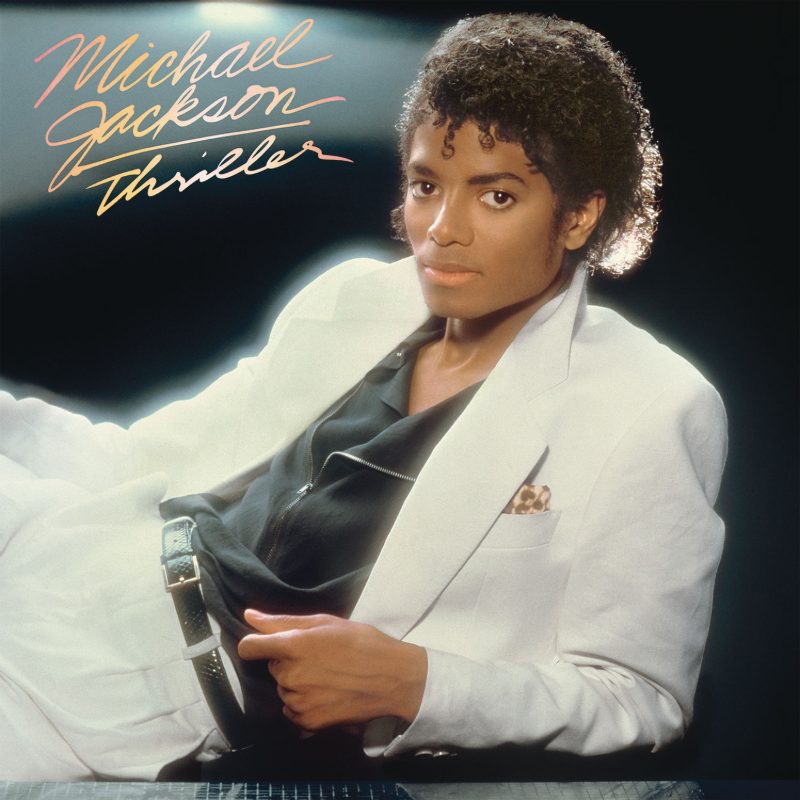
Thriller by Michael Jackson (1982), № 15 in The Lead-In’s 100 greatest albums. The bestselling album of all time. We placed it here at sixteen because the bar above it is What's Going On, and Thriller knows it.
Thriller by Michael Jackson (1982), № 15 in The Lead-In’s 100 greatest albums. The bestselling album of all time. We placed it here at sixteen because the bar above it is What's Going On, and Thriller knows it.
Quincy Jones in the producer's chair, Michael Jackson at twenty-four, Eddie Van Halen on guitar, Vincent Price reading horror narration, Paul McCartney on a duet, and a forty-two-minute studio album that became the bestselling record in human history. Released November 30, 1982. Still uncontested.
Three years after Off the Wall, the album Michael Jackson considered his commercial peak, and three years before he would become the most famous person on the planet, Thriller was supposed to sell twice what Off the Wall had sold. It sold sixteen times. It is the only LP in any genre to spend the better part of a year at number one and still be selling at a hit rate fifteen years later.
By the summer of 1982, Michael Jackson was twenty-three years old and very angry. Off the Wall, released in August 1979, had sold seven million copies, produced four top-ten singles, and won Jackson his first Grammy for Best Male R&B Vocal Performance. It had not won Album of the Year. Jackson, accepting the smaller Grammy on stage, made his disappointment public; in private, he told his manager Frank DiLeo and his producer Quincy Jones that he wanted the next album to make any further snubs impossible. He wanted it, in his words, 'to be the biggest album ever made.' He wanted hits on every track. He wanted singles that crossed every demographic. He wanted Album of the Year. He wanted, he said, to make a record that 'broke all the rules.' He was working with the man who had taken him from the Jackson 5, kept under tight Motown studio control until age 21, to a solo artist with full creative authority. Quincy Jones had heard the first version of the wish list and said, characteristically, 'Let's get to work.'
What they made over seven months at Westlake Recording Studios on Beverly Boulevard in West Los Angeles, between April and November 1982, was a forty-two-minute album of nine songs in nine distinct pop styles. 'Wanna Be Startin' Somethin'' is post-disco soul; 'Baby Be Mine' is a Rod Temperton groove tune; 'The Girl Is Mine' is a Paul McCartney/Jackson duet that was the album's first single; 'Thriller' is a Rod Temperton-written horror-funk piece with a Vincent Price narration; 'Beat It' is hard rock with Eddie Van Halen on lead guitar; 'Billie Jean' is the album's masterpiece, a tense, minor-key disco song built around a six-bar bassline by Louis Johnson; 'Human Nature' is a soft-pop ballad written by Toto's Steve Porcaro and John Bettis; 'P.Y.T. (Pretty Young Thing)' is James Ingram and Quincy Jones; 'The Lady in My Life' is a slow-soul closer by Rod Temperton.
Of the nine songs, seven were released as singles. All seven reached the US top ten. No album in any genre had ever before achieved seven top-ten singles from a single LP. Six of the seven also reached the top ten in the UK. 'Billie Jean' reached number one in nine countries; 'Beat It' reached number one in seven; 'Thriller' was kept out of the US number-one slot by 'Karma Chameleon' but topped UK and Australian charts. The album sat at #1 on the Billboard 200 for thirty-seven non-consecutive weeks across 1983 and 1984, a feat unmatched by any subsequent LP. Sales reached one million in the first 6 weeks; ten million by the end of summer 1983; twenty-five million by 1985. By 1990 it had become the best-selling album in history, a position it has held without serious challenge for thirty-five years.
Beyond the sales, what Thriller did was redefine what a pop album could be. The use of multiple genres on a single LP wasn't new, Stevie Wonder, the Beatles, Joni Mitchell had done it earlier, but Thriller's commitment to making every genre work as a single, top-ten chart event was unprecedented. Quincy Jones's production aesthetic, refined since his big-band years with Frank Sinatra and Count Basie and pushed to its limit at Off the Wall, achieved on Thriller its definitive form: drums tight and bright, with Jerry Hey's horn arrangements punctuating; basslines hooky enough to be their own choruses; layered vocals from Jackson with multiple lead-vocal stacks; harmonic structures sophisticated enough to satisfy musicians without alienating casual listeners. The album set the production benchmark for pop for the next decade. Every Janet Jackson Janet., every Madonna True Blue, every Whitney Houston Whitney, all are direct descendants of Thriller's production aesthetic.
It also redefined the music video. The 'Billie Jean' video, Steve Barron directing, became the first video by a Black artist that MTV would put into heavy rotation. CBS Records reportedly threatened to pull its entire roster from MTV if 'Billie Jean' was not added; the network capitulated. The 'Beat It' video, directed by Bob Giraldi, was the first video to use a narrative structure (West Side Story–style street-gang choreography) at a budget approaching feature-film levels. The 'Thriller' video, directed by John Landis (then fresh off 'An American Werewolf in London'), ran 14 minutes, longer than most short films of the era, and was treated as a media event. MTV premiered it on December 2, 1983. The video became the model for the music video as cinema; subsequent attempts by Madonna, Prince, and George Michael followed Landis's template.
Beyond the production and the videos, the album's success had geopolitical consequences for the music industry. Sony's purchase of CBS Records in 1988 was made possible by Thriller's cash flow alone. The CD format's mass-market launch in 1983–84 was accelerated by the album's continuous Top 10 presence; people who bought CD players largely bought Thriller as their first disc. Tower Records and other large retail chains restructured their store layouts around the assumption that any pop release could now move millions of units; the album effectively created the modern blockbuster-pop release schedule that would dominate the next thirty years. Mariah Carey, Whitney Houston, Madonna's True Blue, the Eagles' Their Greatest Hits 1971–1975, AC/DC's Back in Black, all the subsequent Diamond-certified mega-sellers exist on a sales curve Thriller established.
Thriller belongs at #15 because it is the album that proved a pop record could be both commercially absolute and musically rigorous. The songs are well-made; the playing is excellent; the production is faultless. The album doesn't exist as a museum piece. 'Billie Jean' is one of the great records of any genre. 'Beat It' is the rare rock-pop crossover that works in both directions. 'Wanna Be Startin' Somethin' is one of the best opening tracks in pop. The album sits exactly where its commercial position and artistic position align, at the moment where a Black auteur, working inside the most commercially-focused major-label system in pop history, made the album the entire industry expected from him and somehow exceeded the expectation. Without Thriller there is no MTV as a serious cultural force, no music-video-as-cinema, no Diamond certification framework, no Sony/CBS merger. The album's commercial achievements are inseparable from its artistic ones; in this case the two are the same thing.
Original 1982 US first pressing, Epic QE 38112, gatefold sleeve with the Dick Zimmerman white-suit cover and the printed inner with the tiger-cub photo. It was mastered by Bernie Grundman, so there is no 'STERLING' etching; the earliest cut was made hot and the original US pressings are known for sibilance on the loudest tracks. The genuine first state is identified by the absence of the co-producer credits on the labels/jacket, which were added on slightly later 1982 pressings. Clean early copies remain affordable relative to the record's fame, with sealed examples carrying the only real premium.
© The Lead-In · an independent, reader-supported music publication.