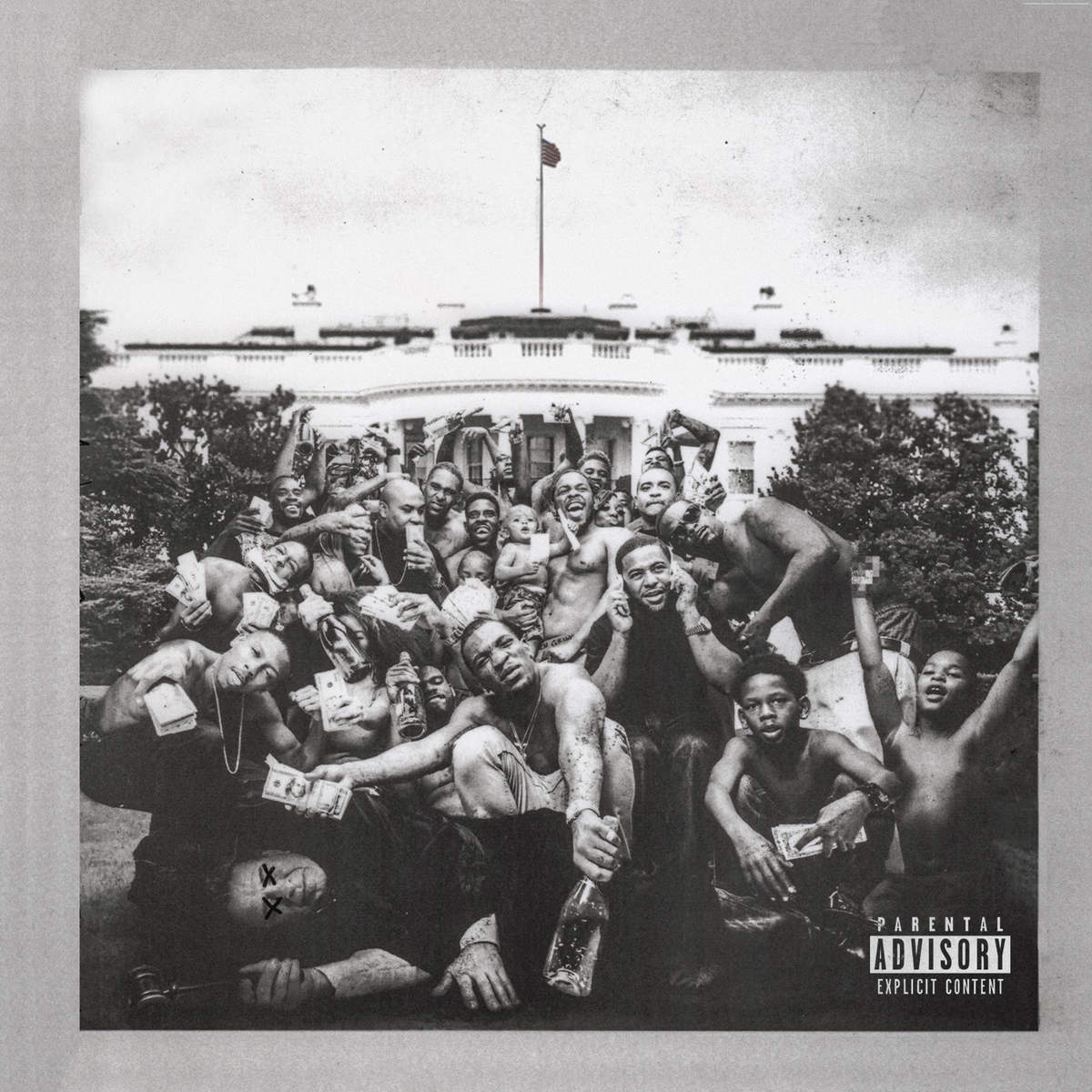
Kendrick Lamar at twenty-seven, three years past his Compton-as-fiction debut, made a 79-minute album in collaboration with Thundercat, Kamasi Washington, Flying Lotus, and Robert Glasper. The record that brought jazz back into hip-hop as primary structural language. Released March 15, 2015. Reached #1 in the US in its first week.
- Released
- March 15, 2015
- Label
- Top Dawg Entertainment · Aftermath · Interscope
- Producer(s)
- Sounwave · Terrace Martin · Flying Lotus · Pharrell · Boi-1da · others
- Runtime
- 78:51 (16 tracks)
- Chart peak (US)
- #1 (Billboard 200)
- Chart peak (UK)
- #1 (Official Charts)
- Certifications
- 3× Platinum (RIAA); estimated 4M+ units globally
- Awards & honours
- Grammy Best Rap Album (2016); 7 Grammy nominations including Album of the Year; Library of Congress National Recording Registry (2020); Pulitzer Prize for Music, awarded to DAMN. in 2018 but contextualized by To Pimp a Butterfly's prior critical canonization; ranked #19 on Rolling Stone's 500 Greatest Albums (2020)
Sixteen tracks in 78 minutes. Recorded across approximately two years (2013-2015) at multiple Los Angeles studios with Kendrick Lamar executive-producing and a collaborative production team led by Sounwave, Flying Lotus, Pharrell Williams, Boi-1da, Knxwledge, Terrace Martin, and Thundercat. Lamar's third major-label LP and TDE / Aftermath / Interscope's most ambitious commercial-pop hip-hop project, the deliberately jazz-funk-soul-and-spoken-word document that consolidated commercial-pop hip-hop as a serious literary-political form and inaugurated the orchestral-jazz-rap vocabulary every subsequent ambitious commercial hip-hop LP has worked within.
Kendrick Lamar Duckworth in late 2013 was twenty-six years old, fifteen months past good kid, m.A.A.d city's October 2012 commercial breakthrough (US #2, 2× Platinum within twelve months) and at a structural decision point. Top Dawg Entertainment, the Carson, California label that had developed Lamar since 2004, was now operating under Aftermath / Interscope distribution; the major-label infrastructure had positioned good kid as a sustained commercial event. Lamar's creative direction for the follow-up was set during multi-month writing sessions in 2013-14: the next LP would be more ambitious than good kid in lyrical, political, and musical scope.
Sessions began in late 2013 at multiple Los Angeles studios, primarily at Westlake Recording Studios (Hollywood), the Record Plant (Hollywood), and TDE's House of Studios (Carson). The collaborative production team, Sounwave, Flying Lotus, Pharrell Williams, Boi-1da, Knxwledge, Terrace Martin, Thundercat, Taz Arnold, Tommy Black, represented the most-extensive Lamar collaboration to that point. Substantial guest contributions: George Clinton, Kamasi Washington, Ronald Isley, Bilal, Rapsody, Snoop Dogg, Anna Wise.
The deliberate sonic vocabulary was jazz-funk-and-spiritual-soul rather than the West Coast hip-hop production palette of good kid. Thundercat's bass and Kamasi Washington's tenor saxophone are the album's signature instrumental contributions; Robert Glasper-influenced piano harmony appears throughout. The album's six-and-a-half-minute 'i' single (released in September 2014) had been the first signal of the deliberate direction shift; the full LP confirmed it.
The album's central artistic decision was the integration of literary-political subject matter (police brutality, the Trayvon Martin / Mike Brown / Black Lives Matter moment, generational survivor's guilt, depression, spiritual struggle) with a deliberately experimental jazz-funk production vocabulary and a recurring spoken-word interview between Lamar and a Tupac Shakur audio collage (constructed from a 1994 Mats Nileskar interview Shakur had given for Swedish radio). The Tupac dialogue is the album's structural-narrative spine.
Interscope released the album on March 15, 2015, one week earlier than the announced March 23 release date, after the album had been accidentally made available on iTunes for several hours on March 15. The early-release event itself became part of the album's commercial-cultural narrative. The album debuted at US #1 with first-week sales of 363,000 SoundScan units; UK #2; Australia #2; Canada #1. RIAA Platinum certification within four months.
Critical reception was extraordinary and unanimous. Pitchfork's Jayson Greene gave the album 9.3/10; Rolling Stone's Greg Tate gave it five stars; the Village Voice's Brian Josephs treated it as the canonical commercial-pop hip-hop LP of the 2010s. The album received eleven Grammy nominations for the 2016 ceremony, winning five including Best Rap Album and Best Rap Performance ('Alright'). The 'Alright' track became one of the canonical Black Lives Matter protest songs across 2015-2020.
To Pimp a Butterfly belongs at #28 because it is the album that consolidated commercial-pop hip-hop as a serious literary-political form and inaugurated the orchestral-jazz-rap vocabulary every subsequent ambitious commercial hip-hop LP has worked within. Every Black Messiah-era D'Angelo, Coloring Book Chance the Rapper, IGOR Tyler the Creator, DAMN. Kendrick Lamar, Blonde Frank Ocean, and Mr. Morale Lamar LP runs on the proof To Pimp a Butterfly delivered. The 2018 Pulitzer Prize for Music for DAMN., the first non-classical, non-jazz LP to win, descended from the proof To Pimp a Butterfly had set up.
Pressing guide — the one to own
Original 2015 US pressing, Top Dawg Entertainment / Aftermath / Interscope, catalogue B0023464-01, a 2-LP gatefold (with a known printing error swapping the 'Momma' and 'Hood Politics' titles on the inner gatefold). Mastered at Bernie Grundman Mastering, cover photograph by Denis Rouvre. This was pressed in quantity and repressed continuously, so originals are common: VG+/NM copies sit around £25-30, with sealed examples roughly £40-70. The genuinely expensive item is the unrelated 2023 Lauren Halsey Gallery limited edition, not this standard pressing.