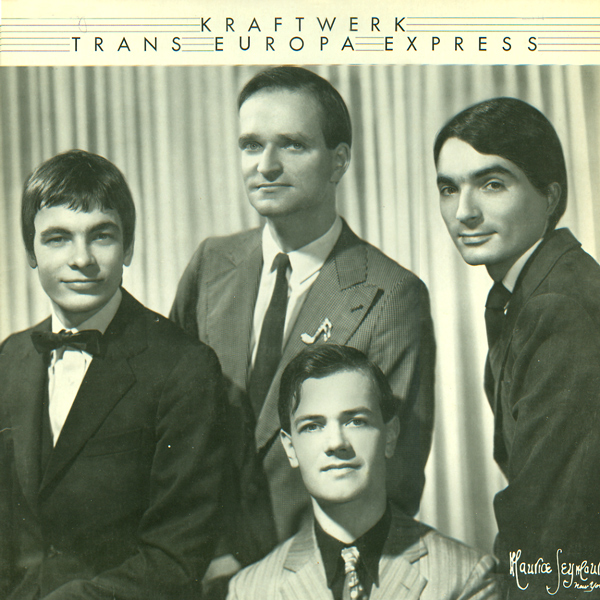
Seven tracks in 43 minutes. Recorded across approximately ten months at the band's self-built Kling Klang Studio in Düsseldorf in 1976 and early 1977 by Ralf Hütter, Florian Schneider, Karl Bartos, and Wolfgang Flür. The fourth Kraftwerk LP after the breakthrough Autobahn (1974) and Radio-Activity (1975) and the album that translated krautrock's experimental vocabulary into the pop-album format that would inaugurate techno, hip-hop, and electronic dance music. Afrika Bambaataa's 'Planet Rock' (1982), the founding text of electro and hip-hop's sample-of-everything era, is built on Trans-Europe Express's title track and Numbers from the subsequent Computer World.
- Released
- March 17, 1977 (Germany) · May 1977 (UK) · May 1977 (US)
- Label
- Kling Klang / EMI Electrola (Germany, 1C 064-82 306) · Capitol (US, SW-11603)
- Producer(s)
- Ralf Hütter · Florian Schneider
- Runtime
- 42:35 (7 tracks)
- Chart peak (US)
- #119 (Billboard 200)
- Chart peak (UK)
- #49 (UK Albums Chart)
- Certifications
- Gold (BPI, 1981 retroactive); Silver (BPI, 1977)
- Awards & honours
- Ranked #238 on Rolling Stone's 500 Greatest Albums (2020); Library of Congress National Recording Registry (2024); BBC Top 25 Greatest Electronic Albums (2019 #1); Grammy Lifetime Achievement Award for Kraftwerk (2014)
Seven tracks in 43 minutes. Recorded across approximately ten months at the band's self-built Kling Klang Studio in Düsseldorf in 1976 and early 1977. The fourth Kraftwerk LP after the breakthrough Autobahn (1974) and Radio-Activity (1975) and the album that translated krautrock's experimental vocabulary into the pop-album format that would inaugurate techno, hip-hop, and electronic dance music. Afrika Bambaataa's 'Planet Rock' (1982), the founding text of electro and hip-hop's sample-of-everything era, is built on Trans-Europe Express's title track and Numbers from the subsequent Computer World.
Kraftwerk in autumn 1976 was four years old as a working band. Ralf Hütter and Florian Schneider had been making electronic music together since 1968 at Düsseldorf's Robert Schumann Conservatory; the Kraftwerk band proper had emerged in 1970 with Klaus Dinger and Thomas Homann as the original rhythm section. The band's first three LPs (Kraftwerk 1, 1970; Kraftwerk 2, 1972; Ralf and Florian, 1973) had built a small underground reputation in Germany and almost no international profile. The breakthrough was Autobahn (November 1974), the twenty-three-minute title-track suite peaked at UK #11 and US #25, transforming Kraftwerk from a regional German art-music duo into the leading European electronic-music act. Radio-Activity (October 1975) had consolidated the band's new commercial position; by autumn 1976, Kraftwerk was working on what they intended to be their first deliberately conceptual pop album.
The Kling Klang Studio, the band's self-built recording facility on Mintropstrasse in Düsseldorf, was the album's central technical achievement. Hütter and Schneider had been refining the studio since 1970; by 1976 it was a fully self-built electronic-music facility with custom-designed synthesizers, modified Minimoogs, Schneider's homemade vocoder, and Karl Bartos and Wolfgang Flür's custom electronic-percussion units. The studio was deliberately not connected to any external recording infrastructure; Kraftwerk did all their recording, mixing, and arrangement work in-house, with no outside engineers or producers. The Kling Klang Studio is therefore one of the first artist-owned, self-built recording studios in the rock era and the model for every subsequent home-studio operation.
Sessions for Trans-Europe Express ran from autumn 1976 through early 1977. The working method was specific to Kraftwerk's collective approach: Hütter and Schneider would build synthesizer beds at the Kling Klang Studio, then Bartos and Flür would add the electronic percussion, then the four would jointly write and arrange the vocal sections. The vocoder, Schneider's homemade unit, derived from telecommunications speech-encoding technology, was the album's central new technical addition. The vocoder treatment on 'The Hall of Mirrors' and the title track established the specific Kraftwerk vocal sound that would carry through Computer World (1981) and Electric Café (1986).
The album's seven tracks are a deliberately conceptual statement about European modernity. 'Europe Endless' opens the album with a nine-and-a-half-minute Minimoog meditation on the railway-and-highway European geography. 'The Hall of Mirrors' is the album's celebrity-identity meditation. 'Showroom Dummies' is the album's most-conventional pop track, with a satirical self-deprecating lyric about Kraftwerk's perceived mechanical performances. 'Trans-Europe Express' is the album's centerpiece, a deliberately-mythic narrative about a train journey through 1970s Europe, with David Bowie and Iggy Pop referenced in the lyric ('From station to station / back to Düsseldorf city / Meet Iggy Pop and David Bowie'). 'Metal on Metal' is the title-track's instrumental coda. 'Franz Schubert' is the album's Germanic-art-classical reference. 'Endless Endless' closes the album with a 54-second extension of 'Europe Endless' that completes the album's structural frame.
EMI Electrola released the album simultaneously in German and English versions in March 1977. The two versions had different lyric tracks (the German version uses 'Trans-Europa-Express'; the English version uses 'Trans-Europe Express') but identical music. The English version was distributed by Capitol in the US and UK; commercial reception in both markets was modest. The album peaked at UK #49 (Kraftwerk's commercial position had risen since Autobahn but was still substantially underperforming the band's critical recognition) and at US #119 (the band's first chart entry on Billboard 200; previous Kraftwerk albums had not charted in the US). The single 'Showroom Dummies' was released in May 1977 in Germany only and didn't cross to international markets at the time.
What transformed the album's commercial profile was the 1982 Afrika Bambaataa sample. Bambaataa, a New York DJ and the founder of the Universal Zulu Nation, had been playing the album's title track at Bronx jam parties since 1977-78. In 1982 he and producer Arthur Baker recorded 'Planet Rock', a hip-hop track built on the Trans-Europe Express title-track rhythmic pattern (sampled from the original Kraftwerk recording) and Kraftwerk's 'Numbers' (from the 1981 Computer World) for the melodic break. 'Planet Rock' was released June 1982 on Tommy Boy Records; it peaked at US R&B #4 and became the founding text of electro and the foundational hip-hop sample-of-everything-era track. The royalty arrangement between Kraftwerk and Tommy Boy/Bambaataa took eighteen months to resolve and produced a substantial settlement that has shaped subsequent sample-clearance economics.
The album's late-period commercial trajectory has been the gradual canonization of Kraftwerk's foundational role in electronic music. The 1980s techno scene (Detroit's Juan Atkins, Derrick May, Kevin Saunderson) explicitly cite Trans-Europe Express as a foundational text. The acid house scene of the late 1980s draws on the album's specific motorik structures. The 1990s electronica wave (Aphex Twin, Boards of Canada, Autechre) all work in the vocabulary the album established. The album's specific influence on hip-hop sampling (via Bambaataa) and on electronic dance music (via techno) has been continuous since 1982. The album's 2024 induction into the Library of Congress National Recording Registry confirms canonical status.
Trans-Europe Express belongs at #59 because it is the album that translated krautrock's experimental vocabulary into the pop-album format and provided the rhythmic and conceptual template for techno, electro, hip-hop, and electronic dance music. The album's specific contribution, the deliberately-mythic European-modernity narrative, the vocoder vocal treatment, the motorik electronic-percussion patterns, the self-built Kling Klang Studio production discipline, became the template every subsequent electronic-music album has worked within. Afrika Bambaataa's 'Planet Rock' is the most-direct downstream consequence; the founding texts of techno (Detroit 1985-1988), house music (Chicago 1984-1987), acid house (UK 1987-1989), and the rave generation (UK 1989-1992) all trace partly to Trans-Europe Express. The album's commercial trajectory (modest initial reception, gradual canonization through hip-hop sampling and electronic-dance influence, eventual Library of Congress recognition) is the rock-album-as-foundation-text template for electronic music.
Pressing guide — the one to own
Original 1977 German first pressing, Kling Klang / EMI Electrola 1C 064-82 306, with German-language vocals (the title track is 'Trans Europa Express'). It is a single laminated picture sleeve with a colour-portrait inner and a fold-out poster, not a gatefold; the Maurice Seymour cover portrait styles the group as mannequins. The deadwax matrix is machine-stamped with no hand-etched engineer initials, so disregard the 'Walter Quintus / WQ' mastering claim (Quintus's documented Kraftwerk credit is on 'Radio-Activity,' not this album). First-press tells include the black 'Kling Klang Schallplatten' labels and an embossed EMI stamp on the rear sleeve. The parallel English issue is Capitol SW-11603. Originals trade around £30-£100, more with the poster intact.