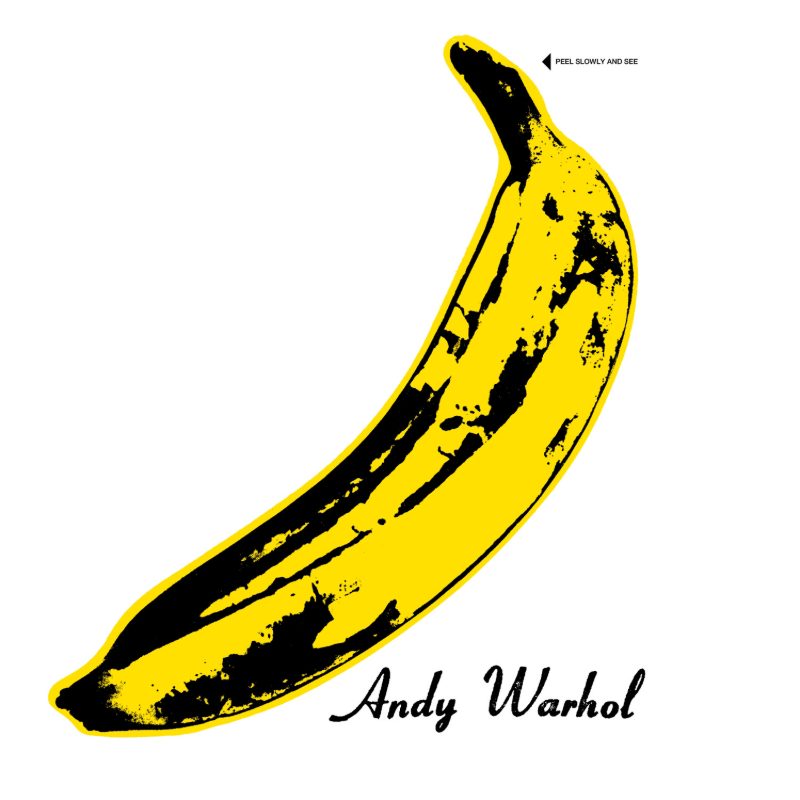
Andy Warhol produced it. Nobody bought it. Sixty years later every interesting band in the Western world is its direct descendant, the rare record whose commercial failure is central to its myth. The peeled-banana sleeve, the Verve label sticker, the lawsuit that pulled it from shelves at exactly the wrong moment. The album that became canonical by refusing to be popular first.
- Released
- March 12, 1967
- Label
- Verve Records (MGM)
- Producer(s)
- Andy Warhol (nominal) · Tom Wilson (uncredited, mixed)
- Runtime
- 48:55 (11 tracks)
- Chart peak (US)
- #171 (Billboard 200)
- Chart peak (UK)
- Did not chart
- Certifications
- Gold (RIAA, 1996, 29 years after release); estimated 1M+ units globally, the album most-cited as influential whose commercial profile was effectively zero on release
- Awards & honours
- Library of Congress National Recording Registry (2006); ranked #23 on Rolling Stone's 500 Greatest Albums (2020); Grammy Hall of Fame (2003); ranked #1 on countless lists of 'most influential albums never to chart'
Lou Reed had been writing pop songs for a dollar a song at Pickwick Records. John Cale was a Welsh classical violist who could drone for 6 hours without flinching. Maureen Tucker played standing up with no cymbals. Nico had been a Fellini extra and a Bob Dylan girlfriend. Andy Warhol paid for everything and wrote his name on it. Sixty years later, every band you have heard of owes them a debt.
Lou Reed had been writing pop songs for a dollar a song at Pickwick Records, a budget label in Long Island City that churned out 'Surfin' Songs of the '60s' and 'Twisting With the King.' He was 23. He had attended Syracuse University, where he'd been mentored by the poet Delmore Schwartz; he had developed an opiate habit while in college; he had written a handful of his own songs and was looking for a band to play them. John Cale was a Welsh classical violist who had moved to New York in 1963 to study with La Monte Young's Theatre of Eternal Music; he could drone on a viola for 6 hours without flinching. Sterling Morrison played guitar like a blues player who had read too much French poetry. Maureen Tucker played drums standing up, no cymbals, no kick drum, tom-toms thudding like a heart that had forgotten about syncopation. They met in various combinations in a loft on Ludlow Street in the Lower East Side and within a year they were the house band at a multimedia circus called the Exploding Plastic Inevitable, where Andy Warhol projected films on them while Gerard Malanga cracked a whip and a German model named Nico, whose voice sounded like a foghorn translated from German, sang three of their songs.
Warhol produced the album, which meant he paid for it and wrote his name on it and insisted that Nico be given the songs. What he did in the studio is debated. Cale says he was present; Reed says he wasn't. Everyone agrees that his contribution was, in a Warholian sense, the contribution: he got it made, he kept the label from interfering, he insisted the record be called 'The Velvet Underground & Nico' and that his banana be on the cover, peelable, the fruit underneath as pink as the inside of an ear. MGM's Verve imprint, which had signed the band without having much idea what to do with them, released the album in March 1967, four months after 'Sgt. Pepper' was finished and two months before the Summer of Love.
No record has ever opened the way this one does. 'Sunday Morning' is the softest song on the album and Reed's least characteristic vocal, tentative, almost boyish, the celesta tinkling like something from a jewelry box. Tom Wilson, brought in to produce a single, added it at the end of the sessions. Then the second track hits: 'I'm Waiting for the Man,' a piano pounding like a fist on a door, Reed narrating a trip uptown to buy heroin from a dealer on Lexington and 125th, a subject no song on a major-label release had ever treated as mere scene-setting.
What follows is a record that behaves like a short-story collection by a writer with a very specific beat. 'Femme Fatale' is a three-minute warning about a girl on the Factory scene (Edie Sedgwick, most likely). 'Venus in Furs' is a song about Leopold von Sacher-Masoch's novel, set to a droning viola that sounds like a medieval funeral played by a junkie. 'Run Run Run' is amphetamine, narrated in second person about five Lower East Side dealers and addicts named by their street nicknames. 'All Tomorrow's Parties,' the song Warhol loved most, is a dressmaker's lament over Cale's piano drone and Nico's Teutonic mourning, it is also, not incidentally, the most beautiful song on the record. 'Heroin' is 7 minutes long and does, musically, exactly what its title describes: builds, collapses, builds, collapses, Tucker's drums speeding and slowing with the pulse of the nod. 'There She Goes Again' is a Marvin Gaye-esque pop riff lifted wholesale, under a lyric about a man who hits his girlfriend. 'I'll Be Your Mirror' is the album's tenderest moment, sung by Nico with Cale's bass walking gently underneath. 'The Black Angel's Death Song' is Cale's most Schwartz-influenced lyric, all chanted at Cale's viola scrape. 'European Son,' closing the album, is 8 minutes of noise dedicated to Delmore Schwartz, the poet who had been Reed's professor at Syracuse and the only person Reed had ever fully admired.
The record sold poorly. Verve promoted it tepidly. Radio wouldn't touch it, the subject matter was too uncomfortable for AM, and the band's experimental commitments were too jagged for the emerging FM rock format. Stores in some cities would not stock it. A lawsuit from an actor named Eric Emerson, who appeared by accident in a photo on the back cover collage and demanded £500,000 in damages, forced Verve to pull the album from distribution briefly and to slap a sticker over his face, at the exact moment the record had begun to find momentum. By the time the sticker issue was resolved, the moment had passed. 'The Velvet Underground & Nico' peaked at number 171 on the Billboard 200, then fell off. It was, by every commercial measure available to a major label in 1967, a failure.
It also didn't sound like the Summer of Love. San Francisco was producing the Grateful Dead and Jefferson Airplane, bands that played long songs about good times and bad acid. The Velvet Underground played short songs about heroin and sadomasochism and a girl who had stayed at a party too long. Sgt. Pepper was about the universal. The Velvets were about a specific address in lower Manhattan. The wider culture had no use for them, not yet. Lou Reed has said in print that the band 'looked at the hippies and laughed'; the West Coast utopianism that the Velvets recorded against was already, in the band's view, naive about what cities and modern life actually were.
The cliché, Eno's famous line that only thirty thousand people bought the first Velvet Underground album but every single one of them started a band, is nearly true and is worth examining. The Velvet Underground & Nico is the founding document of an entire alternative musical tradition that the album's commercial irrelevance permitted. Almost every consequential guitar band in the Anglo-American world from 1975 onward is, at some point in its family tree, descended from this record. David Bowie covered 'I'm Waiting for the Man' in every band he was in from 1967 forward, Bowie was one of the album's first international fans, having received an import copy from his manager Kenneth Pitt in spring 1967. Iggy Pop and the Stooges built an entire career on the proposition that you could make 'Sister Ray' (the Velvets' 1968 closer) simpler. Patti Smith, Television, Talking Heads, Blondie, the Ramones, every band that came out of CBGB was in conversation with this album. Joy Division and the Jesus and Mary Chain and the Strokes and Galaxie 500 and Yo La Tengo and Sonic Youth are more or less unimaginable without it.
Beyond the family tree, the record invented two permanent things. First, the idea that a rock song could be about whatever you wanted it to be about, that the form could admit heroin and S&M and death and literary allusion without apology, because it was a form and all forms would eventually have to grow up. Second, the idea that amateurism was a sound. Tucker's drumming is not technically good, and 'Venus in Furs' is barely in tune, and half the guitar work sounds like it was worked out that morning. None of this is concealed. It is, in fact, the signature. The record declared that a band didn't have to be virtuosic to be worth hearing, it had to be specific. Every DIY and indie and punk and post-punk scene of the last half-century has run on that premise.
The Velvet Underground & Nico belongs at #20 because it is the founding document of an entire alternative musical tradition and because the album's commercial failure is part of its argument. There is a particular kind of greatness that looks, at the time, like failure. It does not win the crowd. It does not go platinum. It gets pulled from shelves and pilloried in the press and then, ten years later, turns up as the thing every subsequent generation has to reckon with. The record exists on the proposition that the most interesting thing a rock band can do is refuse the audience it has been assigned, and find, eventually, an audience that did not yet exist. The gap between the thing being made and the world being ready for it, that gap is exactly the size of the album's greatness.
Pressing guide — the one to own
The true holy grail is the 1967 US MONO first pressing, Verve V-5008, with the unpeeled Andy Warhol banana 'Peel Slowly and See' sticker intact and the original Eric Emerson 'torso' back cover (before the airbrush/sticker fix forced by the lawsuit). It is a single sleeve, not a gatefold. The mono is the more coveted and scarcer mix; the stereo (V6-5008) is the common one. Intact-banana, first-state torso copies are among the most valuable rock LPs, and unpeeled sealed examples have reached extraordinary auction figures.