
№ 1 of 100
What's Going On
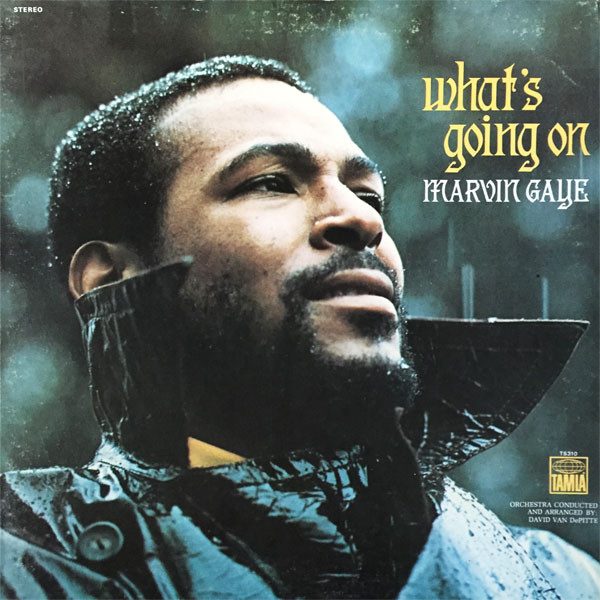
What's Going On by Marvin Gaye (1971), № 1 in The Lead-In’s 100 greatest albums. The sound of a grown man asking the question out loud. Every politically-engaged record since is quietly in its shadow.
What's Going On by Marvin Gaye (1971), № 1 in The Lead-In’s 100 greatest albums. The sound of a grown man asking the question out loud. Every politically-engaged record since is quietly in its shadow.
The album where a major-label soul star walked into the hit factory, locked the door behind him, and came out with the first Black American concept record the industry couldn't ignore.
Motown's golden boy turned the company's hit-making machine inside out and made a record about Vietnam, ecology, and his own crumbling faith, and then had to smuggle it past his own label to release it.
By the end of 1970, Marvin Gaye had stopped recording. His duet partner Tammi Terrell had died of a brain tumor in March at twenty-four, collapsing into his arms on stage three years earlier and never quite recovering. His brother Frankie had come back from Vietnam with stories. His marriage to Berry Gordy's sister Anna, seventeen years his senior, was unraveling. He had tried out for the Detroit Lions, shown up at training camp at two hundred pounds, and been politely declined. He was drinking. He was reading scripture. He wasn't making records, and Motown, which ran on records the way a refinery runs on crude, was beginning to panic.
When he finally went back into the studio, he did it on his own terms. He wanted to produce himself, unprecedented at Motown, where Gordy ran the label as a vertically integrated hit factory in which artists sang what writers wrote and producers produced. He wanted the Funk Brothers, Motown's house band, credited on the sleeve by name, also unprecedented. He wanted to record a song Obie Benson of the Four Tops had brought him about a demonstration at People's Park in Berkeley where the police had beaten protesters bloody. Gordy refused. "That's the worst record I ever heard in my life," he told Gaye. "Why do you want to ruin your career?"
Gaye went on strike. For months he refused to record anything else, which at Motown was the equivalent of a wheat field refusing to grow. Gordy was in Los Angeles tending to the Jackson 5 and couldn't personally supervise Detroit. So Gaye and a Motown executive named Harry Balk quietly pressed a single of "What's Going On" and shipped 100,000 copies to radio. By the time Gordy heard about it, the song had sold 200,000 copies in a week and programmers were calling the label asking for more Marvin Gaye like this. Gordy, not sentimental but not stupid, gave him thirty days to make an album.
Gaye cut the entire record in ten. He worked at Hitsville and at Golden World, flipping the normal Motown assembly line on its head. Instead of cutting vocals over completed tracks, he had the Funk Brothers jam while he directed. He triple-tracked his own vocal, three Marvins talking over each other, the baritone confiding, the falsetto pleading, a third Marvin improvising somewhere in the middle. He let conversations at the top of "What's Going On" stay on the tape. He ran the songs into each other so side one plays as a nine-part suite and you cannot tell where one song ends and the next begins.
It is the sound of freedom being taken rather than given. What the record is about, finally, is whether a Black American in 1971 could still believe in America. The vantage is his brother's: a veteran returning from a war nobody could explain, to a country that didn't want him. "Inner City Blues" is an unemployment anthem; "Mercy Mercy Me" the first great mainstream ecology song; "Save the Children" a prayer in the shape of a question. "What's Happening Brother" is a man trying to find out what his own country looks like while he's been gone. Under all of it, stitching the suite together, is Gaye's conviction, religious in origin, earned in grief, that tenderness is the only remaining politics.
It is also a sonically radical record. James Jamerson cut his bass part on the title track reportedly lying on his back on the studio floor, too drunk to sit up, and produced one of the two or three most melodically intricate bass lines in popular music. David Van De Pitte's strings don't swoop; they hover. The percussion is a conga and a vibraphone and sometimes what sounds like someone tapping a pen on a desk. The whole record feels overheard rather than performed.
What's Going On was the album that made it possible for a Black pop star to make a concept album about the state of the country and have his label release it. Stevie Wonder, still a teenager, was paying attention; within five years he had delivered Talking Book, Innervisions, Fulfillingness' First Finale, and Songs in the Key of Life, four albums of comparable ambition, none of which exist in the same shape without Gaye first. Curtis Mayfield's Roots, Gil Scott-Heron's Pieces of a Man, the entire arc of politicized soul that runs through the early '70s, all downstream.
Gaye was murdered by his own father in 1984, the day before his forty-fifth birthday. The grief that runs through What's Going On, which was already the grief of a brother, a husband, a believer, a working musician watching his country burn, became retroactively biographical. But the record is not great because of what happened afterward. It is great because it is the sound of a major artist inside a major institution deciding, in real time, that he will not be a product any longer. The courage of it, the refusal to cut another "I Heard It Through the Grapevine," the risk of telling Berry Gordy no, is baked into the performance. You can hear him making the record while fighting to be allowed to make it. Fifty-five years later the taking is still going on.
Original 1971 US pressing on Tamla, catalog TS-310 on the spine and cover (the labels read T-310). The label is the classic brown-and-gold Tamla design, and the earliest copies were pressed on thin Dynaflex vinyl. First-press deadwax carries Motown's own matrix family beginning A4RS-2682 (side 1) and A4RS-2684 (side 2), not an 'ARP/American Record Pressing' stamp. It comes in a gatefold sleeve with the Jim Hendin photo of Marvin in the rain and inside liner notes; an inner sleeve promoting other Motown releases is the easy-to-lose extra.
© The Lead-In · an independent, reader-supported music publication.