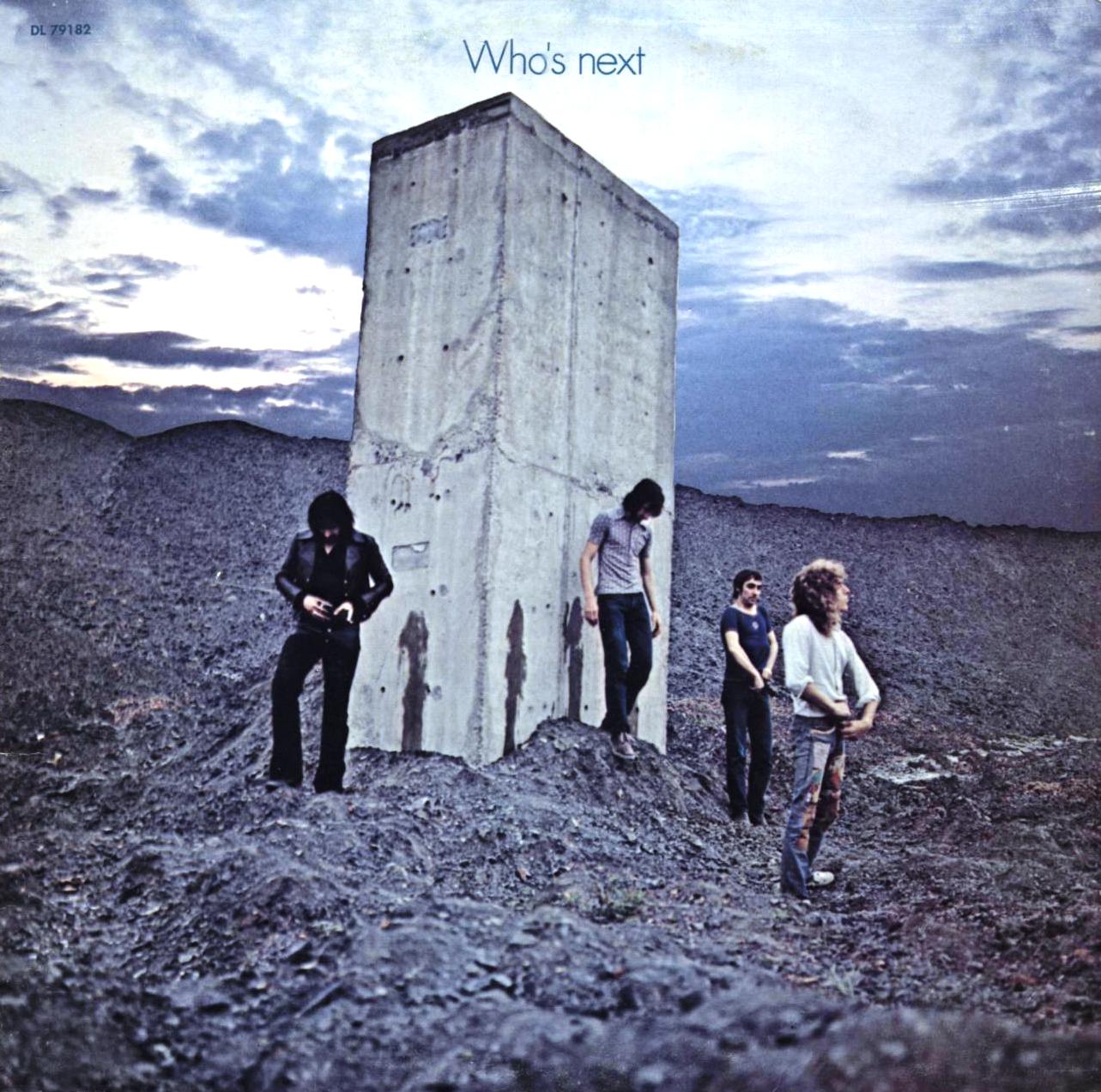
Pete Townshend abandoned an ambitious multimedia project called Lifehouse and salvaged its best material into a 41-minute rock album. The Who's most-direct studio statement. Released August 14, 1971. Reached #1 in the UK; #4 in the US.
- Released
- August 14, 1971 (UK) · August 14, 1971 (US)
- Label
- Track Records (UK) · Decca (US)
- Producer(s)
- The Who · Glyn Johns
- Runtime
- 43:22 (9 tracks)
- Chart peak (US)
- #4 (Billboard 200)
- Chart peak (UK)
- #1 (Record Retailer)
- Certifications
- 3× Platinum (RIAA); 2× Platinum (BPI); estimated 6M+ units globally
- Awards & honours
- Library of Congress National Recording Registry (2008); ranked #29 on Rolling Stone's 500 Greatest Albums (2020); routinely #1 on Who-album polls
Pete Townshend's most-ambitious project, a multimedia rock opera called Lifehouse, collapsed in early 1971 after months of failed implementation at the Young Vic. The Who salvaged the eight strongest songs into a forty-three-minute studio LP, recorded across 6 weeks at Olympic Sound Studios with Glyn Johns engineering. The album that consolidated synthesizer-and-rock-band integration as a sustained commercial-pop form and inaugurated the synth-loop-as-song-foundation vocabulary every subsequent arena-rock LP has worked within.
Pete Townshend in autumn 1970 was twenty-five years old, two years past Tommy's commercial-and-critical breakthrough (May 1969, US #4), and at a structural creative decision point. He had spent the previous six months developing a project he called Lifehouse: a multimedia rock opera in which a band would perform in a giant concert hall while an audience of approximately two thousand participants would, through biofeedback equipment Townshend was designing with engineer Bobby Pridden, produce individual musical-spiritual avatars that the band would weave into a continuous performance. The concept was technically impossible at 1970 instrumentation levels, conceptually difficult to communicate to anyone outside Townshend's immediate circle, and was abandoned in early 1971 after months of failed rehearsal at the Young Vic theatre in London.
What survived was the music. Townshend had written approximately twenty songs intended for Lifehouse; eight became Who's Next plus 'Pure and Easy' and 'Let's See Action' that were released as B-sides or held for later catalogue. Recording began at Olympic Sound Studios in London in March 1971 with Glyn Johns engineering. Johns had been the Who's regular engineer since 1968's The Who Sell Out; the Who's Next sessions were his first formal co-production credit on a Who LP. The sessions ran approximately 6 weeks from March through early May 1971.
The album's central artistic decision was the integration of synthesizers into a rock-band format at sustained album-length scale. Townshend's home Lowrey Berkshire Deluxe TBO-1 organ produced the thirty-three-second arpeggiated loop that opens 'Baba O'Riley', the loop was programmed at Townshend's Twickenham home studio, transferred to half-inch tape, and played back through the Olympic system during the band recording. Townshend's ARP 2600 synthesizer produced the background loop underneath 'Won't Get Fooled Again.' The synth-rock integration was unusual for 1971 commercial rock; the album's commercial success consolidated it as a sustained vocabulary.
The nine final tracks across 43 minutes are sequenced as a deliberate band-statement album rather than as an attempt to preserve the Lifehouse narrative. Roger Daltrey's vocal performances are the most-cited individual contributions: the scream that closes 'Won't Get Fooled Again' at 8:09 has been treated as a defining rock-vocal moment for fifty-three years. John Entwistle's bass and Keith Moon's drums anchor the band performances; Townshend's guitar and synthesizer fills define the album's specific harmonic vocabulary.
Track Records released the album on August 14, 1971 in both UK and US (US distribution by Decca). UK chart entry at #1 was the Who's only studio LP to reach UK #1 during the band's classic-period existence (1965-1982). US peak at #4 was the band's commercial peak for any single LP to that point. RIAA Platinum certification came in 1986; 3× Platinum in 1995. UK BPI 2× Platinum in 1996.
The Ethan Russell cover photograph, the band relieving themselves against a concrete monolith at Easington Colliery slag heap in northeast England on a damp August 1971 day, became one of rock's most-recognized sleeve images. The monolith was actually a coal-mining piling; Russell's photograph was a deliberate parody of '2001: A Space Odyssey' (1968). The site has been visited by Who fans for fifty years; the monolith was removed in 1992 as part of mining-site reclamation.
Who's Next belongs at #27 because it is the album that consolidated synthesizer-and-rock-band integration as a sustained commercial-pop form and produced two of the most-cited rock songs in the FM-radio repertory ('Baba O'Riley' and 'Won't Get Fooled Again'). Every subsequent arena-rock LP that takes synth-bed integration seriously, from U2's Joshua Tree (1987) to Achtung Baby (1991) to virtually every Coldplay LP, runs on the proof Who's Next delivered. The 2008 Library of Congress National Recording Registry induction and Rolling Stone 2020 #77 ranking ratify the institutional standing.
Pressing guide — the one to own
Original 1971 UK pressing, Track Record 2408 102 (the 2408 prefix is the Polydor-group series, reflecting Track's UK distribution through Polydor), on the matt black-and-silver Track label. It is a single picture sleeve with the distinctive pleated spine, housing Ethan Russell's photograph of the band by the concrete monolith, with sleeve design by John Kosh. First-press runouts typically read '2408 102 A//1 / B//2'. The US issue was on Decca (DL 79182); rather than the UK being automatically superior, many collectors in fact favour the early US Decca 'W1' pressing mastered by Doug Sax.