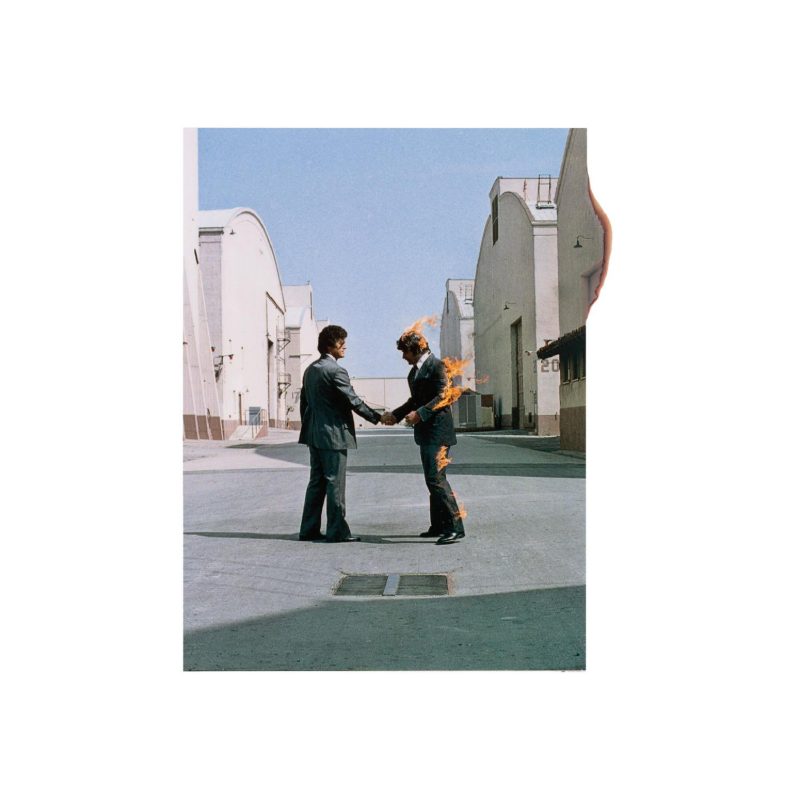
Pink Floyd's ninth album. Recorded at Abbey Road in 1975. A tribute to Syd Barrett and a critique of the music industry.
- Released
- September 12, 1975
- Label
- Harvest (UK) · Columbia (US)
- Producer(s)
- Pink Floyd
- Runtime
- 44:11 (5 tracks)
- Chart peak (US)
- #1 (Billboard 200, 2 weeks)
- Chart peak (UK)
- #1 (Record Retailer, 4 weeks)
- Certifications
- 6× Platinum (RIAA); 13M units globally
- Awards & honours
- Library of Congress National Recording Registry (2017); ranked #167 on Rolling Stone's 500 Greatest Albums (2020); often cited by the band as their personal favorite
Six months at Abbey Road Studios with the band self-producing. Five tracks across 44 minutes, the album is structured as four shorter pieces bookending a 26-minute suite split across the two sides. The album that followed Dark Side of the Moon's 962-week chart run, the album that the band recorded with Syd Barrett unexpectedly visiting the sessions on June 5, 1975, and the album whose central preoccupation, what success had done to the band and what mental illness had done to Barrett before them, has shaped every subsequent reading of Pink Floyd as a working artistic concern.
Pink Floyd had spent the two and a half years between The Dark Side of the Moon (March 1973) and Wish You Were Here (September 1975) as the biggest active rock band on Earth and were, by 1975, deeply uncomfortable with what that had done to them. Dark Side had sold 15 million copies in its first three years (eventually exceeding 50 million across its lifetime) and had spent 962 consecutive weeks on the Billboard 200, a chart record that has never been matched. The band, David Gilmour, Roger Waters, Richard Wright, Nick Mason, had toured the album extensively through 1973 and 1974, with shows running approximately 3 hours and featuring increasingly elaborate stage productions (a flying inflatable pig appeared in 1975, foreshadowing Animals). The commercial scale had created the conditions under which the band's internal dynamics began to deteriorate. Roger Waters, the band's principal lyricist, was the most visibly affected; he'd been processing the loss of Syd Barrett (the band's original founder and songwriter, removed in 1968 after sustained LSD-related psychosis) for years and the post-Dark Side commercial scale had given his preoccupation with mental fragility additional weight.
Recording began at Abbey Road Studios in January 1975 and continued intermittently through July 1975. The band had returned to Abbey Road specifically, having recorded Dark Side there, for both sentimental and practical reasons (the studio's familiarity with their working methods, the deliberate Hipgnosis cover-design ecosystem that Abbey Road's London location supported). The sessions were difficult from the start. Gilmour, Waters, Wright, and Mason had divergent ideas about the album's structure; Waters wanted a more conceptually unified album organized around the Barrett theme; Gilmour and Wright wanted a more conventional collection of tracks. The compromise was the album's eventual structure: four shorter pieces ('Welcome to the Machine,' 'Have a Cigar,' 'Wish You Were Here,' and the closing 'Shine On You Crazy Diamond Parts VI-IX' fragments) plus the 26-minute 'Shine On You Crazy Diamond' suite split across the album's two sides as Parts I-V and Parts VI-IX.
'Shine On You Crazy Diamond' is the album's central composition and the deliberate Barrett elegy. The piece had been developed by Gilmour and Wright at the band's rehearsal warehouse in autumn 1974, originally as an instrumental track. Waters wrote the lyrics in early 1975, the opening line ('Remember when you were young / You shone like the sun') addresses Barrett directly. The recording was conducted across multiple sessions at Abbey Road in spring 1975. The piece's specific structural feature, the four-note guitar motif that opens the suite ('Shine On You Crazy Diamond Part I') and the piece's deliberate length and structural patience, was the band's deliberate decision to give the elegy appropriate weight. The piece runs approximately 26 minutes across the two album sides; Gilmour's guitar work, particularly the sustained solos in Parts II and IV, is among the most-cited Pink Floyd instrumental performances.
Syd Barrett unexpectedly visited the Abbey Road sessions on June 5, 1975, the day the band was mixing 'Shine On You Crazy Diamond Parts VI-IX' (the closing suite that bookended the album with the opening Parts I-V). Barrett had not been in regular contact with the band since his 1968 departure; he had spent the intervening seven years in increasing psychiatric difficulty, eventually retiring to live with his mother in Cambridge. He arrived at Abbey Road unannounced, bald, forty pounds heavier than the band remembered, eyebrows shaved, in a white raincoat carrying a plastic bag. The band didn't initially recognize him; Roger Waters reportedly wept when he realized who the figure was. Richard Wright also wept. Barrett spent approximately 3 hours at the studio, listening to playback of the song he had inspired without recognizing it as music about himself. He left after a few hours and never met the band again. He died in 2006 at age 60. The session is the single most-mythologized event in Pink Floyd's history; multiple band members have addressed it extensively in subsequent interviews. The deliberate emotional weight of the album is partly the document of this visit.
The album's other three principal tracks operate as deliberate complements to the central elegy. 'Welcome to the Machine' is the music-industry critique, 6 minutes of synth-driven indictment of the recording-and-touring machinery that had consumed the band post-Dark Side. 'Have a Cigar' uses guest vocalist Roy Harper (the deliberately ironic choice, Harper was a fringe British folk singer-songwriter rather than a major Pink Floyd-tier figure) singing Waters's deliberately satirical lyrics about a music-industry executive's hollow congratulations to a band. The choice of Harper rather than Gilmour or Waters singing the track was deliberate; the band wanted the song to sound like it was being delivered by someone outside the band's own voice. 'Wish You Were Here' is the album's title track and central acoustic moment, Gilmour and Waters trading vocal duties on the closest the album gets to a conventional song. The track has been one of the most-streamed Pink Floyd songs across the streaming era.
The album was released on September 12, 1975 in the UK and September 15 in the US. Hipgnosis's cover photography (featuring two businessmen shaking hands while one is on fire, plus the deliberately empty deckchair on the back cover and the diver photograph on the inner gatefold) is one of the most-cited album-cover designs in rock history. The deliberately opaque visual identity, no band name on the outer sleeve, the deliberately strange imagery, was the band's structural decision. The album reached US #1 (the band's first US #1) and UK #1. First-year sales: approximately 6 million units. Critical response was strong; reviewers consistently praised the album's structural coherence compared to the more fragmented post-Dark Side work the band would produce afterward (Animals 1977 and The Wall 1979).
Wish You Were Here belongs at #50 because it is the album in which Pink Floyd looked at what success had done to them, what it had done to Barrett before them, what it was doing to them now, and made a record about it. The Barrett visit during the sessions gave the album its specific weight; the post-Saigon economic and cultural exhaustion gave it its specific historical position. The record sits at the seam between prog rock's peak and punk's arrival, between the album-rock 1970s and the singles-and-MTV 1980s. The band would never make another record this emotionally direct; punk would, within eighteen months, make this kind of record commercially impossible to repeat. The Library of Congress added Wish You Were Here to the National Recording Registry in 2017. The album closes the canonical 1970s Pink Floyd catalog at the highest point of the band's working chemistry; Animals and The Wall would extend the commercial scale but introduce internal conflicts that would dissolve the band by 1985.
Pressing guide — the one to own
1975 UK first pressing, Harvest SHVL 814 with the original Hipgnosis cover (the burning businessman handshake photograph, the empty deckchair on the back, the diver photograph on the inner gatefold). Look for the matrix etchings SHVL 814-A-1 / B-1, hand-etched at Abbey Road by either Doug Sax (for US) or Chris Blair (for UK). The original UK pressings include the embossed-and-shrink-wrapped outer packaging, the deliberate decision was that the album would be sold sight-unseen (the shrink-wrap was opaque, with only a sticker indicating it was a Pink Floyd album). The inner sleeve includes the deliberately conceptual additional Hipgnosis photographs.