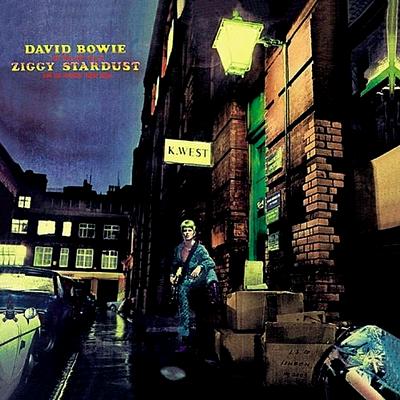
David Bowie at twenty-five, two albums into his career as 'David Bowie' and one album into his career as someone else, invented a fictional rock star who would become more famous than he was. The album dropped on June 16, 1972. 8 weeks later, on Top of the Pops, he put his arm around Mick Ronson and the world changed.
- Released
- June 16, 1972
- Label
- RCA Records
- Producer(s)
- Ken Scott · David Bowie
- Runtime
- 38:32 (11 tracks)
- Chart peak (US)
- #75 (Billboard 200, then rose to #21 after 1972 US tour)
- Chart peak (UK)
- #5 (Record Retailer)
- Certifications
- Platinum (RIAA); 2× Platinum (BPI); estimated 8M units globally, Bowie's bestselling early-career album
- Awards & honours
- Library of Congress National Recording Registry (2017); ranked #35 on Rolling Stone's 500 Greatest Albums (2020); ranked #1 on UK glam-rock and 1970s-album polls since 1990
Five years on Earth before destruction; an alien rock star arrives to deliver hope and ends up destroyed by his own audience. The concept-album premise was sketched, Bowie has said in print, in a single afternoon at his Beckenham home in autumn 1971. The album that delivered the premise made him a star.
By the autumn of 1971, David Bowie had been making records for six years and had had exactly one hit: 'Space Oddity,' a 1969 single tied to the Apollo 11 moon landing. The 1970 album Hunky Dory had been critically praised and commercially modest. He was twenty-four years old, married to Angie Bowie, the father of an infant son (Zowie, later Duncan Jones), and living in a basement flat in Beckenham, south London. He had been reading Anthony Burgess's A Clockwork Orange, William Burroughs's cut-up novels, and a quantity of science fiction. He had been watching The Stooges' Iggy Pop perform in a feather boa at a London show. He had been thinking about what would happen if he stopped being David Bowie and became a fictional character instead.
The character he invented, 'Ziggy Stardust,' a bisexual androgynous extraterrestrial rock messiah who arrives on Earth in its final five years to deliver hope and is destroyed by his own fans, was sketched out, Bowie has said in print, over a single afternoon in autumn 1971. He showed the rough concept to his then-producer Ken Scott (who had been engineering Bowie's records since 1969 and had been promoted to co-producer for the Hunky Dory sessions). Scott understood the brief immediately. The album would be recorded at Trident Studios in St Anne's Court in central London, the same studio that had produced Hunky Dory and would produce most of Bowie's classic-period work. The Spiders from Mars, Mick Ronson on guitar, Trevor Bolder on bass, Mick 'Woody' Woodmansey on drums, were already Bowie's touring band; they would also be the album's session musicians.
Recording took 12 weeks across November 1971 to February 1972. The sessions ran from late afternoon until late evening; Bowie wrote in the morning at his home in Beckenham and brought new songs to the studio each day. The band would learn the songs in two or three takes; Mick Ronson arranged most of the guitar parts and a significant proportion of the string arrangements; Bowie's vocal performances were typically captured in one or two takes. The album as a whole feels live, eleven songs played by a band of four musicians who knew each other's playing in real time. The string overdubs that elevate 'Five Years' and 'Lady Stardust' were arranged by Ronson and recorded in a single afternoon at Trident with the studio's house string section.
The album's narrative arc, five years before Earth's destruction, an alien rock messiah arrives to deliver hope, the audience adores him too much, he is destroyed by his own myth, is told across eleven tracks in approximately the order they appear. 'Five Years' opens the album with the apocalyptic setup; 'Soul Love' and 'Moonage Daydream' establish the alien's emotional and sexual range; 'Starman' is the messianic moment, delivered as a Beatles-style pop song with a fade-out chorus; 'It Ain't Easy' is the song the album's editors have most often debated (it is a Ron Davies cover and arguably interrupts the narrative; Bowie has said he kept it because he loved playing it); 'Lady Stardust' is the song Ziggy plays for his lover; 'Star' is his rise; 'Hang On to Yourself' is the band's introduction; 'Ziggy Stardust' tells his rise and fall in 5 minutes; 'Suffragette City' is his sexual swagger at peak fame; 'Rock 'n' Roll Suicide' is his end, sung as a redemption-song farewell to the abandoning audience.
Released on June 16, 1972, the album reached #5 in the UK within 4 weeks. The first single, 'Starman,' had been released two months earlier and was climbing slowly. The breakthrough moment came on July 6, 1972, when Bowie appeared on Top of the Pops to perform 'Starman.' He wore a quilted multi-colored jumpsuit and red boots; mid-performance, he draped his arm around Mick Ronson's shoulders and stared into the camera. The gesture, a man putting his arm around another man on prime-time British television in 1972, became one of the most-discussed cultural moments of the decade. The single rose from #40 to #10 within a week. The album, which had been peaking modestly, climbed to #5. The Ziggy Stardust tour began 2 weeks later and ran for eighteen months across three continents, becoming one of the most-celebrated rock tours of the 1970s.
Ziggy Stardust belongs at #22 because it is the album on which an unknown English songwriter invented a fictional persona who became more famous than he was, then used the persona to produce some of the most direct rock-pop songwriting of his career, then killed the persona on stage at Hammersmith Odeon eighteen months later and continued his career as a different artist. The album is the founding document of glam rock as a global commercial form (T. Rex had been ahead but Bowie's reach was wider). It is also the proof that a concept album could be both rigorously narrative and immediately tuneful, every song on Ziggy is also a potential single. Without Ziggy Stardust there is no Roxy Music as a commercial force, no Queen's stadium-scale theatricality, no Madonna's identity-shifting career, no Lady Gaga, no Janelle Monáe, no The Weeknd's character work. The road from 'David Jones' through 'Ziggy Stardust' to every subsequent pop-star-as-persona runs through this record.
Pressing guide — the one to own
Original 1972 UK pressing, RCA Victor SF 8287, in stereo, on the thick glossy orange RCA Victor label crediting Gem Production and Titanic Music (no MainMan, which appears only on later issues). It is a single, unlaminated sleeve with the cut-and-paste front shot of Bowie outside the K. West furrier at 23 Heddon Street and a printed lyric/photo inner; the earliest copies also carried a tour insert. The cover photograph is by Brian Ward (colourised by Terry Pastor), not Brian Duffy, who shot Aladdin Sane. The key first-press marker is the '1E/1E' stamper in the runout; genuine high-grade copies trade around £400 and up.