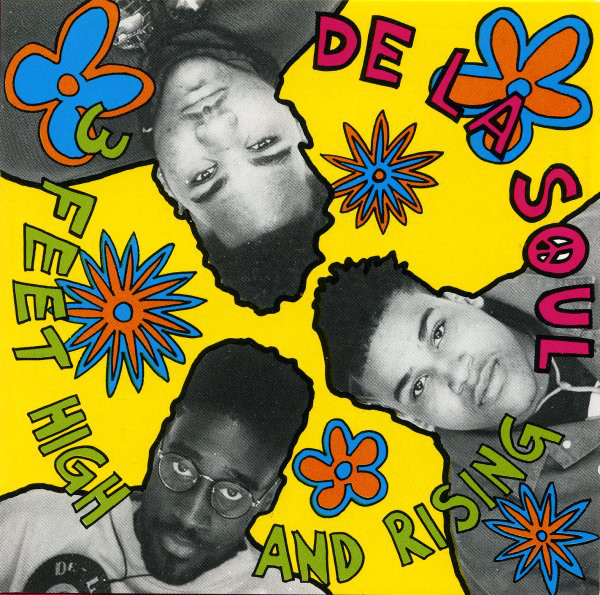
De La Soul's debut, made with Prince Paul in about 2 months, turned three Long Island teenagers' record collections into a game. The invention still lands. The length and the quiz-show glue don't.
- Released
- Early 1989 in the US (Tommy Boy; sources give 23 January, 6 February and 3 March); 21 March 1989 in the UK (Big Life)
- Label
- Tommy Boy (US: TBLP 1019 on the spine, TB 1019 on the labels, CD TBCD 1019); Big Life (UK: DLSLP 1, distributed by Rough Trade)
- Producer(s)
- Prince Paul; co-produced by De La Soul
- Runtime
- 67:17 on CD (24 tracks); the LP has 23
- Chart peak (US)
- #24 (Billboard 200, 10 and 17 June 1989), then #15 on its return in March 2023; #1 (Billboard R&B albums, 5 weeks from 27 May 1989)
- Chart peak (UK)
- #13 (Official Albums Chart, 27 January 1990), then #9 in April 2023
- Certifications
- RIAA Gold (30 May 1989) and Platinum (26 April 2000); BPI Platinum (1 February 1990)
- Awards & honours
- #1 in the Village Voice Pazz & Jop critics' poll for 1989. Added to the Library of Congress National Recording Registry with its 2010 class. 'Me Myself and I' was nominated for Best Rap Performance at the 1990 Grammys
The Village Voice's critics made it the album of 1989. It's a record about the pleasure of finding records, and that pleasure explains both why it still sounds fresh and why it sprawls across 24 tracks.
In May 1989 the Washington Post reported that Tommy Boy was offering $500 to anyone who could name a sample on 'Plug Tunin''. The answer, Jeff Chang wrote in Pitchfork in 2018, was a rare doo-wop record by the Invitations. The story ran on 18 May. On 13 July, 8 weeks later, Mark Volman and Howard Kaylan of the Turtles sued over a different sample on the same album. Both facts belong to the record. One is a game. The other is the bill for playing it.
3 Feet High and Rising runs on that game. Three teenagers from Long Island and a DJ from Stetsasonic treated the records they grew up with as a toy box, and invited the listener to play along. That's why it still sounds fresh 37 years on. It's also why it sprawls. The impulse that makes the best tracks thrilling also fills 67 minutes with in-jokes, sketches and a quiz-show frame it didn't need. It's a great record. It was never a tidy one, and the mess is what the freedom cost.
The group were very young. When the Post interviewed them, Posdnuos and Trugoy were 19, and Maseo was 18 and finishing at Amityville High. Prince Paul, born Paul Huston, was the DJ in Stetsasonic. Chang writes that he felt under-credited there and knew rap was moving towards the sampler. He heard the group's demo of 'Plug Tunin'', made on a Casio RZ-1, and re-recorded it with them at Calliope in New York. Tommy Boy signed them soon after. Trugoy told Rolling Stone in 2009 that they wanted to stand for individuality against the boasting and gold chains of the time. Posdnuos had been plainer with the Post in 1989. They sampled what they'd grown up with, he said, and weren't trying to be different. The record bears him out. Its strangeness comes from honest taste, not from a manifesto.
It was made fast and cheaply. Chang puts the recording at about 2 months. The budget depends on whom you ask. Posdnuos told the Guardian in 2014 that it cost $13,000, while Chang gives $25,000. Either way, the tools were modest. Posdnuos says the whole album was made with a Casio RZ-1 drum machine and an Eventide harmonizer, used to bring different records into the same pitch. They mixed 3 songs a day. The room was crowded, with 15 or more people and sometimes 25. That's how MC Lyte and Red Alert ended up in the crowd on 'Do as De La Does', and how the Jungle Brothers ended up on 'Buddy'. You can hear it. Much of the album sounds like a party where somebody left the tape running.
Rolling Stone wrote in 2009 that many of the album's samples were used without clearance. That's true, but it isn't the whole story. Spin reported in November 1989 that Tommy Boy had worked out deals with Hall & Oates, Steely Dan and George Clinton. Chang counts 60 cleared samples out of more than 200. Trugoy said in 2009 that the label expected to sell a couple of thousand copies, so it didn't think it really had to clear the samples. Read together, those accounts suggest the famous names were paid for and the obscure ones were a gamble. The Turtles were where the gamble failed. Their suit, filed on 13 July 1989, said the first 4 bars of 'You Showed Me' were looped on 'Transmitting Live from Mars'. It sought $1.7 million in damages, according to the Los Angeles Times. Spin reported that Tommy Boy had offered them $1,000 after the album came out. The case was settled out of court, and the terms have never been published.
That suit came 29 months before Grand Upright, the December 1991 ruling that ended free sampling. The order matters. 3 Feet High and Rising isn't the last record of a lawless age. It's one of the early records to get the bill. The Los Angeles Times saw a court test coming in July 1989, 10 days after the Turtles filed. The album sits right on the line between a business that could shrug at a rare doo-wop record and one that couldn't.
The best tracks show what the gamble bought. 'The Magic Number' opens the album proper with Bob Dorough's Schoolhouse Rock song about multiplication, a record the group already had and loved. Posdnuos names a beat from Double Dee & Steinski underneath it. Chang adds a Led Zeppelin drum break and a line from Johnny Cash. That's children's television, a hip-hop cut-up, hard rock and country in 3:16. It plays as one song, and it's over before you've finished naming the parts.
'Eye Know' is gentler, and better. Posdnuos took a line from Steely Dan's 'Peg' for its chorus. The whistle is Otis Redding's, the beat Lee Dorsey's and the horns the Mad Lads'. He told Rolling Stone in 2009 that it was 'kinda my first time programming a beat'. Four records by four acts sound like one band, though the players were never in one room. This is the album's real achievement. It doesn't quote records so much as cast them, and on 'Eye Know' every part knows its role.
The hit came late, and to order. Late in the sessions Tommy Boy asked for something easier to get into. Maseo and Paul suggested a loop from Funkadelic's '(Not Just) Knee Deep', and 'Me Myself and I' was the second-to-last song recorded. It became their biggest single. It went to #1 on Billboard's black singles chart, #1 on its rap chart for 8 weeks and #34 on the Hot 100. The group came to dislike it. On tour, Chang writes, they had crowds chant that they hated it. They had a point. It's the most conventional thing here, a funk loop and a chorus, and the one track another group could have made. 'Say No Go' is the smarter crossover, an anti-drug song set on Hall & Oates' 'I Can't Go for That'. 'Potholes in My Lawn' turns a loop from War's 'Magic Mountain' into a complaint about rappers copying them.
The trouble is what sits between the songs. The quiz show that frames the album wasn't the plan. Posdnuos says that once the album was finished, Paul told them it needed something to glue it together, so the game-show skit was added at the end. The host is Al Watts, who was also the mix engineer. Michael Azerrad's Rolling Stone review called it a running gag, which is about right. It comes back, but it never organises anything. Around it sit sketches that were funnier in the room than they are on the 20th play. 'De La Orgee' is 73 seconds that the Washington Post traced to Barry White. 'Tread Water' is a children's story written in Paul's room, and Posdnuos has said he never really liked it. Nine of the 24 tracks run under 2 minutes.
None of this was hidden in 1989. Robert Christgau gave the album an A− in the Village Voice. He found it danceable, but called its music 'maddeningly disjunct'. He also thought it too long for vinyl, and that a few tracks indulged themselves. He was right on both counts. A 45-minute version would be easier to love and much less interesting, which is the bind. The sprawl is where the surprises live. But cohesion is the weakest thing about the record, its lowest score here, and repeat plays make that plainer rather than less.
What it changed is easier to document than most claims of influence. Posdnuos says recording 'Buddy' with Q-Tip and the Jungle Brothers is how the Native Tongues came together, and the Jungle Brothers weren't even booked. They dropped into the session. In 2009 Rolling Stone named Digable Planets, Mos Def, OutKast and Kanye West among the group's followers. Chang traces LA's True School, the Bay Area underground, the Dungeon Family and Dilla's Detroit back to the Native Tongues. Critics saw it at the time. The Village Voice's Pazz & Jop poll, published on 27 February 1990, made it the album of 1989, ahead of Neil Young's Freedom and Lou Reed's New York. What passed down was a permission. Rappers could be suburban and funny and still be taken seriously.
For 34 years it couldn't be bought as a download or streamed, apart from a one-day giveaway on 14 February 2014. It reached streaming services on 3 March 2023. Okayplayer reported in 2019 that the old sample agreements may not have covered digital formats. It added that Warner, which then held the catalogue, had told the New York Times in 2016 it didn't believe every sample could be cleared. Reservoir bought Tommy Boy in 2021. From January 2022, Deborah Mannis-Gardner's company spent about a year clearing the samples, and some parts had to be replayed. Trugoy died on 12 February 2023, aged 54, 19 days before the album arrived. In the weeks after, it charted higher than ever, at #15 in the US and #9 in the UK. The version people stream isn't quite the original, though. 'Cool Breeze on the Rocks' has become a 17-second 'Melted Version'.
So what's it worth now? At its best, on 'The Magic Number', 'Eye Know' and 'Say No Go', it's still a thrill, and its innovation score, the highest on its card, is earned. It sounds like three teenagers who knew a lot of records cutting them together for the fun of it, and the fun survives. But play it straight through and you feel the length. The skits are glue that doesn't hold, and too many of the sketches were made for the room. 3 Feet High and Rising is a great album that's better programmed than played. The game was worth playing. It just didn't need every round.
Pressing guide — the one to own
The original to own is the 1989 US Tommy Boy LP. It's a single LP in a single sleeve, with a printed paper inner carrying a cartoon and the credits. The spine reads TBLP 1019 and the labels TB 1019. Two cuts exist. One was mastered at Masterdisk with Direct Metal Mastering, and its runouts read 'MASTERDISK DMM', with no 'RE1'. Specialty pressed it with an embossed 'T' on the B-side label. The other carries 'RE1' in the runouts, the mark of a recut. The catalogue entries don't say which came first. There's no Frankford/Wayne or Tom Coyne cut, whatever a listing says.