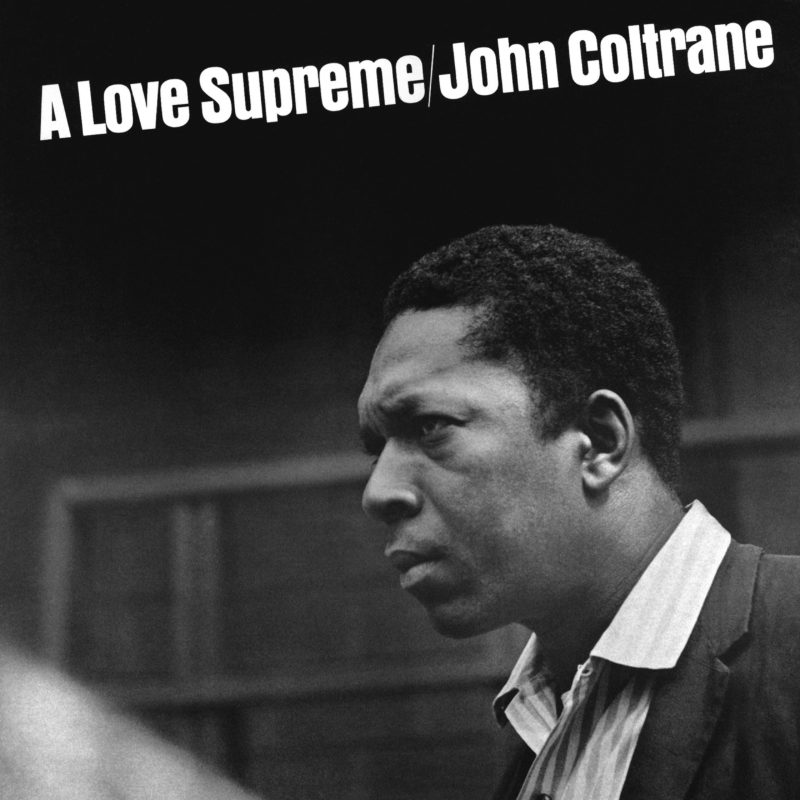
John Coltrane's four-part suite of thanks, cut by his quartet in one evening in December 1964. A record of faith that holds up just as well as a piece of construction.
- Released
- January 1965 (US, Impulse! A-77 mono and AS-77 stereo), though Pitchfork's dating implies February; UK, HMV, mid-1965
- Label
- Impulse! (a product of ABC-Paramount Records)
- Producer(s)
- Bob Thiele · recorded by Rudy Van Gelder
- Runtime
- 32:50 on the 2002 CD; the 1965 LP labels give 7:39, 7:15 and 17:40 (side two as one band)
- Chart peak (US)
- Never on the Billboard 200; #3 on Billboard's Traditional Jazz Albums (October 2020)
- Chart peak (UK)
- Never on the Official Albums Chart; #2 on the Official Jazz & Blues Albums Chart (2015 and 2020)
- Certifications
- RIAA Platinum (10 November 2021)
- Awards & honours
- Grammy Hall of Fame (1999); National Recording Registry (2015 class, announced March 2016); The Complete Masters won DownBeat's 2016 Readers Poll for Historical Album of the Year
Coltrane meant A Love Supreme as an offering to God, and it works as one. What keeps it alive for listeners without his faith is the design: one four-note idea, worked through four movements by a band that knew exactly when to hold back.
Near the end of 'Acknowledgement', John Coltrane takes the four-note figure the movement is built on and plays it in all 12 keys. Lewis Porter, his biographer, has pointed to the passage as deliberate, not improvised. It isn't a solo any more. It's a man saying one thing from every side, so that nobody could mishear it. Then Coltrane chants the album's title, his own voice laid over itself. The chant is the famous part. The minute before it is the one that explains the record.
That minute holds the record's whole argument. A Love Supreme is famous as a prayer, and Coltrane meant it as one. His sleeve note calls the album 'a humble offering to Him'. But the reason it still reaches people who don't share his faith is its design. Four movements grow from one small idea, played by a quartet that had been together for three years. There's a second reason, and it's less flattering. Mark Richardson argued in Pitchfork in 2015 that Coltrane had already gone further out than this, and dialled back here to carry a message to more people. He was right. The restraint is the record's strength, and it's also its limit.
The message was thanks. Miles Davis fired Coltrane after a show in April 1957, and that year Coltrane gave up heroin and drink. His liner note, signed December 1964, dates a spiritual awakening to 1957. It also admits something the legend tends to drop: a later 'period of irresolution', when he lost his way. So the album is gratitude for a rescue, and also a promise from a man who knew he could fall again. He wrote the suite at the family's new house in Dix Hills, on Long Island. His handwritten sketch for it is now at the Smithsonian's National Museum of American History.
It came at a turn in his music, too. In 1961 a Down Beat critic had called his music 'anti-jazz'. His next studio albums were cautious: Ballads, a record with Duke Ellington and another with the singer Johnny Hartman. Crescent, in 1964, found the quartet stretching out again. He'd been on Impulse! since the label bought his Atlantic contract in May 1961. Six months after A Love Supreme he recorded Ascension with 11 players, and by early 1966 McCoy Tyner and Elvin Jones had both left. A Love Supreme sits between those two Coltranes. It has the reach of the later one and the discipline of the earlier, held in balance for half an hour.
The session took place on the evening of 9 December 1964, at Rudy Van Gelder's studio in Englewood Cliffs, New Jersey. The writer Bill Milkowski gives the hours as 7pm to midnight. Tyner remembered the lights being dimmed so the room felt like a club, and Coltrane giving very few directions. Bob Thiele produced, and the photographer Chuck Stewart shot the session; six rolls of his film turned up in 2014. Whatever the legend says, it wasn't one take. 'Resolution' ran to at least six. The archive sets include take 4, complete, and take 6, a breakdown that stops at 2:13. The chant was overdubbed, and two alternative vocal overdubs survive. The 2015 archive set also includes an undubbed 'Psalm', so the released one carries an overdub as well.
The next day, 10 December, Coltrane recorded 'Acknowledgement' again with Archie Shepp added on tenor and Art Davis on a second bass. The sextet made six takes, four of them complete. Two came out in 2002 and all six in 2015. Coltrane chose the quartet version, with the chant. Nobody recorded his reasons, but you can hear what the choice kept. Two tenors and two basses would have made the record bigger, and he'd make bigger records within the year. The quartet take states the idea once, by four people, with nothing in the way. That plainness runs through all four movements.
Listen to how the idea is planted. 'Acknowledgement' opens with a gong from Jones and a short fanfare from Coltrane. Then Jimmy Garrison starts a four-note figure on the bass. For long stretches it sits underneath, a pattern you stop noticing while Coltrane solos over it. So by the time he spells it out in every key, you've been hearing it for minutes. The chant then gives the idea words. It's a simple trick, and it's why the movement feels inevitable rather than clever. Nothing on the record is better than these 8 minutes.
'Resolution' was the hard one, and it's the most conventional movement here: a band playing a tune, then playing on it. It's also the part that Record Mirror's cool review of the British issue singled out for praise in July 1965. 'Pursuance' is the quartet at full stretch, and its ending is the cleverest join on the record. Garrison plays alone, and on the original LP the passage runs straight on into 'Psalm'. Side two was cut as a single band, 17:40 long, with no gap between the third part and the fourth. That bass solo is the hinge. Before it, the suite is an argument. After it, it's a prayer.
'Psalm' is the boldest idea, and the one that divides people. Coltrane printed a poem inside the gatefold and then played it on the saxophone, one note to each syllable. He called the movement a 'musical narration' of the poem. Pastor Franzo King, whose church treats the album as its central text, has described his congregation finding that the printed words fit the music. Richardson noted how close it sits in tone to 'Alabama', Coltrane's piece from 1963. He also wrote that by 'Psalm' the record 'has wrung its concept dry', and he meant it as praise. To him it was as complete a statement as any in recorded jazz. That completeness is also where the record's limit shows. With the text in front of you, it's moving. Without it, you're listening to someone recite a page you can't see.
Impulse! issued it in a laminated gatefold, with Coltrane's own note and poem inside. The first reviews split. Don DeMicheal gave it five stars in Down Beat on 8 April 1965 and called it a work of art. In Britain, Record Mirror said specialists would get the most from it, not the casual fan. Buyers proved Record Mirror wrong. Pitchfork says it quickly passed 100,000. Bill Milkowski wrote in 2025 that it had sold more than a million. It never reached the Billboard 200, yet the RIAA certified it Platinum in November 2021. It was never a hit, and it never needed to be.
Its life outside jazz was religious from early on. In 1965 Franzo and Marina King heard Coltrane at the Jazz Workshop in San Francisco and had what they call a 'sound baptism'. Their church was still preaching from the album when NPR reported on it in 2020. Musicians answered it too. Carlos Santana and John McLaughlin both named it as an early influence, and recorded their own 'A Love Supreme' in 1973. Alice Coltrane made a 10-minute version with strings in 1972. Will Downing's vocal single 'A Love Supreme', with new words by Downing and David Cole and Coltrane credited as composer, reached #14 in Britain in 1988. Jazz players keep coming back to it, too. Elvin Jones, the drummer on the original, played the first three movements live in Tokyo in 1992 with Wynton Marsalis on trumpet. Columbia issued it in 1994 as Tribute to John Coltrane.
So the reputation is enormous, and mostly earned. It entered the Grammy Hall of Fame in 1999 and the Library of Congress's National Recording Registry with its 2015 class. The doubts are worth hearing, though. Robert Christgau gave it an A− in 2020. He said how much you value it depends on 'how much faith you place in your own spirituality'. Tom Hull gave it an A+ and said he'd never given much thought to it as spiritual. What struck him was how perfectly it's plotted. Hull's reading is the stronger one, because the plot is what survives without the faith. The live tapes make the other case against it.
NPR reported in 2000 that Coltrane played the whole suite on stage only once. uDiscover later called the Antibes festival tape the only documented live recording. That concert, on 26 July 1965, was issued on the 2002 Deluxe Edition. Pitchfork heard a harsher edge there than in the studio. A second tape, from The Penthouse in Seattle on 2 October 1965, wasn't released until 2021. By then the band had grown to seven, with Pharoah Sanders, Carlos Ward on alto and Donald Garrett on a second bass. These tapes are the strongest argument against the studio record. They show where the suite could go once Coltrane stopped holding back, and how tidy the original sounds beside them.
A Love Supreme is one of the best jazz records ever made. Four musicians play as one, and the structure never loses its thread. The bass figure plants the idea in the first movement, and Garrison's solo hands the suite over to the prayer in the last. The weakness is real, though. 'Psalm' asks for more patience, or more faith, than a listener without the poem can easily give. Antibes and Seattle show a band that could go further. The studio version is the one where every part points the same way. Play it as a prayer if you like. It works just as well as an argument, and it needs all four movements to make it.
Pressing guide — the one to own
The prize is a 1965 US original on Impulse!, in the thick laminated gatefold: A-77 for mono, AS-77 for stereo. Check the runouts. Originals carry a stamped VAN GELDER and a hand-etched 'LW' for Longwear Plating. Stereo copies print 'STEREO A-77' on the cover, back and spine. The first stereo label reads 'AS-77' with no side suffix.