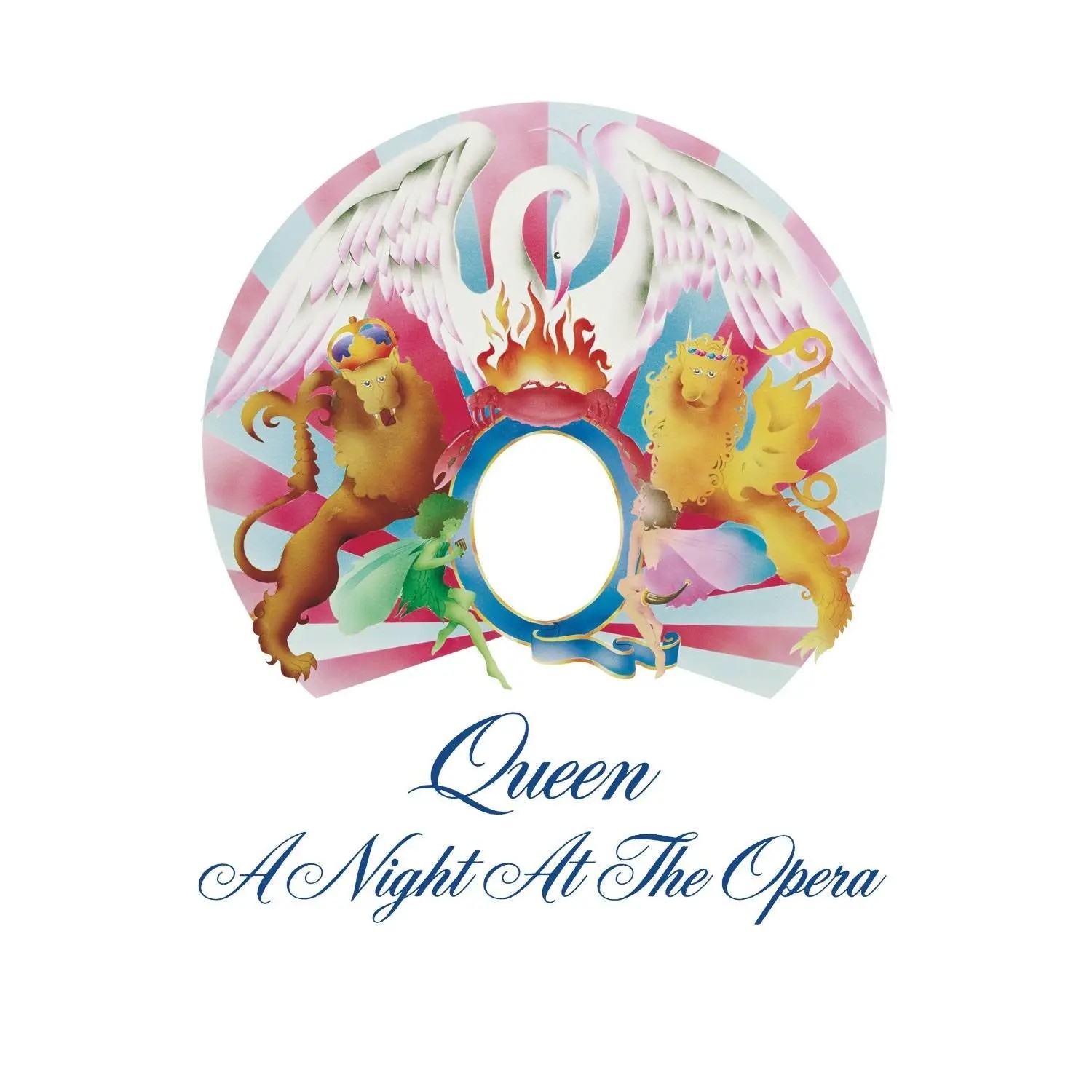
Queen made it across seven studios in four months in 1975, on a budget of roughly £40,000 — reportedly the most expensive album ever recorded at the time — while close to bankrupt and freshly escaped from a management deal that had taken almost everything they'd earned. At its centre was a six-minute mock-opera with no chorus that no label believed could be a single.
- Released
- 28 November 1975 (UK, EMI, EMTC 103); 2 December 1975 (US, Elektra, 7E-1053)
- Label
- EMI (UK) / Elektra (US)
- Producer(s)
- Roy Thomas Baker and Queen (engineer: Mike Stone; assistant: Gary Langan)
- Runtime
- 43:08
- Chart peak (US)
- #4 (Billboard) — Queen's first US platinum album (later 4× platinum)
- Chart peak (UK)
- #1 (four non-consecutive weeks) — their first UK #1 album
- Certifications
- UK Platinum; US 4× Platinum; ~12M worldwide
- Awards & honours
- 'Bohemian Rhapsody' nominated at the 19th Grammys (Best Pop Vocal by a Duo/Group, Best Arrangement for Voices); voted Britain's favourite single in a 2002 Guinness poll
Queen's fourth album, the one that turned a struggling singles act into one of the biggest bands on earth. Recorded across seven British studios on the band's first 24-track tape, it spans music hall, sea shanty, hard rock and a mock-opera — and it cost more than any record before it.
In the autumn of 1975 Queen were simultaneously one of the most talked-about bands in Britain and one of the most miserable. Sheer Heart Attack had reached UK #2 the year before and 'Killer Queen' had given them their first real American airplay, but a disastrous management arrangement with Trident meant they had seen almost none of the money. Their new manager, John Reid, negotiated them out of Trident with one instruction: go and make the best album you can. They did — and nearly bankrupted themselves doing it.
A Night at the Opera was recorded from August to November 1975 across seven different studios — Rockfield in Monmouthshire, plus Roundhouse, Olympic, Lansdowne, Scorpion, SARM and (for the year-old 'God Save the Queen' coda alone) Trident. The band rented houses near each room and worked around the clock; the cost, widely reported at the time as roughly £40,000, made it the most expensive album ever recorded to that point, about four times an average rock budget — money the band, having just bought out of Trident, didn't have. It was also their first record made on 24-track tape rather than 16, which let producer Roy Thomas Baker and the band think of vocal harmonies in stacks of eight and twelve.
That extra width is the album's secret. Baker insisted on multitracking Queen's already dense vocal arrangements until they functioned as a separate instrument; Mercury, May and Taylor sang in shifts of ten to 12 hours a day for the better part of 3 weeks, bouncing sub-mixes down to free up tracks for more overdubs. By the end the tape had been bounced across eight generations and was, by Brian May's account, worn nearly transparent — the oxide thinned by so many passes through the heads. The total number of vocal overdubs on 'Bohemian Rhapsody' alone is usually put at somewhere around 180.
The range of the thing is its argument. 'Death on Two Legs' opens the record as a vicious kiss-off to the band's former manager; 'Lazing on a Sunday Afternoon' is music-hall whimsy sung through a tin bucket for a megaphone effect; 'I'm in Love with My Car' is Roger Taylor's grease-and-petrol rocker, complete with his own Alfa Romeo revving at the end; 'You're My Best Friend' is John Deacon's warm pop song, written on a Wurlitzer electric piano despite the sleeve's proud 'No Synthesizers!' credit; '39' is Brian May's folk song about relativistic space travel; and 'Love of My Life' is the Mercury ballad that would become a stadium singalong for the rest of the band's life.
Then 'Bohemian Rhapsody' — 5 minutes and 55 seconds, no repeating chorus, lurching from piano ballad through a mock-operatic passage of Galileos and Scaramouches into hard rock and back to a quiet coda. EMI's executives said it was twice too long for radio and could not be a single. Mercury and Baker handed a copy to the DJ Kenny Everett, who played it relentlessly on Capital Radio until the public demanded it; the unedited single went out and spent 9 weeks at UK #1, the 1975 Christmas number one. A purpose-shot promo film by Bruce Gowers — made in about 4 hours — did the rest. It is the only single ever to reach UK #1 twice with the same recording, the second time after Mercury's death in 1991.
A Night at the Opera is not in our hundred only because the hundred is closed. Brian May called it 'our Sgt. Pepper', and the comparison holds: it is the record where a band's ambition, technology and budget all arrived at the same moment and produced something no one had quite heard before. It made Queen unavoidable, it made the rock-as-grand-theatre template that everyone from Meat Loaf to Muse would later work in, and it proved — definitively, on the most expensive tape money could ruin — that a six-minute song with no chorus could be the most popular record in the country.
Pressing guide — the one to own
The origin grail is the 1975 UK first pressing on EMI, EMTC 103, in its embossed matte gatefold (lyrics printed inside the gatefold, with a cardboard picture inner sleeve). The first-press tell is the hand-etched 'BLAIR'S' in the runout, marking Chris Blair's lacquer cut, alongside stamped matrices YAX 5063 / YAX 5064. Clean early US Elektra copies (7E-1053), embossed gatefold with the butterfly label, are the audiophile alternative many American collectors chase, though Elektra pressed concurrently at several plants. As with most enormously popular 1970s rock albums the pressing count is huge, so condition and true first-press runout markers drive value.