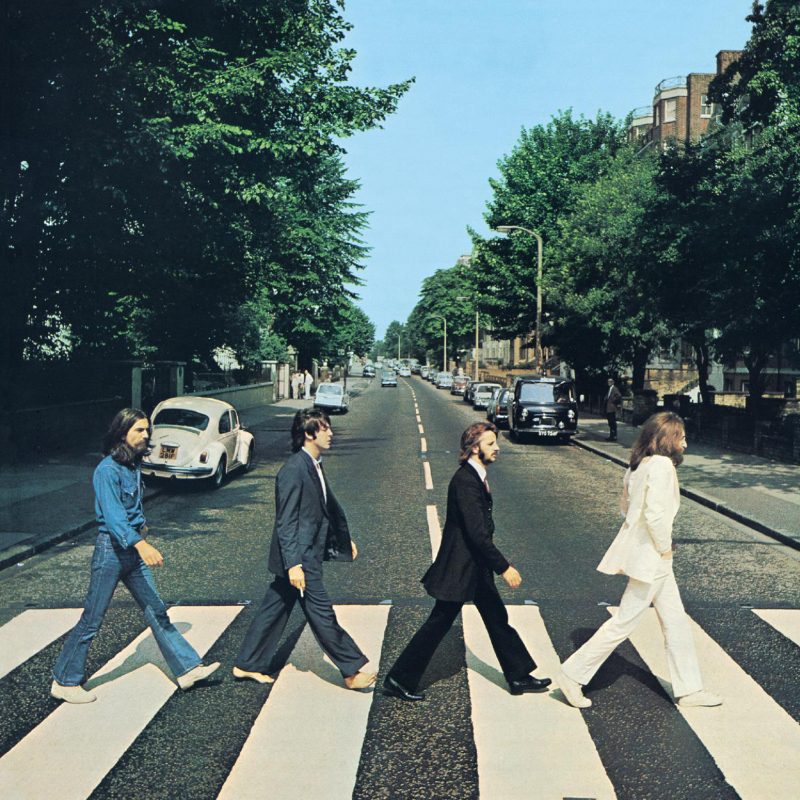
The last album the Beatles recorded, made in 1969 by a band that was, the evidence says, planning its next one. Their best-made record, if not their boldest.
- Released
- 26 September 1969 (UK, Apple PCS 7088); 1 October 1969 (US, Apple SO-383)
- Label
- Apple (manufactured by EMI in the UK, Capitol in the US)
- Producer(s)
- George Martin; Chris Thomas and Glyn Johns produced individual sessions
- Runtime
- 47:03
- Chart peak (US)
- #1 (Billboard 200), 11 weeks at the top in three spells, interrupted twice by Led Zeppelin II
- Chart peak (UK)
- #1 (Official Albums Chart), 17 weeks at the top in 1969–70 and one more in October 2019
- Certifications
- RIAA 12× Platinum (Diamond, 2001); BPI 8× Platinum (2021); Music Canada Diamond
- Awards & honours
- Grammy for Best Engineered Recording, Non-Classical (Geoff Emerick and Phil McDonald, 1970); Grammy Hall of Fame (1995); #5 on Rolling Stone's 500 Greatest Albums (2020)
Abbey Road is remembered as a farewell. A tape from September 1969 says otherwise, and so does the music: a band at the height of its craft, polishing what it already knew rather than saying goodbye.
On 8 September 1969, a fortnight after the last Abbey Road session, John Lennon, Paul McCartney and George Harrison met at Apple's offices in Savile Row. Ringo Starr was in hospital, so Lennon taped the meeting for him. They talked about the next Beatles album. Lennon proposed four songs each from himself, McCartney and Harrison, two from Starr, and a Christmas single. McCartney admitted that until this album he hadn't thought much of George's songs. Mark Lewisohn brought the tape to light in 2019 and put it plainly. The books always said the Beatles knew Abbey Road was their last album. Here they were, discussing the next one.
That changes how the record should be heard. For half a century Abbey Road has been the Beatles' goodbye, with the side-two medley as a farewell suite and 'The End' as a curtain line. It wasn't made as any of those things. Four professionals had just come through the misery of the Get Back sessions. They wanted to make a record properly again, with George Martin in charge. As far as the evidence goes, they assumed there would be more. So what you hear isn't an elegy. It's craft at the highest level the band ever reached, on their most refined record, if not their most inventive.
The background is real enough. The Get Back sessions of January 1969, filmed at Twickenham and then in the Apple basement, went badly. Harrison walked out on 10 January and only came back after meetings. On 3 February the others appointed Allen Klein to run their affairs, over McCartney's objection. On 8 May Lennon, Harrison and Starr signed Klein's contract, and McCartney refused. The Get Back tapes were shelved. Then McCartney rang George Martin. In Martin's account to Lewisohn, Paul asked whether he'd produce another record, really produce it. Martin said yes, if he was really allowed to. In the Anthology version the condition is sharper: only if they let him produce it the way they used to.
It wasn't made in one summer, either. The first song recorded for the album was 'I Want You (She's So Heavy)', at Trident in Soho on 22 February 1969. Glyn Johns produced, and Billy Preston played organ. There were sessions at EMI in April and May, and at Olympic in Barnes, where Harrison recorded his solo for 'Something' on 5 May. The main block began on 1 July in EMI's Studio Two, booked every afternoon and evening until the end of August. McCartney worked alone that first day. Lennon had crashed his car in the Scottish Highlands and was in hospital in Golspie. When he came back on 9 July, Harrods delivered a double bed to the studio for the injured, pregnant Yoko Ono. A microphone hung above it. The last time all four Beatles were in a studio together was 20 August, when they put the songs in order.
What they built there is the best-sounding record they made. Abbey Road Studios calls it the only Beatles album recorded and mixed entirely on the TG12345, EMI's first transistor desk. Geoff Emerick said you could hear the difference. The new desk couldn't make the warm distortion of the old valve consoles, and it gave a smoother, mellower sound. Eight-track tape let Emerick record Starr's kit in stereo for the first time, with a compressor on every channel. McCartney later said they'd thought eight tracks were too many. Starr credited new calf-skin drum heads for the album's tom-heavy sound. 'Come Together' makes the case on its own. McCartney asked for it slower and swampier, and played the bass line that carries it. Its backing track was even cut on four-track and copied across to eight.
The best songwriting belongs to the Beatle whose songs McCartney had just admitted underrating. 'Something' and 'Here Comes the Sun' are the two best songs on the album. Harrison wrote 'Something' on a piano in an empty studio during the White Album sessions. The band tried it in April and remade it in May, then added the vocal in July and the strings in August. Released with 'Come Together', it was the first Beatles A-side Harrison wrote. He wrote 'Here Comes the Sun' in Eric Clapton's garden in Ewhurst, Surrey, on a day he skipped work at Apple. It was mixed slightly fast, at 51 cycles rather than 50, which lifts it by about a quarter of a tone. By October 2026 it had 1.94 billion plays on Spotify, more than any other Beatles recording.
Lennon's songs pull the other way, towards repetition and noise. 'I Want You (She's So Heavy)' runs 7:47, but Lennon stops singing at 4:35. The last 3 minutes are one riff. It thickens as massed guitars, Preston's organ and Lennon's own Moog white noise pile up, until the tape is cut dead. That ending was an edit, not an accident: on 20 August Lennon told the engineer to cut the tape there. 'Because' is the opposite. Lennon, McCartney and Harrison sang three-part harmony three times over, which Martin called nine-part harmony, above his electric harpsichord. The chords came from Beethoven's 'Moonlight' Sonata, which Lennon asked Yoko Ono to play backwards. McCartney's 'Oh! Darling' is his best vocal on the record. He tried it once a day for a week, so that it would sound as though he'd been singing it on stage all week. Lennon said in 1980 that he should have been allowed to sing it.
The album's weaknesses are on side one. 'Maxwell's Silver Hammer' is the Beatles at their most insufferable: a jaunty song about a murderer that McCartney drove the band through over three days in July. Lennon said in 1980 that he hated it. Harrison called it 'so fruity', and Starr called it the worst session ever. Ian MacDonald went further. If any single recording shows why the Beatles broke up, he wrote, it's this one. On the September tape, Lennon told McCartney that nobody had liked it, and suggested songs like it should go to other artists. 'Octopus's Garden' is charming and slight. Side one is a collection of songs by four writers, and it sounds like one.
Side two is why the album is famous, and it's built from leftovers. The idea was in place by 6 May, when 'You Never Give Me Your Money' was recorded at Olympic with an abrupt ending so something could follow it. Most of what followed was old. Lennon dismissed his own contributions, 'Sun King', 'Mean Mr. Mustard' and 'Polythene Pam', as rubbish he'd written in India. In 1980 he called the whole sequence unfinished songs stuck together. The pieces were recorded in pairs. One join is a set of tape loops McCartney made at home: bells, birds and crickets. Another works because two songs share a key. And 'Carry That Weight' brings back the melody of 'You Never Give Me Your Money'. It isn't the first rock suite. The Who, the Small Faces and Procol Harum got there first, and Ian MacDonald says McCartney's own model was Keith West's 'Excerpt from A Teenage Opera'. But it's the best one, because the editing turns fragments into momentum. Starr's 13-bar drum solo, his only one with the band, gives way to McCartney, Harrison and Lennon trading guitar lines, taped in one take on 7 August. Then the record ends on a couplet McCartney said he wrote because he'd followed the Bard.
The farewell reading came later, and it's easy to see why. 'Her Majesty' is 23 seconds of McCartney alone. It was cut from the medley on 30 July and survived only because the tape operator, John Kurlander, had been told never to throw anything away. McCartney heard it on the lacquer and liked it at the end. On 20 September Lennon told McCartney and Starr he was leaving, and in April 1970 McCartney made the split public. An album that closes on a couplet about love, then a short song to the Queen, was always going to sound like a goodbye once the band had gone. Martin's version is the honest one: nobody knew for sure it would be the last album, but everybody felt it was.
It wasn't universally received as a triumph, either. Rolling Stone ran two reviews in November 1969. Ed Ward complained that the Moog made the sound artificial and the medley was overproduced. John Mendelsohn raved. In the New York Times, Nik Cohn called the medley the best music they'd made since Rubber Soul. He also dismissed Harrison's songs as mediocrity incarnate, the verdict history has reversed most completely. Robert Christgau reported that everyone was putting it down, before he came round to it himself. Its standing grew later. It was #14 on Rolling Stone's 500 Greatest Albums in 2012 and #5 in 2020, the highest of any Beatles record. In October 2019, 50 years after its first run, it went back to #1 in Britain.
Heard without the farewell story, Abbey Road is the Beatles' most accomplished album rather than their most adventurous. Revolver and the White Album took bigger risks. This one does what they already knew how to do, better than they'd ever done it, on the best equipment EMI owned. Its high points are Harrison's two songs and the second half of side two. Its low point is 'Maxwell's Silver Hammer'. And its sound is why it still feels modern next to records half its age. This is a band at the top of its craft, planning its next record. It's better understood that way than as an ending.
Pressing guide — the one to own
The original to own is the 1969 UK Apple PCS 7088, in a single laminated sleeve rather than a gatefold. The labels are dark-green Apple, with a whole apple on side one and a sliced apple on side two. First pressings have the matrix numbers YEX 749-2 and YEX 750-1. The earliest labels don't list 'Her Majesty'; it was added during 1969, and it never appeared on the UK back cover. A sleeve with the Apple logo misaligned on the back is often sold as the true first. But aligned copies with first-issue labels exist too, and collectors report owning more of them.