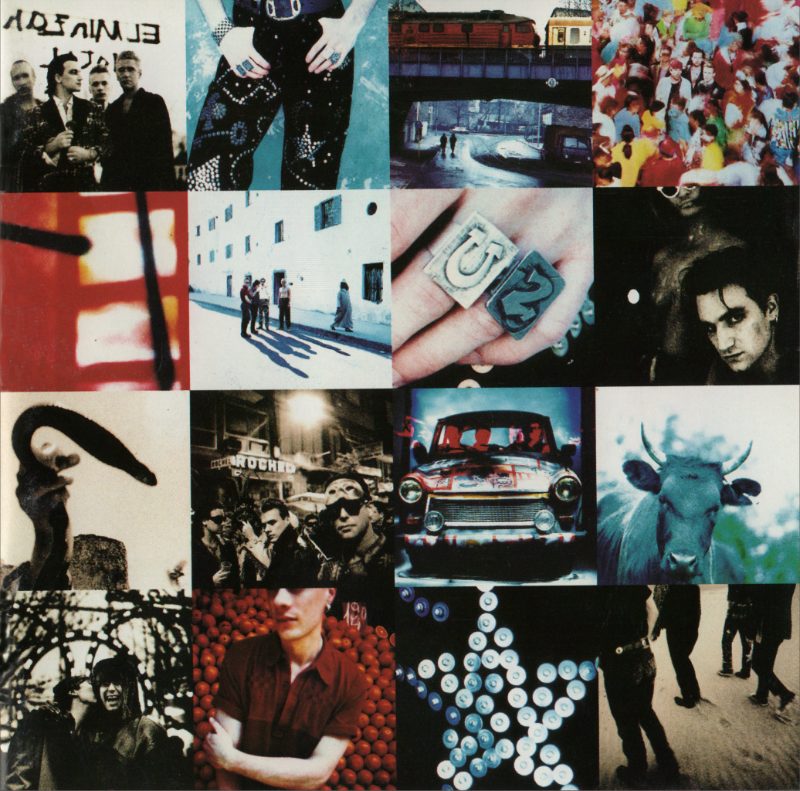
U2's seventh album, from November 1991, traded sincerity for noise and irony. It was mostly made in Dublin, not Berlin, and its best songs are old-fashioned torch songs.
- Released
- 18 November 1991 (UK, Island); 19 November 1991 (US, Island)
- Label
- Island Records
- Producer(s)
- Daniel Lanois (all tracks); Brian Eno (tracks 2–5, 8–10); Steve Lillywhite (track 5)
- Runtime
- 55:27 (12 tracks)
- Chart peak (US)
- #1 (Billboard 200, chart dated 7 December 1991), 1 week at the top
- Chart peak (UK)
- #2 (Official Albums Chart, 24–30 November 1991), behind Michael Jackson's Dangerous
- Certifications
- RIAA 8× Platinum (October 1997); BPI 4× Platinum (March 2001)
- Awards & honours
- Grammy for Best Rock Performance by a Duo or Group with Vocal (1993), and an Album of the Year nomination. Eno and Lanois shared Producer of the Year
The reinvention was real, and it was a disguise. Under the noise and the Berlin legend are some of the most traditional songs U2 ever wrote. They're why it has lasted, and where they thin out, on side two, the noise can't hide it.
For the first minute of 'Zoo Station', nobody sings. Adam Clayton has said the band wanted people's first thought to be that the record was broken. In November 1991 that was a joke with a target. U2 had spent the late 1980s as rock's band of open roads and plain sincerity, and they'd been mocked for it. Now the first thing their new album did was sound faulty.
The noise was a disguise, and a very good one. Achtung Baby is remembered as the record where U2 tore themselves down and came back colder and more European. Under the distortion, though, are some of the most traditional songs they ever wrote: torch songs and love songs, with one great ballad among them. The disguise made the record a sensation. The songs are why it has lasted. Even its legend is a costume. It's sold as a Berlin album, but most of it was made in a rented house in Dalkey that the sleeve calls Dog Town.
The reason for the disguise was Rattle and Hum. The 1988 album sold 14 million copies, and critics called it and the film pretentious and bombastic. Larry Mullen Jr.'s verdict on the period was that U2 had become the biggest band, not the best one. On 30 December 1989, at the Point Depot in Dublin, Bono told the crowd it was the end of something. The band, he said, had to go away and 'dream it all up again'. Two side projects in 1990 showed where they might go. Their version of 'Night and Day' for Red Hot + Blue was their first use of dance beats. Bono and the Edge wrote music for the Royal Shakespeare Company's A Clockwork Orange.
The pair had also started writing without Adam Clayton and Mullen, and their listening had moved on. The Edge was playing Einstürzende Neubauten, Nine Inch Nails and KMFDM. Mullen was listening to Cream, Blind Faith and Hendrix, and felt the drum machines left him with less to do. You can hear that split all over the finished album. It's a rock band's record with a dance record's ideas pressed into it, and the friction between the two gives it its grain.
They flew into Berlin on the eve of German reunification, on the last flight into the East. In the band's own telling, they went looking for the celebrations and joined a march that turned out to be a Communist protest against unification. The sessions at Hansa went about as well. They worked in the Meistersaal, a former ballroom the band found oppressive. The studio had been so neglected that Brian Eno and Daniel Lanois had to import recording equipment. Nobody could agree on a direction. At one point Clayton offered Bono his bass and told him to play it himself. Bono and Lanois nearly came to blows over the jam that became 'Mysterious Ways'. After 6 to 8 weeks the band had two songs and were talking about splitting up.
One of the two was 'One', and nobody planned it. The band were working on a jam called 'Sick Puppy' when the Edge played two separate chord sequences back to back. Lanois urged them on, and the song came together quickly. Bono said in the 2011 film From the Sky Down that making this album is the reason U2 still exists. Clayton put it more bluntly: if the record hadn't been great by their own standards, the band's future would have been in doubt. Over Christmas 1990 they talked it through at home, heard the Berlin tapes again, and found them better than they'd thought.
The record itself was made in Dublin. From February to July 1991 U2 rented Elsinore, a house in Dalkey, for £10,000 a month. The recording room was a converted garage, linked to the control room by TV monitors. Sound on Sound's 1994 account of the sessions says Lanois pushed performances to the point of recklessness. Nothing was erased. Overdubs went onto a separate digital tape locked to the 24-track, so every idea stayed on hand. Bono found his character, The Fly, in that house. 'The Fly', 'Ultra Violet' and 'Zoo Station' all came out of a long fight with another song, which ended up as the B-side 'Lady with the Spinning Head'.
Eno's job was to come and go. He worked a week at a time, then stayed away for a month or two so he could hear the work fresh. His stated aim was to erase anything that sounded too much like U2. Sent tapes of the early Dublin work, he called them a total disaster, then joined the band and stripped away overdubs. Later, at a crisis a month before the deadline, he made them take a 2-week holiday. The mixing at Windmill Lane became a contest. Lanois and Flood worked at one desk, Steve Lillywhite and Robbie Adams at another, and the band picked from the rival mixes. The Edge reckoned half the work was done in the last 3 weeks. The guitar overdub on 'Mysterious Ways' went on after its mix was finished. The deadline was 21 September 1991.
All that labour bought the sound, and the sound is the record's greatest strength. The Edge gave up the chiming, echoing guitar that had been U2's signature. In its place came feedback, dissonance and solos. A DigiTech Whammy, a pitch-shifting pedal, is what turned 'Even Better Than the Real Thing' around. Its title doesn't arrive until 1:07. Albin Zak, in his book The Poetics of Rock, hears Mullen's drums on 'The Fly' and 'Zoo Station' as cold and processed, like a tin can. Bono drops into a lower register and sings through a distortion pedal. Bono described 'Mysterious Ways' as Sly and the Family Stone meeting Madchester. Its groove runs for 20 seconds before he comes in, long enough to test the comparison for yourself.
Strip the sound away, though, and what's left is old-fashioned. The Irish critic Niall Stokes traces the slow songs to Roy Orbison, Scott Walker and Jacques Brel. 'One' hides nothing. Bono is singing by 0:14 and has sung the title by 0:29. 'So Cruel' runs almost 6 minutes, and from 10 seconds in the singing never stops for long. Nell Catchpole plays its strings, arranged by Eno and the Edge. Robert Hilburn, reviewing the album for the Los Angeles Times in November 1991, ranked 'So Cruel' and 'Until the End of the World' with the best things U2 had done. 'Love Is Blindness' closes the record in the same register. Bono's last line comes at 3:12, and the minute after it has no lead vocal. Bill Wyman, in Entertainment Weekly, likened the song's guitar to a dentist's drill.
The weakness sits right next to the strength. Take the disguise away and the second side has fewer great songs than the first. After 'Mysterious Ways', two of the last four tracks go back over moods the first side has already set. 'Tryin' to Throw Your Arms Around the World' is pleasant and slight. Wyman heard warmth in it, and he was right, but warmth is all it has. On 'Acrobat' Bono doesn't come in until 0:45. He sings the title only twice, and 43 seconds of the middle have no lead vocal. Even Wyman, who gave the record an A, called the song formless and overwrought. Between those two sits 'Ultra Violet', which he thought the album's standout. It isn't quite that, but it's the song that keeps the side afloat. Robert Christgau listed the album among his duds in the Village Voice in 1992, and two years later still found it diffuse. As a verdict on the whole record he was wrong. As a description of those two songs, he had a point.
None of that slowed it down. Achtung Baby entered the Billboard 200 at #1 on the chart dated 7 December 1991, with 295,000 copies sold in its first week. No U2 album had entered there at #1 before. In Britain only Michael Jackson's Dangerous kept it off the top. The BPI had certified it Platinum before it reached the shops. The Zoo TV tour that followed ran from February 1992 to December 1993: 157 shows, 5.3 million tickets and a reported US$151 million. In 1993 the album won the Grammy for Best Rock Performance by a Duo or Group with Vocal. Bill Flanagan, in his 1996 book on the period, argued that U2 had made themselves the first of the new groups instead of the last of the old.
Its influence on other musicians is harder to pin down, and smaller than its reputation. Spin named it the best album of the 25 years to 2010. Rolling Stone's list of the 500 greatest albums has moved the other way, from #62 in 2003 to #124 in 2020. Few later records lead back to it directly. Its clearest heirs are U2's own: Zooropa, made in a break from the Zoo TV tour, and Pop, which took the dance turn furthest. When Q had Jack White, Depeche Mode, Nine Inch Nails and others cover it in 2011, that was a tribute, not a family tree. What the record changed most was U2's chance of lasting.
In 2023 U2 opened their Las Vegas residency at Sphere and named it after this album. Its 40 shows took US$244.5 million, according to Pollstar, more than 30 years after the record came out. That's a measure of the reputation, not of the record. The record is the best-made one U2 have released, and the production still sounds strange and expensive in the right places. Its finest songs, 'One', 'So Cruel' and 'Love Is Blindness', stand with anything they wrote. Its second side thins out, and its legend leans on a city where it was only begun. Play the first side, then 'The Fly', 'Mysterious Ways', 'Ultra Violet' and 'Love Is Blindness', and you'll hear a band that saved itself by pretending to be someone else.
Pressing guide — the one to own
The original to own is the 1991 European LP, Island U28 / 510347-1: a single sleeve with a picture inner sleeve and a separate lyric insert. The first issue prints the uncensored nude of Adam Clayton on the back, and initial copies came with sixteen 12-inch prints of the cover photographs. Its runouts carry American lacquer numbers (314-510-347-1). Its plates were made at Specialty Records Corporation in the US, from the same A&M lacquer series as the American pressing.