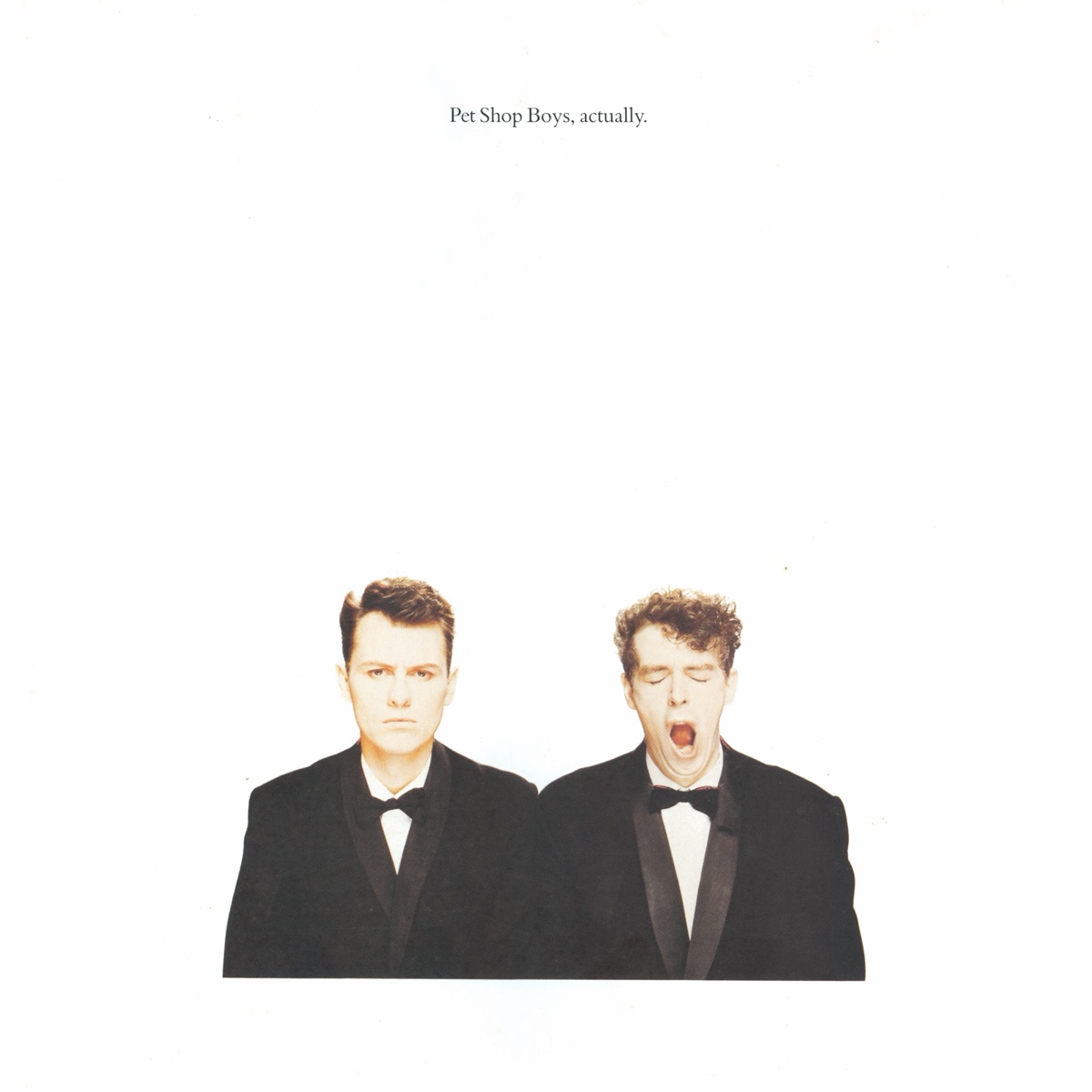
Pet Shop Boys' second album has two men in dinner jackets on the front and ten songs about money, sex and waiting inside. Its weight was built in the studio.
- Released
- 7 September 1987 (UK, Parlophone)
- Label
- Parlophone (UK and Europe); EMI-Manhattan (US and Canada)
- Producer(s)
- Julian Mendelsohn, Stephen Hague, David Jacob, Shep Pettibone, Andy Richards and Pet Shop Boys
- Runtime
- 47:49 across 10 tracks
- Chart peak (US)
- #25 (Billboard Top Pop Albums, week of 21 November 1987)
- Chart peak (UK)
- #2 (Official Albums Chart, week ending 19 September 1987), behind Michael Jackson's Bad
- Certifications
- BPI 3× Platinum (28 April 1988); RIAA Gold (23 November 1987)
- Awards & honours
- Nominated for British Album at the 1988 Brit Awards, where Pet Shop Boys won British Group. Julian Mendelsohn was nominated for Producer of the Year
Actually is remembered as Pet Shop Boys' serious album. Much of it was old material, and its biggest hit began as a camp joke. Five producers made those songs sound like verdicts, which is both its triumph and its limit.
In 2009 Neil Tennant told Andrew Sullivan that 'It's a Sin' was written “in about 15 minutes, and was intended as a camp joke”. In the same answer he wondered whether there had been more to it than he thought at the time. Listeners didn't take it as a joke. Released on 15 June 1987, it spent 3 weeks at #1 in Britain that July. St Cuthbert's, the Catholic grammar school in Newcastle that Tennant had attended, complained to the Evening Chronicle. A Newcastle parish priest preached a sermon on it. A song its writer thought of as a joke ended up as the text for a homily.
That gap is the way into Actually. The album is usually heard as the moment Pet Shop Boys got serious. It's ten songs about money, sex, faith and Thatcher's Britain, under a sleeve of two men in dinner jackets. Some of that seriousness is in the writing. A good deal more was put there in the studio. Five producers and a team of programmers made old, sometimes light songs sound like verdicts. Actually is a superbly made pop record. It's also less radical than its reputation, and its singer is the weakest thing on it.
Much of the album was old stock. Tennant has dated 'It's a Sin' to 1982, written at Ray Roberts' studio in Camden. 'Rent' came in 1984, while he was still a journalist at Smash Hits. 'One More Chance' had been released as a single that year, produced by Bobby Orlando, whose name stays on the writing credit. 'Heart' was begun during the sessions for Please. 'What Have I Done to Deserve This?' was written with the American songwriter Allee Willis around the turn of 1985, and was first meant for Please as well. None of that is a fault in itself. It does mean this is a second album assembled partly from the first one's drawer, then dressed for the year it came out in.
What was new was where Tennant aimed. He talked the album through with Smash Hits that September, and he was precise. 'Shopping' began with Chris Lowe singing the title spelled out, letter by letter, as he did the shopping. Bobby Orlando had built songs that way. Tennant pointed it at the sale of the nationalised industries and the 'Tell Sid' adverts for British Gas shares. The voices in it, he said, belong to City share-dealers, not to him. The interviewer, Tom Hibbert, called 'Rent' a mercenary love song, and Tennant took up the phrase, calling it “a kind of mercenary love song”. 'King's Cross', he said, was “about people waiting”: in the dole office, for a train, for things to get better. Chris Heath's sleeve notes later have him calling the album loosely a critique of Thatcherism. Loosely is the right word. These are sketches of people inside a system, not arguments about it, and they work because nobody in them raises their voice.
The bigger change was in how it was made. Julian Mendelsohn produced half the album, five tracks, in Studio 2 at Sarm West in Notting Hill. The room had a 48-channel SSL desk and a Mitsubishi 32-track digital recorder. His tracks took 8 or 9 weeks to record and mix, and he kept them all moving at once. “We never laboured on any track for more than a few hours,” he told Sound on Sound in 2010. Tennant and Lowe would leave at 7 or 8 in the evening with a list of jobs. Mendelsohn and the programmers worked through it, and the duo gave their verdict in the morning. It's close to a factory method, and you can hear it in the finish. Nothing on Actually sounds worried over, even where a great deal was piled on.
'It's a Sin' shows the method at full stretch. They began with the bass line and drums, cut a guide vocal and built up from there. Andy Richards, who had done much of the programming on Frankie Goes to Hollywood's 'Relax', made the thunder on a Roland keyboard. Mendelsohn took a Nagra tape recorder to the Brompton Oratory, and thinks that may be where the Catholic mass on the record came from. “The whole overblown production style was them telling me they wanted it overblown,” he said. Then Stephen Hague was given a go at the mix, and his version was the one released. Hague dropped half a bar halfway through each verse, for what Mendelsohn called a turnaround effect. Mendelsohn still thought his own mix sounded fatter. He also admitted it got a bit boring halfway through. A camp joke became a storm because Mendelsohn and Richards kept adding to it, and Hague knew where to cut.
The best song on the record took the oddest route. In 1987 Tennant called 'It Couldn't Happen Here' probably the album's highlight, a song about how complacent people can be. In 2018 he tied its title to the early belief that AIDS wouldn't do much harm in Britain, and to his friend Christopher Dowell. Heath's notes tell how it was built. The duo asked Ennio Morricone to arrange another song, 'Jealousy'. Morricone sent back an Italian song of his own. They kept the music of its chorus and wrote a new verse, and Morricone's name went on the writing credit. In 1987 Tennant credited Lowe with the song's chord changes. Angelo Badalamenti, already known for his music for Blue Velvet, wrote an orchestral arrangement. Then Blue Weaver programmed it into a Fairlight in place of an orchestra. The sleeve still credits Badalamenti with arranging an orchestra that never played. That's the album's trick in one track: machines doing a session orchestra's job, and mostly getting away with it.
'What Have I Done to Deserve This?' needed a second singer, and about two years passed before one recorded it. Tennant and Lowe wrote it with Willis as a duet before anyone knew who would sing the other part. Tina Turner was suggested. Then someone in their office suggested Dusty Springfield. She turned it down at first, then agreed, and recorded her part in London in December 1986, aged 47. Hague produced it and spent a week or two on it before Mendelsohn mixed it with fresh ears. Mendelsohn, who worked with her again later, remembered a great singer who was slow to satisfy herself. The single reached #2 in Britain in August 1987, held off by Rick Astley's 'Never Gonna Give You Up'. It reached #2 in America in February 1988. The duo went on to produce for her again, including 'Nothing Has Been Proved' for the 1989 film Scandal. On Actually, though, the best vocal belongs to a guest.
That's the record's real limit. “In those days, Neil wasn't a great singer and he knew it,” Mendelsohn said in 2010, and getting his vocals right took work. In 'Shopping' and 'Rent' that hardly matters. The speaker is a dealer or a kept lover, and coolness is the point. Elsewhere the production has to do more of the work. Two tracks show it. 'I Want to Wake Up', the one track Shep Pettibone produced, runs nearly 2 minutes past its last sung line at 3:14. 'Hit Music' is a club track about the pop business. The band likened its opening to a 1960s spy theme, and Heath links it to the Art of Noise's 'Peter Gunn'. It says less than anything else here. Connie Johnson's review in the Los Angeles Times found the album “a tad soulless”, and only two of its tracks interesting. That's too harsh by a distance. But the middle of the record does run on production more than on songs.
The record also kept gaining meanings after it left the studio. 'King's Cross' had been in the shops for 10 weeks when fire killed 31 people at King's Cross station on 18 November 1987. The Sun then campaigned for the song to be released as a charity single. Tennant has since said it's about the people Thatcherism failed, and in 1987 he described it with no disaster in it at all. Section 28 received Royal Assent on 24 March 1988. That June the duo played 'It's a Sin' at Before the Act, a benefit against it at the Piccadilly Theatre. In 2021 Russell T Davies named his Channel 4 drama about the AIDS years after the song. Each of these is a real part of the songs' lives. Together they've made the album sound braver in hindsight than its makers claimed at the time.
At home it was enormous. It entered the UK chart at #2 behind Michael Jackson's Bad and stayed on the chart for 58 weeks without a break. The BPI certified it 3× Platinum on 28 April 1988, a level no other Pet Shop Boys album has reached. In September 1988 Music & Media reported that it had sold more than a million copies in Britain. America was cooler: #25 on Billboard's album chart and a Gold disc, with more than 750,000 sold by May 1988. Lowe conceded to the Los Angeles Times that the duo lacked an identity there. British critics were warmer. Mat Snow in Q called it “1987's most intelligent, bittersweet mainstream pop album”. Robert Christgau gave it an A− in the Village Voice. The sound travelled too. In 1989 the duo and Mendelsohn produced Liza Minnelli's Results, and it reached #6 in Britain. In 2020 Rolling Stone placed Actually at #435 in its list of the 500 greatest albums.
So what is it worth now? The songwriting is very good, and in four songs better than that: 'It's a Sin', 'What Have I Done to Deserve This?', 'It Couldn't Happen Here' and 'King's Cross'. The production is the reason it lasts. It sounds expensive while being built largely from machines, and that's a real achievement. But it isn't the fearless state-of-the-nation album its reputation describes. It's a set of sharp, often older songs, finished by a studio working at its peak and sung by a man still learning to sing them. 'Hit Music' and 'I Want to Wake Up' coast. Admire it, play the best of it often, and don't mistake the polish for the courage it's now credited with.
Pressing guide — the one to own
The British original is Parlophone PCSD 104, which also carries a second catalogue number, 74 6972 1. Its runouts are stamped in the PCSD 104 family, and 18 variants are documented with no known order, so no first state can be pinned. The sleeve code is SP8709JU, and the sleeve was printed by James Upton. The German pressing carries the same 74 6972 1 number. It's a second original for continental Europe, made by EMI Electrola, not a lookalike. The real test of a copy is the white sleeve, which shows every mark.