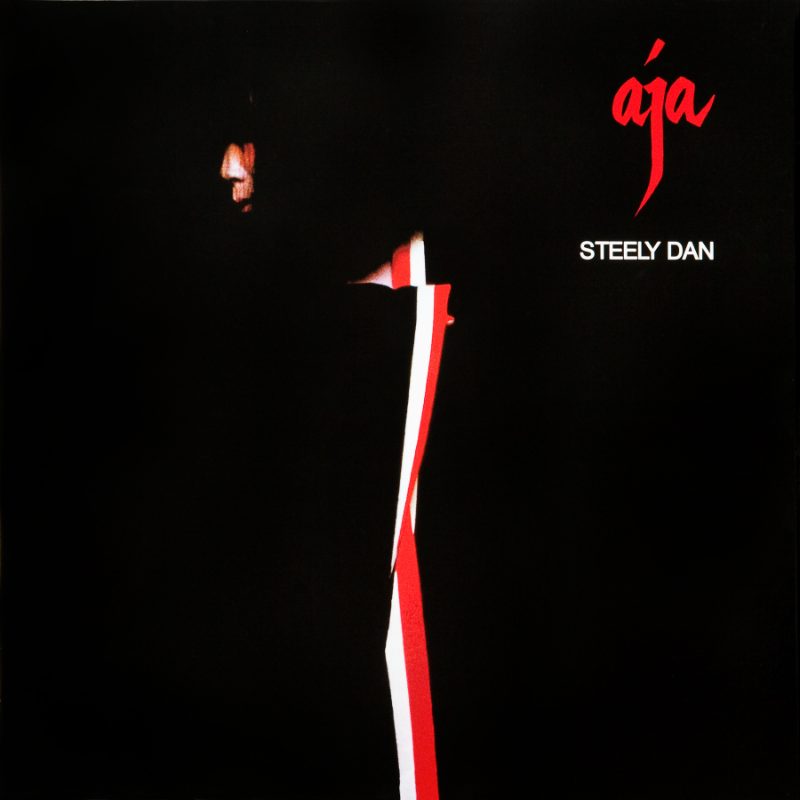
Steely Dan's sixth album, made with 35 hired musicians and singers. The legend says endless retakes. Most of the basic tracks were played live, and briskly, on union hours.
- Released
- 23 September 1977 (US, ABC Records)
- Label
- ABC Records (US, AB-1006; later copies AA-1006) · ABC (UK, ABCL 5225, marketed by Anchor Records)
- Producer(s)
- Gary Katz
- Runtime
- 39:31 (7 tracks, US label timings)
- Chart peak (US)
- #3 (Billboard Top LPs & Tape)
- Chart peak (UK)
- #5 (UK Albums Chart, 15 October 1977)
- Certifications
- RIAA 2× Platinum (September 1993); Music Canada 2× Platinum (November 1978); BPI Gold (March 2022)
- Awards & honours
- Grammy for Best Engineered Recording, Non-Classical (23 February 1978: Roger Nichols, Elliot Scheiner, Al Schmitt, Bill Schnee); nominated for Album of the Year; Library of Congress National Recording Registry (2010)
Aja is famous for perfectionism, but most of its basic tracks were cut fast by session players in a small Hollywood room. Months of overdubs gave it the sound that made it a hi-fi demonstration record. Its main weakness is the writing at the end of side two.
At the end of Steve Gadd's first day on the Aja sessions, the engineer Bill Schnee passed Walter Becker and Donald Fagen in a corridor. He heard one of them say, "No, I didn't care for him either." Gadd had just cut 2 songs. Asked what was wrong, one of them told Schnee that Gadd had played fine, but his snare sat right on top of the beat. He preferred something more laid-back, like Jeff Porcaro or Jim Keltner. Schnee, telling the story to Sound on Sound in 2020, says he told them to listen to what Gadd had actually played. The next day 'Aja' was the first song on the list. After nearly 3 hours of rehearsal, the band got it in 2 takes. Of the 4 songs Gadd played for them, it's the only one on the record.
It's a useful place to start, because it cuts against the story usually told about Aja. That story is perfectionism. Brian Sweet's essay for the Library of Congress says each song was recorded "countless times", with at least 6 or 7 different drummers or line-ups. Schnee, who engineered almost all the basic tracks, remembers something else. Union rules meant 3-hour sessions, which generally started at 2pm and never went late into the night. "This was more like a band," he said, and the work moved "really briskly". The two accounts can both hold, because they describe different stages. The basic tracks were mostly played live and fast by great players reading Larry Carlton's charts. The obsession came afterwards, in the overdubs and the mix. Both stages earned their place: the first gave Aja its life, and the second its famous shine. The record's main weakness lies somewhere else, in the writing of 2 of its 7 songs.
The method was already 3 years old. Steely Dan played their last show as a touring band in Santa Monica on 5 July 1974. Becker told Rolling Stone's Cameron Crowe it was unfair to spend 8 months writing and recording while others in the group wanted to tour. From Katy Lied in 1975, Becker and Fagen wrote the songs and their producer, Gary Katz, hired the players. Carlton had been turning their writing demos into charts since that album. By 1977 Becker could say it wouldn't bother him at all not to play on his own record. So Aja didn't invent the session-player Steely Dan, whatever its reputation suggests. What changed was the reach. Katz told Schnee the sessions would be a "drug-free zone" with "a rotating list of drummers". The songs got longer, and Becker later called the record "dangerously ambitious".
The title track is where the ambition pays off. 'Aja' runs nearly 8 minutes, and from about 2:07 the singing stops for 4 of them. Anthony Robustelli and Sweet both trace part of that middle to 'Stand by the Seawall', an instrumental older than the band. It holds guitar solos by Denny Dias and Becker, a synthesiser solo by Fagen, and Wayne Shorter on tenor saxophone with Gadd playing underneath. That exchange sounds like a conversation, but it was built in stages. Gadd played his part on the tracking date, with nothing yet to answer. Shorter came later, to the Village Recorder. He'd already turned down one approach, so Dick LaPalm, who ran the studio and had known him for years, rang him himself. LaPalm remembers 6 passes, 35 minutes and Becker and Fagen splicing the passes into one solo. Don Breithaupt's account of the session differs: half an hour of scales at the piano, then 3 or 4 takes. Gadd's solo closes the track, about a minute of it after the last vocal. The record's famous duel is a live take with a reply stitched on, and it works because the live part came first.
'Peg' shows the other half of the method. An early version with Gadd was dropped. Sound on Sound says the released one was recut faster at the Village with Rick Marotta on drums, though Sweet places 'Peg' in New York. Then came the hunt for a guitar solo. Becker tried first, then Robben Ford, Elliott Randall and Rick Derringer, among others. Jay Graydon, by his own count the seventh guitarist, told Newsweek he spent about an hour and a half on his melodic jazz style before Fagen told him to play the blues. The whole session took 4 or 5 hours, breaks included, though Fagen remembers him essentially knocking it off. What they were hunting for, on that account, was less cleverness, not more. The solo sits in the break that opens at 1:23. It's the record's catchiest stretch, and it was found by elimination.
'Deacon Blues' is the album's heart, and its credits show how freely the casting worked. Chuck Rainey plays bass on 6 of the 7 songs. Here the bassist is Becker, with Bernard Purdie on drums. Pete Christlieb, a tenor player in the Tonight Show band, came over one evening after a taping. By his own account he recorded 2 takes and was gone in half an hour. His first solo fills the break that opens at 3:46, and he plays again over the long fade. Sweet hears the song as a musical version of Norman Mailer's essay 'The White Negro'. Robert Christgau admitted in the Village Voice that he'd hated the album at first. He gave it a B+ and picked out 'Deacon Blues' as one of the band's strongest and warmest songs. He was right about that.
'Home at Last' is the floor at its best. Told that Becker and Fagen didn't want a Motown or a Chicago shuffle, Purdie offered what he called the Purdie Shuffle. It carries a song built on Homer's Odyssey, and Becker's guitar solo rides on it from about 2:40. It's also where the second stage went furthest. Dick LaPalm recalls the assistant engineer Lenise Bent asking to come off the sessions. They'd spent 6 hours the night before on the first 2 words of one line. On release day Fagen told Crowe they'd spent most of the year recording. Becker supplied the detail: "We overdubbed a lot of the overdubs over." You can't hear those hours on 'Home at Last', only the result, which is the point of spending them.
The overdubbing didn't spoil the sound, and the reason is the first stage. Even some solos were cut on the floor: Robustelli says Victor Feldman's electric-piano solo on 'Black Cow' went down live with the basic track. Schnee recorded the room tight, with close microphones on the drums and none in the room. Rainey's bass went straight into the desk. Months later, Schnee tried mixing the album and withdrew after a day. Elliot Scheiner mixed it instead, nearly all of it at A&R Studios in New York, with Neve's NECAM automation. When Dave Lockwood compared a tape of the tracking session with the album, he found the drum solo and ending of 'Aja' came from a single take. All four engineers shared the Grammy for best engineered recording. Sound on Sound says Aja stayed the hi-fi demonstration record of choice until Fagen's The Nightfly in 1982. That reputation rests on playing that was captured cleanly before anyone started polishing it.
The weakness is at the end of side two, and it's in the writing. 'I Got the News' was first tried in the Royal Scam sessions and rebuilt for this one. Fagen called it "basically erotic material". It has Ed Greene's drums, a tight groove and 2 guitar solos, from Carlton and Becker. What it lacks is a song worth the care spent on it. 'Josie', the closer, is better. It's played by Jim Keltner, one of the 2 drummers named in the complaint about Gadd, and Becker takes the solo. But AllMusic's Stewart Mason calls it the album's most conventional rocker, and it's hard to argue. Christgau found the solo licks on Aja too tasty. He ended his review on a worry: that the band would rather play it safe at length than risk getting something wrong, and that the habit could become their fatal flaw. On the long songs he was wrong, because the length is where they take their risks. On the last 2 songs his worry comes true. Taste stands in for an idea, and no amount of polish supplies one.
None of this held it back. Aja came out on 23 September 1977, the same afternoon as a new Rolling Stones album. Within 3 weeks it was the third best-selling album in America, behind Rumours and Linda Ronstadt's Simple Dreams. It was Steely Dan's first Top 5 album and, Crowe reported, by far their fastest seller. Their manager, Irving Azoff, had offered it to record chains at $6.98 instead of the $7.98 list price for 2 weeks. Days after release, Becker and Fagen cancelled their first tour in 3 years, and it made no difference. 'Peg', 'Deacon Blues' and 'Josie' all reached the Top 30 of the Billboard Hot 100. At the Grammys on 23 February 1978 it won for engineering and lost Album of the Year to Rumours. In Britain it reached #5 and spent 10 weeks on the chart.
Its influence is real, but narrower than its name. The clearest documented line runs through a drummer. Jeff Porcaro said the groove of Toto's 'Rosanna' drew on Purdie's shuffle from 'Home at Last', along with John Bonham and Bo Diddley. Hip-hop found the record too. De La Soul sampled 'Peg' for 'Eye Know' in 1989, and 'Black Cow' runs under Lord Tariq and Peter Gunz's 'Deja Vu (Uptown Baby)', a US #9. Then came the yacht-rock tag. Fagen hated it enough to swear at a documentary's director, though his manager licensed 6 songs to the film anyway. Critics haven't settled it either. Rob Sheffield gave it 3.5 out of 5 in The New Rolling Stone Album Guide in 2004. Rolling Stone's 500 Greatest Albums list moved it from #145 in 2003 to #63 in 2020. For Amanda Petrusich, writing in Pitchfork in 2019, it overturned her belief that polished music had to be bloodless.
So what is it worth now? Becker's phrase, "dangerously ambitious", is half right. The ambition is the long middle of 'Aja' and the slow build of 'Deacon Blues', and neither is in danger. Nor is the sound, which is the best thing about the record: months of overdubs laid on tracks mostly cut cleanly and quickly, and it still sounds alive. What Aja lacks is novelty, and a real song in every slot. The method was 3 years old by the time the record came out, and the last 2 tracks are craft without much of a song inside. That makes it a great record with 2 ordinary tracks at the end. Its first 5 songs are the best music Steely Dan made. Start with side one, and listen to the drummer they didn't care for.
Pressing guide — the one to own
The original is the 1977 US ABC pressing, catalogue AB-1006, in a glossy gatefold with a printed card inner sleeve carrying the lyrics and credits. Bernie Grundman mastered it at A&M, but his initials aren't in the runouts. The runouts read 'AB 1006 (RE-3)' with a plant letter: S for Santa Maria, T for Terre Haute, P for Pitman, all Columbia plants. Soon after release the prefix changed to AA-1006. The catalogue notes call AB an ABC price code and say the price rose $1 about 2 weeks after release. Irving Azoff told Rolling Stone his $6.98 offer to the chains ran for 2 weeks.