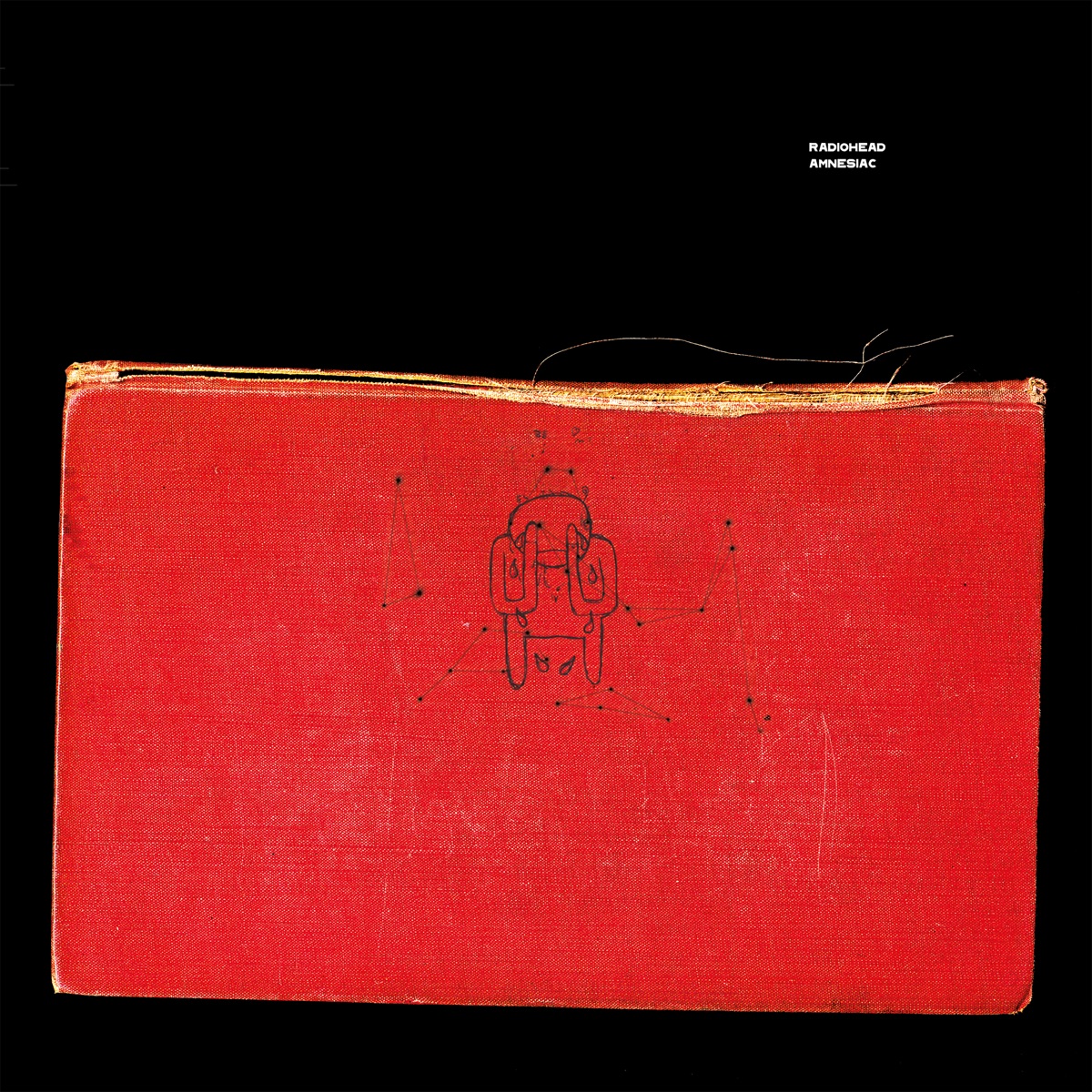
Radiohead's second album from the Kid A sessions, out in June 2001. The 'Kid B' jokes were wrong about how it was made, but not entirely wrong about how it plays.
- Released
- 4 June 2001 (UK, Parlophone); 5 June 2001 (US, Capitol); 30 May 2001 (Japan, Toshiba EMI)
- Label
- Parlophone (UK and Europe); Capitol (US); Toshiba EMI (Japan)
- Producer(s)
- Nigel Godrich and Radiohead
- Runtime
- 43:55 (11 tracks)
- Chart peak (US)
- #2 (Billboard 200), 231,000 copies in the first week, behind Staind's Break the Cycle
- Chart peak (UK)
- #1 (Official Albums Chart), 1 week at the top, 17 weeks in the top 100
- Certifications
- RIAA Gold (3 July 2001); Music Canada Platinum (26 July 2001); RIAJ Gold (May 2001)
- Awards & honours
- Grammy for Best Recording Package (2002), for the limited book edition; nominated for Best Alternative Music Album. Shortlisted for the 2001 Mercury Prize
Amnesiac wasn't scraped from the bottom of a drawer, and it holds Radiohead's best song of the period. But it never quite becomes an album. Thom Yorke admitted it was much harder to put together than Kid A, and you can hear why.
In May 2001 Ed O'Brien told Rolling Stone what Stanley Donwood had said after hearing the finished Amnesiac. Kid A, Donwood said, was like ringing someone and getting an answering machine. With Amnesiac you got through to the person. It's the best short description of the record, and it came from the man who drew its cover. O'Brien put the difference down to the singing. The vocals, he said, were so far up front that the songs engaged you. On Kid A, Yorke is often a signal buried in the machinery. On Amnesiac he's at the front of the room, and he wants to be heard.
That's the case for the record, and it's a strong one. Amnesiac has Radiohead's best song of the period and a 3-minute protest song that knows when to hold back. It ends with a jazz funeral played by a bandleader of 79. The 'Kid B' jokes that greeted it are wrong about how it was made. It's closer to the truth about how it plays. Amnesiac holds some of the finest music Radiohead have recorded, and it hangs together less well than Kid A. Both things are true. The second is why it deserves admiration rather than worship.
The music came out of about a year and a half of work with Nigel Godrich. Sessions began in Paris early in 1999, moved to Copenhagen by March and took in a stay at Batsford. From July the band rehearsed and recorded in their own studio in Oxfordshire, a converted barn. At the end of 1999 they met to decide what to do with nearly 50 pieces of music. Philip Selway told Rolling Stone they were split for 2 days. By his account Yorke wanted a double album that would clear the decks. Selway thought a double would be unpalatable. O'Brien thought OK Computer had already been a song too long. They settled on two single albums. Kid A came first, in October 2000, and Amnesiac followed 8 months later.
So there were two reasons for the split. The first was Yorke's. He told the Chicago Tribune in 2001 that the two records came from different places. Together, he said, they 'cancel each other out as overall finished things'. He told Mojo that on Kid A the fires were on the other side of the hill. On Amnesiac, 'you're actually in the forest while the fire's happening'. The other reason was O'Brien's: with their music, 45 minutes is enough. Amnesiac runs just under 44. Both reasons are real. But the second explains the shape of the record better than the first.
The leftovers charge still doesn't survive the facts. Nick Kent reported in Mojo that every track on both albums was begun and finished in the same sessions. Some songs did spend time on the shelf. Yorke said the band abandoned 'Morning Bell' and 'Like Spinning Plates', then heard them again months later and wondered why they'd stopped. That describes a chaotic session, not a second division. Yorke also admitted something the record's defenders rarely quote. Amnesiac, he told Mojo, was much harder to put together than Kid A. That may have been because they'd concentrated so much on the first one, he said. Either way, you can hear the difficulty in the running order.
Start with the best of it. Yorke wrote 'Pyramid Song' the week he bought a piano, the same week as 'Everything in Its Right Place'. He told Mojo he was obsessed with Charles Mingus's 'Freedom' and was 'just trying to duplicate that'. An early version even copied the handclaps on 'Freedom', until he decided the band's own claps sounded naff and erased them. The song started as a live take, with Selway on drums and Yorke on piano and voice. Jonny Greenwood's strings were overdubbed at Dorchester Abbey, a 12th-century church about 5 miles from the band's studio. John Lubbock conducted the Orchestra of St John's there on 4 February 2000. O'Brien's diary set the day against the OK Computer string session at Abbey Road, where Jonny's ideas had been dismissed.
Listen at 1:40. Yorke stops singing and doesn't come back for about 45 seconds. The song doesn't need him to, which is the surest sign of how well it's built. O'Brien told Rolling Stone it was the best song Radiohead had recorded. A quarter of a century on, nothing else from these sessions beats it. It went out as their first single in 3 years and reached #5 in Britain. For Kid A the band had released no singles and made no videos. This time they did both, and the change suits a record this keen to be heard.
'You and Whose Army?' is the other great performance. O'Brien said the band rehearsed it a little, then went in and played it together. He described its shape: about 2 minutes of holding back, then a break-out for the final minute. On OK Computer, he said, that break would have lasted 4 minutes. His diary for December 1999 records the idea for its low vocal harmony, in the style of the Ink Spots. Yorke said it began with the voices in his head and became a song about Tony Blair once he had the title. The restraint is the politics. It's angrier for refusing to shout for so long.
'Knives Out' shows the cost of the other method. O'Brien's diary dates its start to Copenhagen on 10 March 1999. In September 1999 he heard it sounding like the Smiths. In October Yorke and Selway played it together for 7 takes, and Godrich edited the best bits into one. He wrote in March 2000 that it was finally finished some 373 days after it was begun, 'a ridiculously long gestation period for any song'. The finished song is the tidiest thing on the album, and the least surprising. A year of work bought polish, not discovery.
Elsewhere the production is the star, and it's the record's surest strength. Kent described 'I Might Be Wrong' as basically a Yorke home demo, built on a drum machine Jonny Greenwood made. Colin Greenwood said he had Bernard Edwards in mind when he played its bass line. Yorke said 'Dollars and Cents' started out as a 10-minute piece of the band trying to do 'the Can thing'. On the album it runs 4:51. Colin pushed for Alice Coltrane samples to go into its mix. None of this sounds like a band short of ideas. It sounds like a band and a producer choosing among too many.
Then there's the ending. With 'Life in a Glasshouse' going nowhere, Jonny Greenwood wrote to Humphrey Lyttelton, then 79. 'We're a bit stuck,' the letter said. Lyttelton borrowed OK Computer from his daughter and brought his quintet to a studio in Bayswater in the summer of 2000. He told Q the track starts with ad-libbed, bluesy meandering and turns into wild New Orleans playing. The session lasted 7 hours. When the band suggested food and then more takes, he said no. The lyric began with the wife of a famous actor, hounded by the tabloids, who covered her windows with their photographs of her. It's the bravest thing on the record. Kent found it hard going at first, and it does take a few plays to earn its 4 minutes.
That's where the record's real weakness shows. Ryan Schreiber, reviewing it for Pitchfork in June 2001, preferred Kid A and blamed Amnesiac's sequencing for feeding the B-sides argument. Alexis Petridis, in the Guardian, named its lapses: the grinding noise of 'Pulk/Pull Revolving Doors' and the overlong 'Like Spinning Plates'. He called those lapses occasional and slight, and they are. The bigger problem is the sequence. After 'Dollars and Cents' come a 2-minute guitar instrumental, a song whose first forward-sung line arrives at 1:46, and the jazz funeral. Three tracks in a row ask for patience, just when the album needs momentum. And the reworked 'Morning Bell' brings a Kid A song onto a record that Yorke said couldn't run in a straight line with Kid A.
The reputation has moved, slowly. It went straight in at #1 in Britain and sold 231,000 copies in its first American week, the band's best yet. Staind's Break the Cycle kept it at #2. It lost the Mercury Prize to PJ Harvey, and its one Grammy was for its packaging. In 2009 Pitchfork's Scott Plagenhoef recalled the 'Kid B' jokes and argued that it belonged among the band's acknowledged classics. More than Kid A, he wrote, it opened an era of jumbled listening, and sounded like the dawn of the MP3. That's a clever defence of the jumble Schreiber held against it. It's also a generous one. It's hard to point to a record that followed Amnesiac's lead. Dorian Lynskey, in the Guardian in 2016, called it spotty and wished its best songs had been merged with Kid A's.
So Amnesiac is a very good record with clear limits. Its best songs, 'Pyramid Song', 'You and Whose Army?' and 'I Might Be Wrong', stand with anything Radiohead made. The production is consistently remarkable, from the Dorchester strings to Godrich's edits. What it lacks is the thing Yorke admitted was hard to find: an order that makes the parts a whole. Kid A is the statement. Amnesiac is the better place to hear the band as players and Yorke as a singer. Play it for those songs, and admire it. Just don't mistake its rescue from the 'Kid B' jokes for proof that it was the greater album all along.
Pressing guide — the one to own
The pressing to own is the 2001 2×10" on Parlophone, 7243 5 32764 1 6 / LPFHEIT 45101, pressed in the Netherlands by Record Industry. Every runout starts 'LPFHeIT 45101' and carries '5327641' with the side code, plus a short etched message. A later Parlophone repress uses the same catalogue number and labels, so check the runouts. The repress reads 'BC80243-01 A1 MK' instead and has no small boxed EMI logo by the barcode. On 4 October 2026, 5,045 collectors wanted the original 2×10", against about 690 for each book edition.