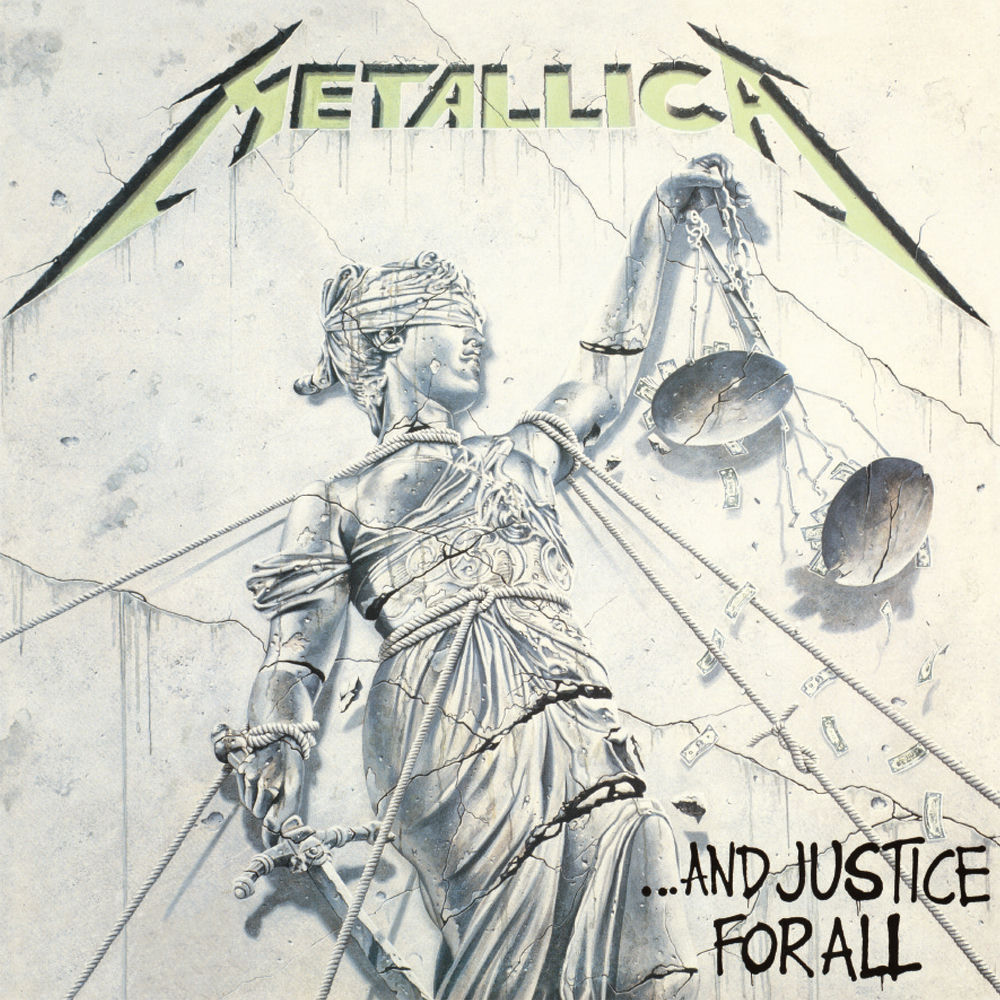
Metallica's first album after Cliff Burton's death: some of the tightest playing of their career, mixed thinner than it was recorded. The bass gets the blame, and it's only half the story.
- Released
- 5 September 1988 (UK, Vertigo); 6 September 1988 (US, Elektra), though some sources give 7 September
- Label
- Elektra (US); Vertigo (UK and Europe); CBS/Sony (Japan)
- Producer(s)
- Metallica, with Flemming Rasmussen; mixed by Steve Thompson and Michael Barbiero
- Runtime
- 65:10 (sleeve timings; 9 tracks, 2×LP)
- Chart peak (US)
- #6 (Billboard 200, chart dated 8 October 1988)
- Chart peak (UK)
- #4 (Official Albums Chart, new entry in September 1988)
- Certifications
- RIAA 8× Platinum (9 June 2003); Music Canada 3× Platinum (27 January 1994)
- Awards & honours
- Nominated for Best Hard Rock/Metal Performance at the 1989 Grammys, which Jethro Tull won; 'One' won the first Best Metal Performance award in 1990
Everyone argues about the buried bass. The bigger story is a band choosing precision over weight at every turn, from riff-stacked songs to razor-edited drums. It made 'One' and 'Blackened' great, and the whole record easier to admire than to love.
In June 1988 Metallica mixed their fourth album in the gaps of a tour. At weekends they played Monsters of Rock dates with Van Halen and the Scorpions. On weekdays they worked at Bearsville Studios, near Woodstock in New York. Steve Thompson, who mixed the album with Michael Barbiero, says the band flew in by helicopter for a day here and there. In 2015 he told Ultimate Guitar about one of those days. Lars Ulrich asked for Jason Newsted's bass to be barely audible. Then he asked for it to come down another 5 dB. Thompson says he called his manager that night. As he remembers it, he also talked to the band's managers, Cliff Burnstein and Peter Mensch, and asked them to find someone else. They talked him into staying.
That story is why people still argue about this record. It's also the wrong place to start judging it. The bass is only the loudest sign of a choice the band made again and again: precision over weight. They wrote songs with more riffs than the songs needed. They built the drums from fragments of tape. Then, in the mix, they turned down the instrument that would have given all that detail a floor. What's left is some of the hardest, tightest playing of their career, in a sound that does it few favours. That's why …And Justice for All is easier to admire than to love.
The record exists because Cliff Burton doesn't. On 27 September 1986, on the tour for Master of Puppets, the band's bus crashed in Sweden. Burton was killed. He was 24. Ulrich has said they buried him and kept moving, because slowing down felt dangerous. Auditions began the week after the funeral. Brian Slagel of Metal Blade suggested Newsted, the bassist in Flotsam and Jetsam, a band from Phoenix, Arizona. He joined in October. His first record with Metallica was a covers EP the next summer, on which he was credited as Master J. Newkid. Its songs were picked to show him off.
Writing began in October 1987 and took 8 or 9 weeks, the band said in 1988. The subjects came from the news. Ulrich later said that reading about blacklisting gave them 'The Shortest Straw'. The title track takes on a justice system bought and sold. 'One' comes from Dalton Trumbo's novel Johnny Got His Gun, about a soldier left blind, deaf and limbless. But the ambition was in the structures more than the subjects. Hetfield told MTV in 2008 that, as songwriters, they were 'showing off', cramming more riffs into every song. Ulrich said they took the approach of Ride the Lightning and Master of Puppets as far as it could go. Nine songs fill 65 minutes, and two of them run past 9 minutes.
The band booked One on One in North Hollywood from 30 January 1988. They said at the time that one look round the room was enough. Flemming Rasmussen, who'd produced the last two albums in Copenhagen, was booked up. So the sessions began with Mike Clink, fresh from Guns N' Roses' Appetite for Destruction. It didn't work out. Two of Clink's drum tracks survive, on 'The Shortest Straw' and 'Harvester of Sorrow', and the sleeve credits him for them. When Rasmussen arrived is disputed. He has put it at 14 February. The band, speaking in 1988, said 6 weeks into the booking. Rasmussen says he took 3 days off in 4 months.
Rasmussen's account to Sound On Sound in 2011 explains how the record got so exact. Ulrich's drums were cut in punch-ins of 20 to 30 seconds, then corrected with a razor blade on 2-inch tape. Each song's drums took at least 3 to 4 days. Hetfield stacked up to 6 or 8 rhythm guitars by the end of 'One'. Kirk Hammett wrote his solos at home, and most were rejected the first time. Ulrich shaped most of them. Newsted recorded with the assistant engineer, Toby Wright, who kept more regular hours. When the others went home at six or eight in the morning, the two of them started work. That's a lot of construction. But the parts being stitched together are ferocious, and the playing is the best thing on the record. The machine-gun section of 'One', Rasmussen says, went down in one take.
'Blackened' sets the terms. Michael Azerrad, reviewing the album for Rolling Stone in 1988, counted something like five changes of meter in it, and Hetfield doesn't sing until 1:21. Rolling Stone reported in 2018 that Newsted wrote its main riff on bass, and it's his only writing credit on the album. So the record's first great idea came from the man the mix would push to the back. 'One' is where the method pays off in full. It starts on clean guitars, under battle sounds that were added at the mix. Its chorus runs faster than its verses, and Rasmussen punched a Linn Drum click in and out to hold it together. Near the end comes the machine-gun part, double kick drums under the stacked guitars. Hetfield said in 1991 that it wasn't written to fit the war theme; it just came out that way. It's the one place where the album's precision sounds like violence.
The method fails where a song has nothing simple at its centre. The title track runs 9:44, and from 4:38 to 7:46 nobody sings. That's where Hetfield's 'showing off' costs most: the playing stays exact, and the stretch still outstays its welcome. The band seem to have agreed. Hammett said in 1991 that on tour they realised fans found the songs too long. By the end, he said, they came offstage swearing never to play the title track again. Ulrich told Vulture in 2020 that 'Eye of the Beholder' was the Metallica song he never wanted to hear again, because it sounds forced. It's hard to argue. Then there's 'To Live Is to Die', built from music Burton left behind and played by Newsted. There's no voice for the first 7:33. Rolling Stone noted in 2018 that this is where the bass is easiest to hear. It's Newsted, playing Burton.
Which brings us back to Bearsville. Rasmussen wasn't at the mix, and says he only learned what happened after release. He says the album sounded much fatter when they recorded it. The people who were there have explained the bass differently, and their reasons have shifted over the years. In 2008 Hetfield told Guitar World that Newsted mostly doubled the rhythm guitar, and that the scooped guitar tone left him no room. That year Ulrich told Decibel it wasn't deliberate: they'd kept turning everything else up. In the same interview Hammett blamed a clash between Newsted's tone and Hetfield's, and called the dry sound 'an experiment'. He also told Guitar World that year that Newsted had been the band's punching bag after Burton died. In 2019 Hetfield blamed his own hearing, shot by gigs between mix sessions. Newsted has pointed to a clash of frequencies and his inexperience. He has also suggested that, underneath it all, the problem was simply that he wasn't Cliff.
The motive will never be settled. The responsibility is clearer. Thompson names Ulrich. Rasmussen, in 2016, named Ulrich and Hetfield. Ulrich himself has called it 'the James and Lars show'. And the cost is real. AllMusic's Steve Huey wrote that the drums 'click more than pound'. Hetfield's own account is that he turned up the high end until the low end went. The riffs have edges but no floor, and 65 minutes of edges is tiring. Hammett has said the album doesn't sound good to him now. Hetfield, turning down a remix in 2017, called his records snapshots, while admitting this one could use more low end. He's right to leave it alone. It's still the album's biggest flaw.
None of it stopped the record selling. On 10 September 1988 Billboard's reviewer predicted that radio would be scared off and that word of mouth would make it platinum anyway. Both came true. It entered the Billboard 200 at #35 and reached #6 in its third week, on the chart dated 8 October. That was before radio had a song to play. It went platinum within 9 weeks of release. In Britain it entered at #4. Then 'One' gave radio and MTV a way in. The video, on MTV from January 1989, cut the band with footage from the 1971 film of Trumbo's novel, whose rights they'd bought. The single became their first US Top 40 hit, at #35. The tour that followed was their first headlining run in arenas.
The Grammys supplied the punchline. On 22 February 1989 the first award for Best Hard Rock/Metal Performance went to Jethro Tull's Crest of a Knave. Ulrich said the result made a mockery of what the award was for. Later copies of the album carried a sticker reading 'Grammy Award LOSERS'. A year on, 'One' won the first Best Metal Performance award. The bigger effect was on Metallica themselves. After the tour, Ulrich said, they wanted simpler songs, and the 1991 album that followed far outsold this one. Anthrax's Scott Ian noticed the turn. He told Billboard in 2018 that by 1988 thrash had a formula, and that Metallica veered off it before anybody else did.
Critics in 1988 mostly liked it. Rolling Stone's Michael Azerrad set it against Bon Jovi's New Jersey and treated it as challenging music, worth the effort of analysis. The Village Voice's Pazz & Jop poll placed it #39 for the year. The dissent came from Robert Christgau, who heard compositions rather than songs, going on longer than Master of Puppets. The 2018 reissue brought the opposite extreme. Pitchfork gave it 9.3, argued that it's the band's best album, and said leaving the mix alone was right.
Both verdicts miss. Christgau undersells the writing. 'Blackened', 'One', 'Harvester of Sorrow' and 'Dyers Eve' are as strong as anything Metallica recorded, and the playing never slackens across 65 minutes. Pitchfork oversells the whole. The title track and 'Eye of the Beholder' are long without being rich, and the sound wears you down well before the last side. This is a very good album with clear limits, and its best songs need no allowances. Put on 'One' and 'Blackened' and you hear a band at full strength. Sit through all four sides and you hear what that strength cost. Admire it. Just don't mistake its thin, clicking sound for a vision.
Pressing guide — the one to own
There's no single prize. The catalogue lists 1988 vinyl from more than a dozen countries, from Canada and Japan to Greece and Argentina. Of the three main issues, the American copy has Masterdisk DMM runouts on all four sides. The Dutch copies have them on sides B to D, and most British B-to-D sides do too. So the old argument over American versus European cuts turns on smaller differences than it sounds. The US issue is a single pocket jacket, with lyrics and credits on two printed inner sleeves. The Japanese CBS/Sony set adds Diamond Head's 'The Prince' on side D. The 2018 deluxe box, numbered and limited to 30,000 by its catalogue notes, adds live sets, demos and rough mixes. None of them fixes the bass: every official edition uses the 1988 mix.