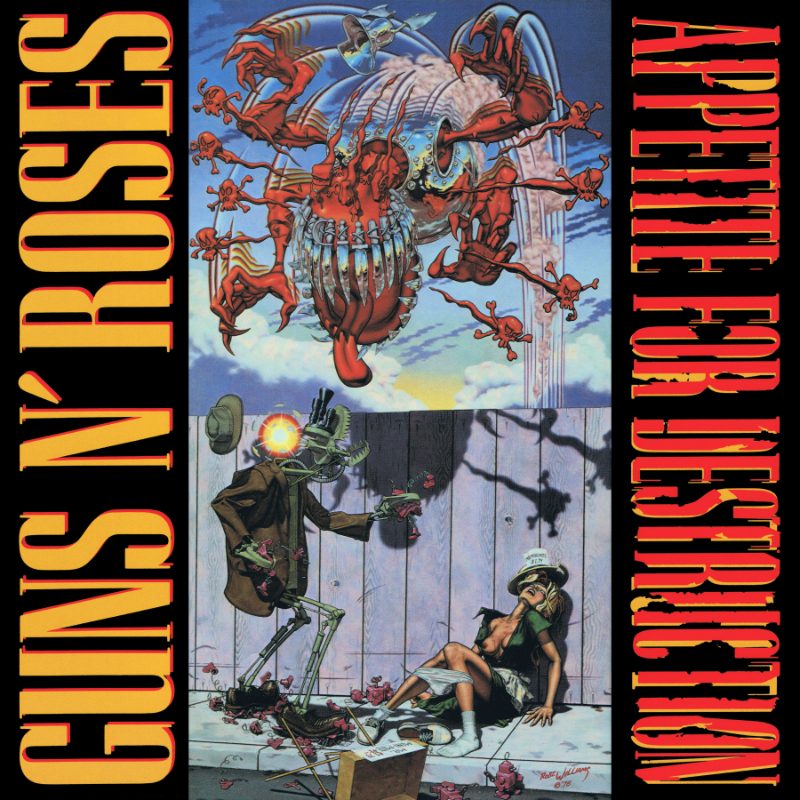
Guns N' Roses' 1987 debut reached #1 in America in its 50th week on the chart. Behind its reputation for chaos is a razor-edited, hand-mixed record whose playing is better than its ideas.
- Released
- 21 July 1987
- Label
- Geffen Records (US LP GHS 24148, with XXXG 24148 on painting-cover jackets; UK and Europe WX 125 / 924 148-1)
- Producer(s)
- Mike Clink
- Runtime
- 53:44 (12 tracks)
- Chart peak (US)
- #1 (Billboard Top Pop Albums, chart dated 6 August 1988, in its 50th week on the chart)
- Chart peak (UK)
- #5 (Official Albums Chart, week ending 22 July 1989)
- Certifications
- RIAA Diamond, 18× Platinum (23 September 2008); BPI 8× Platinum (16 January 2025); Music Canada Diamond
- Awards & honours
- MTV Video Music Award for best new artist, for 'Welcome to the Jungle' (7 September 1988). #62 on Rolling Stone's 500 Greatest Albums (2012). #26 in the Village Voice Pazz & Jop critics' poll for 1988
Appetite for Destruction comes wrapped in stories of drugs, sex and wrecked houses, but the record itself is careful, razor-edited work by a superb band. Its limits are a borrowed style, three weak songs and a view of women that has aged badly.
In January 1987, at Rumbo Recorders in Canoga Park, Mike Clink spent 2 weeks recording the basic tracks for Guns N' Roses' first album. As they went, he spliced the best takes together with a razor blade. Then Clink worked 18-hour days for a month of overdubs. Slash played guitar in the afternoons and evenings, and Axl Rose sang until the sun came up. After that the tapes went to Media Sound in New York. Steve Thompson and Michael Barbiero mixed the album at a desk with no automation, and five people worked the faders by hand. Victor Deyglio, one of the assistant engineers, later told Rolling Stone it might be the last great rock record made entirely by hand.
That isn't the story people usually tell. Grammy.com's 2018 look back said the album "perfectly captured the chaos and debauchery" of the band's life. Rolling Stone's own history of the sessions opens with sex in a vocal booth. The chaos was real, but the record isn't chaotic. It's a carefully built record of exceptional playing, and the care is why it has lasted. The ideas are another matter. In an early review for Metal Hammer, Dave Ling dismissed it as a second-rate reheating of AC/DC, Aerosmith and Hanoi Rocks. He was right about the ingredients. He was wrong to think that settled anything. Nobody else in 1987 was playing that style this well.
The line-up was new. The five first rehearsed together in a Silverlake studio in May 1985, less than 2 years before Rumbo. Duff McKagan and Izzy Stradlin hid Steven Adler's extra drums to force him onto a stripped-down kit. Rose and Stradlin brought songs they already had, among them 'Anything Goes' and 'Think About You'. 'Welcome to the Jungle' was the first song the band wrote together. It grew from a riff Slash played Rose in his mother's basement. McKagan wrote its breakdown, and Slash remembers Stradlin putting together the bridge. Geffen signed the band in March 1986, with Tom Zutaut as their A&R man. 'Sweet Child o' Mine' came later, at a rented house on the former Cecil B. DeMille estate.
What they were reaching for wasn't new. In 1988 Stradlin told Rolling Stone that rock had been worthless since the Sex Pistols. Rose said he'd watched the Stones film Gimme Shelter about a hundred times. Adler says they wanted to be like Aerosmith, Kiss and Led Zeppelin. Twenty years on, Slash put Appetite beside Sticky Fingers, Rocks and Led Zeppelin IV as one of the "be-with-you-forever albums". Finding a producer was harder. Paul Stanley of Kiss heard a 'Nightrain' demo and said its chorus needed an extra hook. By Rolling Stone's account, Rose never spoke to him again. Manny Charlton was another candidate. The job went to Clink, an engineer Rolling Stone credits with superb technical skills and unusual patience.
The sessions weren't chaos, but they weren't easy either. Slash got so frustrated with a rented Gibson SG that he smashed it through a van window. He settled on a Les Paul copy built by Kris Derrig, played through a Marshall. Then he spent hours with Clink paring down his solos, until they were as catchy as the vocal melodies. Clink told Rolling Stone they used classic instruments and amps, in an approach that went back to the 1960s and early 1970s. The album cost about $370,000, which Rolling Stone calls extravagant for a debut at the time. Even the mastering was done with vinyl in mind. What you hear is a band being edited, by its producer as much as by itself. The chaos story leaves that out.
The editing shows most in the voice. Rose is the reason this isn't simply a better Aerosmith record. Rolling Stone says he'd mostly been a high screamer on stage, and that in the studio he revealed an uncanny range. 'Welcome to the Jungle' opens with his siren-like wail, and Clink says it took multiple takes to get the growl right. Then the vocal drops out until the title line lands at 0:40. 'Paradise City' shows the other end. In the slow opening chorus at 0:20, the low harmony under the tune is Rose as well. Even Robert Christgau, who gave the album a B−, granted that Rose made easy what other hard-rock singers strained to do.
The other great strength is the rhythm section. Before the deal, McKagan and Adler spent hours playing along to Prince and Cameo records, and 'Word Up!' was a favourite. Rolling Stone says it left them at ease with swinging rhythms that were unusual in hard rock. McKagan says the groove of 'Rocket Queen' owes a particular debt to Cameo. 'Sweet Child o' Mine' shows what else the band could do. Its riff began as a "goofy personal exercise", in Rolling Stone's phrase, that Slash was fooling with at the DeMille house. Stradlin added chords, and Rose wrote the words upstairs. The intro runs 46 seconds before Rose's first line. A warm-up became a US #1. At 5:55, a Billboard column noted, it was the longest #1 of 1988 so far.
The songs about the life are the most specific on the record. 'Nightrain' pairs a joke chorus, named after a cheap wine the band drank, with a rough riff Stradlin brought in. McKagan says Stradlin played about half the notes and left the others to work out the rest. Jimmy Martin, writing for the Quietus in 2012, heard 'Out ta Get Me' as a startling chronicle of a persecution complex. David Bennun, in the same magazine in 2017, took 'Mr. Brownstone' as proof that the band's drug use was no metaphor. Rolling Stone's notice in December 1988 found 'Mr. Brownstone' more attitude than substance. Christgau's objection went deeper. Rose, he wrote, doesn't love the wine, he loves alcoholism. That's the trouble with all three. They're vivid about the habit and blind to what it cost, so they still read like bragging.
Side R is weaker, though not all of it. The LP's sides are labelled G and R, and Bennun called side G one of the most thrilling rushes rock has ever given him. He's right. Side R holds the album's biggest hit, 'Sweet Child o' Mine', and its best ending, 'Rocket Queen'. Martin counted both among the album's best songs. Around them sit the three weakest songs on the record. Martin called 'Think About You' filler, and it's hard to argue. 'Anything Goes', co-written with Chris Weber, was a song Rose and Stradlin had before this line-up existed, and Martin found it undistinguished. He heard the album's 'You're Crazy' as a runaway train, and wondered whether it worked better played slow, as on G N' R Lies the next year. The slow version makes the better case for the tune. These three are a good bar band's songs, and they make the album's debts easier to hear. This is where Ling's charge sticks.
The deeper problem is what the record thinks of women. Christgau's review praised Rose's voice and damned the album's attitude to women. Bennun made the same case 30 years on. He heard contempt for women across the album, and on side R most of all. His example of the record's pornographic streak is 'Rocket Queen'. Midway through, it carries a recording of Rose having sex with Adriana Smith, made in a Manhattan studio in the spring of 1987. It's hard to hear the song past it. Yet 'Rocket Queen' also has the album's best ending. At 4:04 it turns tender, and Rose has said he wanted to give the album a happy ending after all its darkness. The sleeve didn't help. The Los Angeles Times described Robert Williams's painting as a woman "ravaged by a mechanical monster". Geffen's president, Eddie Rosenblatt, told the paper the band saw the robot as industry raping and polluting the environment. The music gives that reading nothing to stand on.
It wasn't an instant hit. By December 1987 it had sold about 200,000 copies with little radio play. Geffen's executives wanted the band off the road and working on a follow-up. Zutaut begged David Geffen to push MTV into playing the 'Welcome to the Jungle' video. By Rolling Stone's account, the channel showed it once, at 4 a.m. on a Sunday, and its switchboard filled with requests. On 6 August 1988 Appetite reached #1 on Billboard's album chart, in its 50th week there. Billboard noted that in 20 years only Fleetwood Mac had taken longer. A month later the video won MTV's award for best new artist. On 10 September 'Sweet Child o' Mine' topped the Hot 100.
Rolling Stone tells that story as kids overruling a doubtful industry. Billboard's column the week of the #1 suggests something less dramatic. Appetite was the third metal-oriented #1 in a row, after OU812 and Hysteria. Hysteria had got there in its 49th week, only 2 weeks earlier. Hard rock owned that summer, and Appetite won a race in a strong field. Its longer influence rests on critics' readings, and the readings are strong. Martin argued that Appetite, not Nevermind, was the first nail in the coffin of MTV hair metal, and that the same buyers bought both. Brian Hiatt, who wrote Rolling Stone's history, called it a bridge between 1980s hard rock and the alternative music of the next decade. Critics in 1988 were slower than buyers: the Village Voice's poll placed it 26th. By October 2026 it had spent 286 weeks in the UK Top 100, and in 2012 Rolling Stone ranked it #62 among the 500 greatest albums.
Appetite for Destruction is a very good record with clear limits, and it earns admiration rather than reverence. It isn't a new kind of rock record. Its parts came from Aerosmith, the Stones and AC/DC, as Ling and Rolling Stone both heard. What it has instead is playing as good as any hard-rock record of its year, and a singer with more range than anyone around him. Side G holds up from the first song to the last. Side R has the two songs most people know and three the album could lose, and the record's view of women has aged far worse than its sound. Play side G loud. On side R, play 'Sweet Child o' Mine' and 'Rocket Queen', and be choosier with the rest.
Pressing guide — the one to own
The pressing to own is the 1987 US LP in the painting jacket, with GHS 24148 on the labels and XXXG 24148 on the spine and inner sleeve. Allied pressed it, and its runouts carry B-27798 and B-27799 alongside 'Sterling' and 'DMM'. Specialty Records pressed painting copies too, marked 'EAST' near the centre hole. In October 2026 it was on more want lists than any of the album's 617 versions, at 7,959. In Europe the painting is no prize: the German-pressed WX 125 kept it and is plentiful.