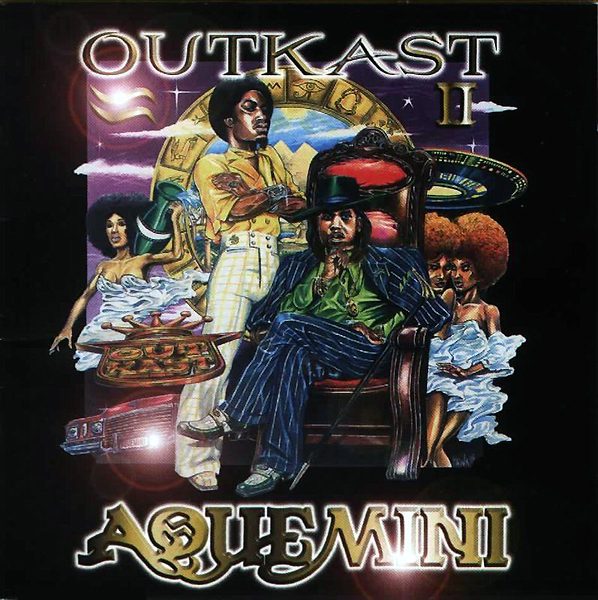
OutKast's third album: 16 tracks and nearly 75 minutes, made with a bigger budget and a room full of players. The best performances of their career, on a record that doesn't know when to stop.
- Released
- 29 September 1998 (US)
- Label
- LaFace Records, distributed by Arista (US CD 73008-26053-2; 3×LP 73008-26053-1)
- Producer(s)
- OutKast (8 tracks), Organized Noize (4), David 'Mr. DJ' Sheats (3); Donny Mathis co-produced the opener
- Runtime
- 74:47 (16 tracks)
- Chart peak (US)
- #2 (Billboard 200), more than 227,000 copies in its first week; #2 (Top R&B/Hip-Hop Albums)
- Chart peak (UK)
- No entry in the UK Top 100 (Official Charts)
- Certifications
- RIAA 3× Platinum (7 November 2023)
- Awards & honours
- 5 mics in The Source (November 1998); #6 in the Village Voice's Pazz & Jop poll for 1998; #49 on Rolling Stone's 500 Greatest Albums (2020), up from #500 in 2003
Aquemini answers everyone who'd boxed OutKast in, from New York's critics to their own fans, and it does so with live musicians. The playing is why it lasts. The length, and the songs that run on past their endings, is what holds it back.
In August 1995, at the Source Awards in New York, OutKast won Best New Rap Group and were booed for it. The room was in the middle of the feud between Death Row and Bad Boy. André Benjamin answered the boos by telling the crowd the South had something to say. Three years later, he and Antwan Patton put a recording of that night near the end of 'Chonkyfire', the last track on Aquemini. It arrives at about 4:10, more than 70 minutes into the album. By then the point has been made at length, in every way they could think of.
That's the record in small: an answer. Aquemini, OutKast's third album, came out on 29 September 1998, and it answers everyone who'd put the duo in a box. It does it with players in a room, and with the two of them at their most equal. The performances are the best of their career. The flaw is that it answers everything at full length. Songs run on after they've finished, and a record that's great for most of its 74:47 asks for more patience than it repays.
It's tempting to hear Aquemini as the start of the split. Five years later OutKast released Speakerboxxx/The Love Below, one solo album each in a single package. Billboard's 20th-anniversary piece found that tension already at work here, and there's evidence for it. André was trying out pitch-corrected singing, and Big Boi warned him it would lose them their audience. But Big Boi's own memory of the sessions is of weeks spent sleeping in the studio, side by side. The credits back him. OutKast produced half the album as a unit, and Big Boi raps on every track but the opener and 'Nathaniel'. Organized Noize, who'd produced every track on the debut, made 4 of the 16.
The boxes came from three directions, and Billboard's 2018 retrospective lists them. New York's rap establishment had them down as country. Purists thought André was getting too strange. At home, fans missed the party record of their 1994 debut. André said people assumed he was gay or on drugs because of the clothes he wore. He'd stopped smoking and drinking by then, he said. 'Return of the 'G'', the first full song after the opening refrain, is his reply. Organized Noize set it against strings and woodwind from the South Central Chamber Orchestra, so the defence arrives dressed for the occasion.
Then there was money. ATLiens had gone platinum, and LaFace gave the next record a much bigger budget and more studio time. No figure has been published, but you can hear where it went. The booklet lists seven recording studios and five for mixing. Omar Phillips, who played percussion, said the budgets meant the musicians could live at Doppler. One grievance came along, and one outsider. The Source had given their debut 4.5 mics, and Big Boi complains about it on 'Skew It on the Bar-B'. Raekwon raps on the same song. Living in Atlanta at the time, he'd met Big Boi by chance at Lenox Square Mall, and he was the duo's first guest from outside the Dungeon Family. When The Source reviewed Aquemini, it gave 5 mics, the first time a Southern act had earned the top score.
What the money bought was musicians. Emma Warren, writing in the Guardian in 2011, heard mostly live players, and the credits bear her out. Donny Mathis plays guitar. Preston Crump plays bass on eight tracks, and Marvin 'Chanz' Parkman plays keyboards, Moog bass and piano. Looking back for Pitchfork in 2013, Mike Powell picked out Crump's sustained bass and the swing of the drums. He's right to start there. Billboard heard warmth in the album, and the low end is where it comes from. Phillips said the band tracked together, with very little overdubbing. Little on the record sits still the way a loop does.
'Rosa Parks' shows the method best. André made the beat, which he'd first offered to the group Total. Big Boi came up with the hook at home, in his bedroom. When André heard the track back, it sounded to him like something off a porch. So his stepfather, Pastor Robert Hodo, came in and played harmonica, in one or two takes. Mr. DJ remembered everyone in the booth stomping and clapping on the wooden floor for the breakdown. Listen for the half-minute break in the rapping at 3:51. It's a Southern rap single with a family gathering in the middle of it, and it couldn't have come from anywhere else.
The title brought a lawsuit. Rosa Parks sued over the use of her name in 1999. The case went to the Sixth Circuit, and in December 2003 the Supreme Court declined to hear LaFace's appeal. It settled in April 2005. The defendants agreed to help develop educational programmes about her, working with the Rosa and Raymond Parks Institute, and the settlement implied no fault. The song itself peaked at #55 on the Hot 100, in January 1999. The Village Voice's critics' poll still ranked it the sixth-best single of 1998.
'SpottieOttieDopaliscious' is the album's peak. It runs 7:07. After Sleepy Brown sings the opening verse, both men speak their verses rather than rap them. André talks through a night at a club. Big Boi talks through a young father who fails a drug test and ends up back in the trap. Darian Emory and Jerry Freeman's horns carry the whole thing, and Rolling Stone's 1998 review heard Fela in them. The two stories don't match, and the mismatch is what makes it: one is a night out, the other a life closing in. The title track does the same job more directly. Its name joins Big Boi's star sign, Aquarius, to André's, Gemini, and both of them rap on it.
Elsewhere the record shows its range. 'Synthesizer' brings in George Clinton, whose falsetto Rolling Stone's review picked out, for a song about technology taking over. Emma Warren called it the album's weirdest moment, and a warning about machines does sound odd on a record this hand-played. 'Da Art of Storytellin' (Part 1)' goes the other way: two short stories over a Mr. DJ beat, told as tightly as anything they'd written. Part 2 turns to the end of the world and stops at 2:48. Then 'Liberation' runs 8:46, a jam that started at the piano, with Cee-Lo and Erykah Badu among its five guests. Those four tracks show the album's spread better than any summary. They also show its habit. Every idea gets its full length, whether it needs it or not.
Billboard's anniversary piece called Aquemini a model for balancing experiment and cohesion. The experiment, yes. The cohesion is where it falls short. Half its 16 tracks pass 5 minutes, and several keep going after they've finished. The last verse of 'Slump' is done by about 3:07, and the track runs to 5:09. 'Chonkyfire' carries on for nearly 2 minutes after the Source Awards clip. 'Mamacita' leans on its title, which is heard 21 times in under 6 minutes. Between songs sit skits André wrote. The clean CD dropped them, along with 'Nathaniel', and the skits, at least, aren't missed.
The running order was argued over to the end. Kawan Prather, LaFace's A&R on the album, said he and Big Boi fell out over the opener. Prather wanted 'Return of the 'G''; Big Boi wanted 'Y'all Scared', and missed his flight to the mastering session. Rolling Stone's advance review, posted on 4 September 1998, had heard 'Chonkyfire' first. On the finished album it closes. An album whose opener was still in dispute at mastering is a set of strong parts first and a shape second. Powell made a different complaint: he wrote that Aquemini isn't fun. He meant it was searching and unforgiving, and he pointed to the bleakness of Big Boi's story in 'Da Art of Storytellin' (Part 1)'. That's the weaker charge. The bleakness is earned. The sprawl isn't.
Its standing has climbed ever since. Rolling Stone gave it 4 stars in 1998, and Robert Christgau an A minus. The Village Voice's critics placed it sixth for the year. Rolling Stone later ranked it #500 among the greatest albums in 2003, and #49 in 2020. Commercially it changed less than its legend suggests. It entered the Billboard 200 at #2 with more than 227,000 copies, behind Jay-Z, and ATLiens had reached #2 as well. No single from it reached the Hot 100's Top 40. The claims for its influence also run ahead of the evidence. Killer Mike said in 2013 that it moved Southern music forward by 20 years. Raekwon said 'Skew It on the Bar-B' helped open New York to the South. Critics at the BBC and CMJ heard it in Kendrick Lamar's good kid, m.A.A.d city. That's real testimony, but it's thinner than the reputation.
So what is it worth now? On performance, it stands with the best rap records of the 1990s: two MCs at their sharpest, and a band playing for them rather than behind them. What has dated is the editing. The ideas still sound fresh. The run times sound like the late 1990s. The core is easy to find: 'Rosa Parks', the title track, both parts of 'Da Art of Storytellin'' and 'SpottieOttieDopaliscious'. Around them sit songs that are good for 3 minutes and then keep going. Aquemini is a great album that would be a better one at an hour. It leaves the cutting to you.
Pressing guide — the one to own
The original to own is the 1998 US triple LP, LaFace 73008-26053-1, on yellow-and-orange speckled LaFace labels. The catch is that the 2009 and 2014 represses, and the 2023 one made in Mexico, use the same catalogue number. The runouts settle it. Originals read 73008-26053-SA through -SF. The 2009 and 2014 represses read 73008-26053-1-A WG/NRP and so on; the 2009 one is on solid yellow labels. The Mexican pressing reads 73008260531 A and so on. The vinyl also has its own running order: 'Chonkyfire' moves to side E, after 'Y'all Scared', and side F holds 'Nathaniel' and 'Liberation'.