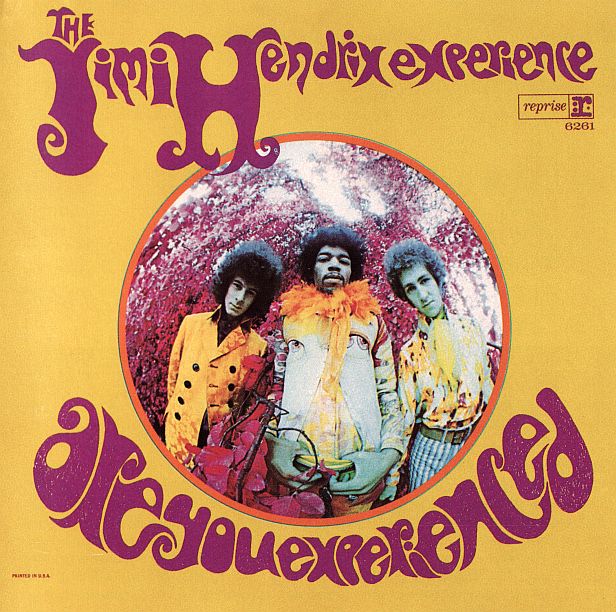
Jimi Hendrix's first album, made in three London studios between October 1966 and April 1967. The playing changed what a guitar trio could do. The album around it never quite settled.
- Released
- 12 May 1967 (UK, Track, mono only); 23 August 1967 (US, Reprise, with a different sleeve and running order)
- Label
- Track Record (UK); Reprise (US and Canada); Polydor (Germany and much of Europe); Barclay (France)
- Producer(s)
- Chas Chandler. Engineers: Dave Siddle (De Lane Lea), Mike Ross (CBS), Eddie Kramer (Olympic)
- Runtime
- About 40 minutes: 40:11 for the UK 11 tracks and 40:48 for the US 11, measured on the 1997 CD. The UK Track LP prints no timings
- Chart peak (US)
- #5 (Billboard Top LPs, now the Billboard 200); 106 weeks on the chart, 76 of them in the Top 40
- Chart peak (UK)
- #2 (Official Albums Chart, week of 4–10 June 1967), behind Sgt Pepper; 33 weeks on the chart
- Certifications
- RIAA 6× Platinum (11 December 2025)
- Awards & honours
- Grammy Hall of Fame (1999); National Recording Registry (2005 list, announced 11 April 2006); #30 on Rolling Stone's 500 Greatest Albums (2020), down from #15 in 2003 and 2012
The distortion on Are You Experienced was deliberate, and the record's greatness is in the playing: noise put to work, and Mitch Mitchell's drums. What it lacks is shape. Built between hit singles, it exists in two running orders, and neither is quite right.
A tape box bound for Reprise in America carried a note from Track. The distortion on 'Purple Haze' was deliberate, it said, and nobody should correct it. Track expected a careful engineer to hear the sound as a fault and fix it. That's the best short guide to what Hendrix's first album does. Its most important sounds are the kind the note was written to protect: feedback, overload, a note bent until it shakes, a guitar solo played backwards. On this record they aren't accidents left in. They're the parts.
That's the case for the record, and it's a strong one. Three musicians who'd been a band since October 1966 play with a nerve that still sounds risky. But Are You Experienced was never planned as an album. It was gathered from 16 sessions in three studios over five months, in the gaps between three hit singles. The British edition left those singles off. It kept 'Red House' and 'Remember' instead, a blues and an R&B song of the kind Hendrix had played in America. The American edition fixed that and lost something else. The playing is the reason it lasts. The album around it never quite settles.
It began with a song. Chas Chandler was leaving the Animals and wanted to produce a hit version of 'Hey Joe'. In the summer of 1966 Linda Keith steered him to the Cafe Wha? in Greenwich Village, where Hendrix was playing it. Hendrix was 23, and he'd spent four years as a sideman for Little Richard, the Isley Brothers and Curtis Knight. On 24 September Hendrix flew to London, under a management and production contract with Chandler and Michael Jeffery. Chandler talked Noel Redding, a guitarist who'd come to audition for the New Animals, into playing bass. Mitch Mitchell, recently fired by Georgie Fame, joined in early October. On 13 October the trio played its first show, supporting Johnny Hallyday at the Novelty in Évreux.
Chandler built the band to frame its guitarist, and he limited what the other two could add. He directed Redding's bass parts himself. The credits reflect it: every song on the British album is a Hendrix original. Mitchell is the exception to the hierarchy. Pitchfork's 2025 review hears a hard-rock Elvin Jones in him, and on this record he plays like a second lead instrument. Chandler pushed Hendrix to write, too. 'Stone Free', from 24 October 1966, was his first song for the Experience. Decca turned the band down, and Track, the label run by the Who's managers, signed it late that month.
The singles came first. 'Hey Joe' was cut at De Lane Lea on 23 October and reached #6 in February 1967. 'Purple Haze' was cut at De Lane Lea on 11 January in about four hours, and its solo was Hendrix's first recording with Roger Mayer's Octavia. It reached #3 in May. 'The Wind Cries Mary', taken the same day in one take, reached #6 in June. None of the three went on the British album. Money was tight throughout. Chandler's cash was short, and the owner of CBS wanted payment up front. Later it was Polydor that guaranteed a line of credit at Olympic. Leaving the hits off made sense for a band living on singles. It also left the LP to be built from whatever else the sessions produced.
That material came from three rooms and three engineers. Dave Siddle recorded at De Lane Lea. At CBS, in sessions on 13 and 15 December, Mike Ross recorded 'Foxy Lady' and 'Red House' and the basic tracks for three more. The band played together live, with the vocals added later. The guitar sound started with Hendrix's own instruction: put one microphone about 12 feet away. Ross used a Neumann condenser across a large room, and he later called that room absolutely vital to the band's sound. Mono was the priority, and he spent no more than about 30 minutes on any mix. A row over payment ended the CBS sessions. Eddie Kramer, aged 24, joined at Olympic in Barnes on 3 February 1967. So the album's sound wasn't Kramer's alone, whatever his later reputation suggests.
What Kramer added was room to build. Olympic was still a four-track studio. He put the drums in stereo across two tracks, then bounced the four tracks down to two to make space for lead guitar and vocals. Earlier sessions had kept the guitar microphones about 12 feet back. Kramer mixed close and distant ones, and he used Beyer M160 ribbon mics, an unusual choice for music this loud. Hendrix sang behind a screen because he didn't like being watched. The final mix was done by 3am on 25 April. At 11am, by Chandler's account, Polydor's Horst Schmaltze heard the acetate and called it the greatest thing he'd heard.
The opening of 'Foxy Lady' sets out the method. It doesn't start on a chord. Hendrix holds one note and shakes it with a wide vibrato until the amp feeds back. Then he slides down into the riff, with amp overdrive and a fuzz box working together, as Keith Shadwick hears it. Biographers including Harry Shapiro and Caesar Glebbeek call the riff chord a 7♯9, the so-called Hendrix chord. Hal Leonard's transcription disagrees: it shows no major third, and finds the full chord on 'Purple Haze'. Either way, the feedback is the hook, and it comes before the riff. 'Manic Depression' does the same thing with rhythm. It's in a triple metre, and Mitchell modelled his part on Ronnie Stephenson's drumming on John Dankworth's 'African Waltz'. Hendrix called it 'ugly times music'. The drums are what make it ugly in the right way.
The record goes furthest in three places. 'I Don't Live Today' closes side one with a wah effect made by hand, before Hendrix had recorded with a wah pedal. Then it dissolves into a long feedback passage. 'Third Stone from the Sun' opens with a mock radio exchange between Hendrix and Chandler, slowed to half speed. Charles Shaar Murray hears Elvin Jones in Mitchell's drumming under the opening chords. Then comes an octave melody in the manner of Wes Montgomery. The title track closes the album with a guitar solo played backwards, the last of four attempts. Hendrix had practised backwards recording at home. The Beatles had used backwards tape on 'Rain' a year earlier. Hendrix made the backwards solo the centre of the song rather than a colour in it.
Between those peaks, the British album sags. 'Red House' is the best of the plainer tracks: a 12-bar blues taken live at CBS, with no bass guitar at all. Redding played a borrowed hollow-body guitar tuned down a half step. 'Remember' is the weakest. Sean Egan and Steven Roby both call it R&B, and to our ears it's the sideman Hendrix had been, not the leader he'd become. 'Can You See Me' is brisker, an uptempo rocker in Egan's words, but it's slight. 'May This Be Love' is the album's gentle song. Pitchfork's 2025 review hears its riff curling in aimless circles, though Dave Whitehill rates its guitar solo among Hendrix's most lyrical. Next to 'Third Stone', those tracks make the album sound like what it was: the work of 16 sessions, sequenced around a gap where the singles should be.
The American edition, released on 23 August 1967, dropped 'Red House', 'Can You See Me' and 'Remember'. It added all three singles and opened with 'Purple Haze'. Pitchfork prefers that running order, and so do we. It has no weak stretch, and it puts the album's best songs where a listener meets them. But it loses 'Red House', the record's one straight blues, so neither edition is the whole thing. Since 1997 the official CDs of both versions have carried all 17 tracks. That fills the gaps. It doesn't give the record a shape.
It sold before anyone agreed on what it was. In Britain it entered at #21, climbed to #6 the week Sgt Pepper arrived, and reached #2 behind it the week after. In America it reached #5 and stayed on the chart for 106 weeks. Reprise spent $20,000 promoting it, and underground FM radio helped sell the album when the singles stalled. Melody Maker praised its integrity and its range of tempos, and Keith Altham in the NME called it brave and original. Not every critic was won over. Jon Landau, writing in Rolling Stone that November, rated Hendrix a great guitarist and a brilliant arranger. He disliked the singing and the songs, and called the record unrelentingly violent. Even at Olympic, the tape operator George Chkiantz remembered plenty of musicians who couldn't see the fuss.
Landau was wrong about the violence, which is the point of the record, and half right about the songs. The lyrics here are mostly sketches, and what other musicians took from the album was sound and tune, not words. The Amboy Dukes quoted the 'Third Stone' melody in 1968. Cozy Powell quoted it on 'Dance with the Devil' in 1973, and Right Said Fred on 'I'm Too Sexy' in 1991. Robert Christgau gave the album five stars in Blender in 2005, and Pitchfork's 2025 Sunday Review called it Hendrix's first and best. Its standing has settled rather than grown, though. Rolling Stone ranked it #15 of the 500 greatest albums in 2003 and 2012, and #30 in 2020.
So what's it worth now? As playing, it's extraordinary. Listen to the opening of 'Foxy Lady', the drums on 'Manic Depression' and the backwards solo on the title track. They still sound like a band finding out what three people could do. As an album, it's weaker than its reputation. It was assembled rather than designed, by three engineers in three rooms, and that shows in both running orders. Hear the American edition first, then go back for 'Red House'. It's a great record with a real flaw, and the flaw is its shape.
Pressing guide — the one to own
The British original is Track Record 612 001, released on 12 May 1967 in mono only. The catalogue dates the first British stereo LP, Track's Backtrack 10 (2407 010), to November 1970. The first issue has matt black labels printed in silver and stamped runouts beginning '612001 A ▽'. It comes in a single sleeve with a laminated colour front and an unlaminated black-and-white back. Philips pressed it for Polydor, and Ernest J. Day printed the sleeve. A fully laminated sleeve and a misprint that opens on the left also exist. The American original is a different record: Reprise R 6261 (mono) and RS 6261 (stereo), with Karl Ferris's cover and the three singles.