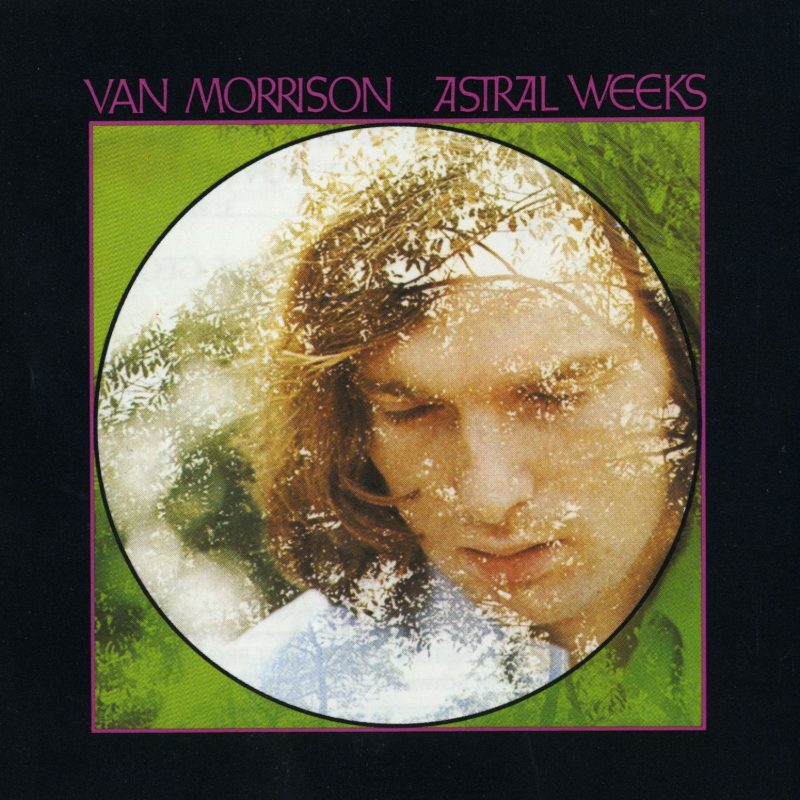
Van Morrison's second album: eight songs he'd carried for years, sung to jazz players, most of whom he'd never met. The playing is a wonder. What was done to it afterwards is the flaw.
- Released
- 29 November 1968 (US, Warner Bros.-Seven Arts)
- Label
- Warner Bros.-Seven Arts Records, WS 1768
- Producer(s)
- Lewis Merenstein, for Inherit Productions · Engineer: Brooks Arthur · Arranger and conductor: Larry Fallon
- Runtime
- 46:54 (2015 remaster); the 1968 label timings add up to 46:05
- Chart peak (US)
- Did not chart
- Chart peak (UK)
- #55 (Official Albums Chart, 1 week, November 2015, after the remastered reissue); did not chart on release
- Certifications
- RIAA Gold (2001); BPI Gold (22 July 2013) and Platinum (21 August 2020)
- Awards & honours
- Grammy Hall of Fame (1999); Rolling Stone's 500 Greatest Albums: #19 in 2003 and 2012, #60 in 2020; Pitchfork 10/10 for the 2015 reissue
The legend says Astral Weeks was made up on the spot by strangers. In fact the songs were years old. What was new was the band, and that meeting is why the record still works. What went wrong was done to it later.
On the evening of 25 September 1968, John Payne listened at Century Sound in New York while another man played flute on Van Morrison's songs. Payne had joined Morrison's group in Boston a few weeks earlier. Nobody has ever named the player who took his place that night. Near the end of the session, Payne asked if he could play on the last song. It was 'Astral Weeks'. By his account the band played it once, and that single take opens the album.
That take carries the record's legend: strangers who'd never heard the songs, and a singer making it up as he went. Half of it is true. The songs were old. 'Ballerina' dated from 1966, and Morrison had already cut 'Madame George' and 'Beside You' for Bang Records in 1967. He'd been playing versions of several others in a Boston club well before the sessions. What was new was the band. Four jazz players met the songs on the night, though Tom Kielbania, Morrison's Boston bassist, says he'd shown Richard Davis the bass lines. Davis embellished them, he said. Astral Weeks is great because of that meeting: a singer sure of every song, and players finding their own way through each one. Its faults came later, from what was added and cut once the singing was done.
Morrison came to those sessions out of a trap. Bert Berns had signed him to Bang, and 'Brown Eyed Girl' reached #10 in America in 1967. Morrison says he saw none of the money. Berns died on 30 December 1967, and the contract passed to his widow, Ilene. Morrison couldn't record or get club work in New York. Ilene Berns tried to have him deported, and he married Janet Rigsbee to stay. Carmine DeNoia, Morrison's main contact at Bang after Berns died, smashed Morrison's guitar over his head after a drunken row. DeNoia told the story himself, to Boston magazine in 2015. Morrison told NPR in 2009 that he'd been broke and working at survival level. None of that anger reaches the record, and its absence is the first strange thing about it.
He got out through Boston. He and Janet moved to Green Street in Cambridge. The producer Lewis Merenstein heard him at Ace Recording, where Morrison played him 'Astral Weeks'. Clinton Heylin's biography says Merenstein was moved to tears. By late summer Morrison was playing the Catacombs club with Kielbania and Payne. The accounts disagree about what came next. Boston magazine says Merenstein's praise brought Warner's Joe Smith to the Catacombs. The New Yorker has Smith buying the contract first and then sending Merenstein. Smith told Boston magazine he carried $20,000 in cash into an empty warehouse on 9th Avenue and came out with it signed. The conditions shaped the record. For a year, Bang's publisher, Web IV, would take half the copyright of any Morrison single. Warner released no single at all, and Pitchfork argued in 2015 that this was deliberate. The album's commercial failure was partly written into its paperwork.
The sessions were at Century Sound, on West 52nd Street. Merenstein called the bassist Richard Davis first. Davis brought in the guitarist Jay Berliner, the percussionist Warren Smith and Connie Kay, the drummer of the Modern Jazz Quartet. Morrison sang and played acoustic guitar in a separate vocal booth. Davis remembered no preparation, no meeting and no introductions. In his account, Morrison strummed each song once or twice, and then they played as the tape rolled. Kay asked what he should play and was told to play whatever he felt. Berliner remembered Morrison playing them the songs on guitar first. Either way, Davis said, nobody explained what the words meant. A singer sealed in a booth, and a band reacting to his voice: that set-up is the sound of the record.
Davis is the real lead instrument. Merenstein said every tune was led by Davis. When Lester Bangs tried in 1979 to say what the record means, the first thing he named was Davis's bass. On the title track, Morrison sings almost without a pause from 0:09 to 5:31. That's more than 5 minutes with no room for a solo, and the bass moves under him all the way. When the voice finally stops, the band plays on alone for about 25 seconds before he returns. It's the clearest demonstration on the album of how the thing works. The words lead, the bass answers, and everyone else listens to both. No producer could have arranged it, because the band was finding the song's shape while the tape ran.
Two of the songs cut that first night are the album's deepest. 'Cyprus Avenue' is a three-chord blues, coloured by Larry Fallon's harpsichord, with his strings added later. Morrison described the street as a wealthy road not far from where he grew up in Belfast, a different world. The song looks at that world from outside, and the street's name keeps pulling him back, at 4:51 and again at 5:07. 'Madame George' runs 9:41 and is the record's centre. Bangs heard it as a portrait of a drag queen. Morrison denied that, and said the character was a composite of several people. The song was first called 'Madame Joy'. The song is better for leaving the question open. Its closing refrain arrives at about 8:48 and lasts under a minute, and the 8 minutes before it are what make it land.
The second productive session, on 15 October, gave the record its other half. 'Sweet Thing' is the nearest it comes to a conventional song. Other singers have taken it up, from the Waterboys in 1988 to Jeff Buckley at Sin-é in 1993. 'Ballerina', written in 1966 when Morrison was still in Them, runs to nearly 7 minutes. His longest pause comes at 3:24, and the band carries the song alone. Across both sessions he never sounds as if he's performing for a band he's just met. He sounds alone, which in the booth he nearly was. This is where the reputation is fully earned. As singing, it's as free and as sure of itself as anything recorded in 1968.
The trouble came after the singing stopped. Fallon arranged and conducted the strings and horns, which were overdubbed later. Some of them help. Others smooth over exactly the roughness that makes the record. Morrison later said the added strings ruined it. He has also complained that the arrangements were too samey, and that four or five songs needed a change of mood. That's harsher than the music deserves. In 1972 he'd said he was pretty happy with the album, apart from feeling it was rushed. Merenstein, not Morrison, chose the running order and named the two halves 'In the Beginning' and 'Afterwards'. He also cut the end off 'Slim Slow Slider'.
That cut is the album's one real wound. The search for a closer had taken up much of the second session when Morrison suggested 'Slim Slow Slider'. Merenstein stripped it to voice, bass and soprano saxophone, then removed a long instrumental coda. Payne's guesses at how much went have ranged from 3 to 10 minutes. Morrison's last line comes at 2:58, and half a minute later the record simply stops on a splice. The 4:53 version issued in 2015 runs well past it. The other weak spot is 'The Way Young Lovers Do', in triple time with brass. Greil Marcus called it out of place in his 1969 review, and Heylin hears lounge jazz. They're right. It's the one track where the arrangement sets the mood instead of following the singer.
Few people bought it at first. The Detroit Free Press praised it a week after release, and Marcus liked it in Rolling Stone. In the NME, Nick Logan heard a pale imitation of José Feliciano's album Feliciano! Robert Christgau wrote in 1972 that it had sold poorly. By 1970 Warner was running an advert for Moondance that called its obscurity a shame. Critics kept it alive. Paul Gambaccini's poll of 50 critics put it at #4 in 1978. A year later Bangs wrote his essay on it for the anthology Stranded. He argued that the people in these songs aren't dying. They're alive, and stunned by it. That reading is still the best guide to the record.
Its influence is easier to feel than to trace. Steven Van Zandt, Springsteen's guitarist, said in Rolling Stone in 2008 that Astral Weeks 'was like a religion to us'. Greil Marcus reports Martin Scorsese saying the first 15 minutes of Taxi Driver were based on it. Elvis Costello called it the most adventurous record in the rock medium. Beyond that, the trail thins, and its clearest heirs are cover versions. Johnny Rivers even named a 1970 album after 'Slim Slow Slider'. Stephen Thomas Erlewine put it well in Pitchfork in 2015. Singer-songwriters treated it as a primary text, he wrote, but nobody, Morrison included, found a way back to it. That's devotion more than influence, and it's why the record still sounds like nothing else.
Its standing has moved. Rolling Stone ranked it #19 among the 500 greatest albums in 2003 and again in 2012, then dropped it to #60 in 2020. It went Gold in the US in 2001, 33 years after release. In Britain it spent a single week on the albums chart, at #55, in November 2015, and went Platinum in 2020. Not one of its songs made Still on Top, the 2007 hits collection Morrison endorsed. The slide in the polls looks like a correction rather than a fall. The record was never as central as its champions claimed, or as marginal as its sales suggested.
So what is it worth now? The singing and Davis's bass are as good as anything recorded that year, and the eight songs hold together as one long mood. The legend of improvised genius undersells that achievement. Morrison knew these songs inside out, and that's what let him leave strangers to find their own way round them. What lets it down is the producer's hand: strings that soften it, a lounge-jazz track that steps outside the mood, and a closer cut off mid-thought. Play it from the first track to the splice and you'll hear both. It's a great record with a scar, and you shouldn't pretend the scar isn't there.
Pressing guide — the one to own
The original to own is the 1968 US first pressing, Warner Bros.-Seven Arts WS 1768, on the green label with the boxed 'W7' logo. The labels read 'Part 1' and 'Part 2' and carry the matrices S39435 and S39436. Columbia pressed it at three plants, and the runout tells you which: 'P' for Pitman, 'S' for Santa Maria, 'T' for Terre Haute. First-state jackets give Warner's address as 321 W. 44th Street. The 1969 repress has the green 'WB' shield label instead.