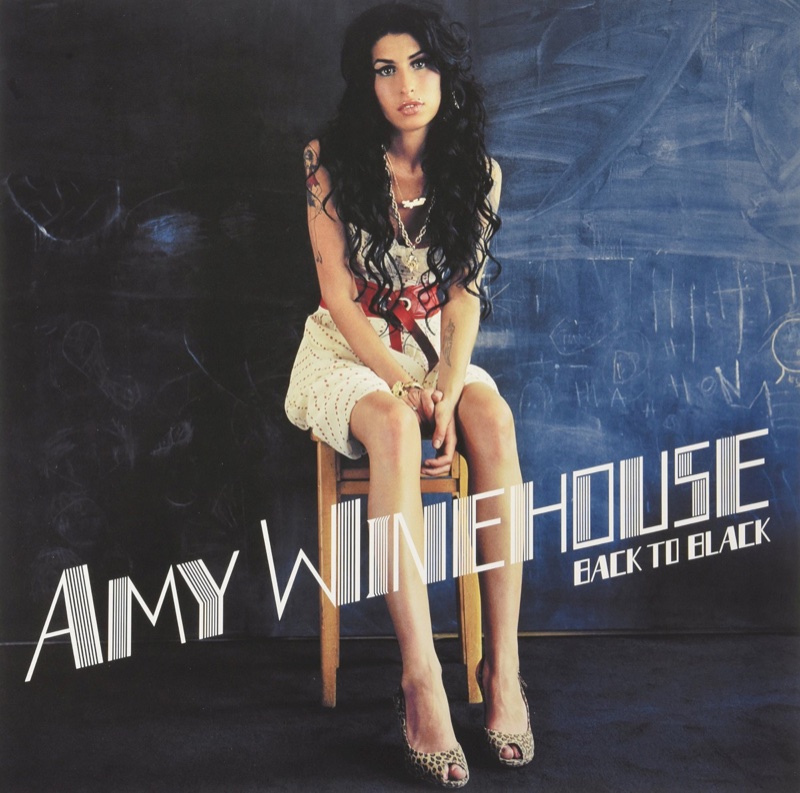
Amy Winehouse's second and last studio album, released in 2006 and made with Mark Ronson, Salaam Remi and a Brooklyn soul band. The sound is borrowed. The voice and the jokes are hers.
- Released
- 30 October 2006 (UK, Island; some sources give 27 October); March 2007 (US, Universal Republic)
- Label
- Island Records (UK) / Universal Republic (US)
- Producer(s)
- Mark Ronson (6 tracks) and Salaam Remi (5 tracks)
- Runtime
- 34:54 (11 tracks, UK edition)
- Chart peak (US)
- #2 (Billboard 200, chart dated 1 March 2008, after the Grammys)
- Chart peak (UK)
- #1 (Official Albums Chart): entered at #3 in November 2006, first #1 in January 2007, 6 weeks at #1 in all · the UK's best-selling album of 2007
- Certifications
- BPI 15× Platinum (March 2025); RIAA 2× Platinum (March 2008); more than 20 million worldwide by 2015, per the Hollywood Reporter
- Awards & honours
- Five Grammys at the 50th ceremony in 2008, including Record and Song of the Year for 'Rehab'. Brit Award for British Female Solo Artist (2007). Ivor Novello for 'Love Is a Losing Game' (2008). Mercury Prize shortlist (2007)
Its sound is a close rebuilding of 1960s soul, and the band that beat it to the Mercury Prize called it retro. Its words are the opposite: exact and funny about her own life, and sung better than the setting asks.
In September 2007 the Mercury Prize went to the Klaxons' Myths of the Near Future, not to Back to Black. Winehouse sang 'Love Is a Losing Game' at the ceremony. The Klaxons' singer, Jamie Reynolds, said his band deserved to win because hers was a 'retro record'. One of the judges, the NME editor Conor McNicholas, explained the verdict in two halves. Her album was "one of the greatest vocal performances this country has ever seen". It was also, he said, arguably backward-looking.
Both halves were right, and 19 years later they still are. As a sound, Back to Black invents almost nothing. It's a close rebuilding of 1960s soul, much of it played by the Dap-Kings, Sharon Jones's band on the Brooklyn label Daptone. What it adds is the thing a period piece usually lacks. A woman of 22 wrote exactly, and often funnily, about her own life, then sang it better than the setting asked. That makes it a great record. The borrowed frame is what keeps it from being a perfect one.
The sound started with a record collection. Her debut, Frank, had come out in 2003, and in 2006 she told the Sun she was "not a jazz girl any more". She'd been listening to 1960s girl groups, she said, and named the Velvelettes and the Shangri-Las. She and Mark Ronson were put together by a publisher they shared. At their first meeting, in March 2006 at his studio on Mercer Street in New York, she played him Shangri-Las records. Overnight he wrote a piano part, which became the chords under the verses of 'Back to Black'. Within 2 weeks, he told Mojo in 2010, they'd worked up five or six songs. The words came from two departures. She left Simon Fuller's management company, which had tried to get her into rehab. Nick Shymansky, her first manager, told NPR in 2015 that the plan held until her father changed his mind. He called the song she made of it "pretty much verbatim" what happened that day. Mitch Winehouse's memoir has her telling Ronson, on a walk, how everyone at her father's house had gone on at her about her drinking. Ronson heard a hook in it. The other departure was Blake Fielder-Civil's. She wrote the album as their relationship came apart, and in 2006 she told the Sun that most of the songs were about him.
Ronson's first instinct was a computer. He told the New York Times in 2007 that he tried computer tricks first, and that the Dap-Kings sounded far better. So his six songs were played by a band. Drums, piano, guitar and bass went down together in one room in Brooklyn, spill and all, with the drums on a single mono track. Then Ronson came to London and added strings, brass and percussion at Metropolis Studios. The mixer, Tom Elmhirst, was sent Ronson's own mixes, with the drums panned to one side, Beatles-style. Under 'Rehab' he added two sampled kick drums and a sampled snare. The 1960s sound got a 2006 finish, and that's no scandal. Authenticity here is a production decision, and mostly a good one.
The other five songs come from Miami, and they're close to a different record. Salaam Remi, who had produced much of Frank, cut them at Instrument Zoo with none of the Dap-Kings. Its engineer, Franklin Socorro, remembered about 10 days of work. People on the sessions told the Miami New Times in 2017 that she sang while playing guitar, a couple of takes a song. Remi played bass on all five, with Vincent Henry on saxophones and flute. Gary 'G Major' Noble mixed four of them in Miami, and only 'Tears Dry on Their Own' went to Elmhirst. So the album has two producers, two bands and two mixers. The running order shuffles them, and the shuffle mostly hides the join.
You can hear what kind of record this is in its first second. 'Rehab' has no intro to settle into: her voice is there within a second. It's a true story told as a joke. Listen to the drums under it. Elmhirst told Sound on Sound he kept them drier in the verses and brought a spring reverb right up for the chorus and the bridge. So every refusal arrives in a bigger room than the verse before it. Its horns mix three Dap-Kings with seven London players added at Metropolis, which tells you how assembled the live sound is. The title song works the other way. The band plays for 16 seconds before she comes in, over Ronson's overnight chords. It's the one song she wrote with Ronson, and the album's centre.
The best song is the shortest of Ronson's six. She wrote 'Love Is a Losing Game' alone, and it runs 2:35. She's singing within 5 seconds and finished by 2:23, with no solo and no detour. An orchestra and a harp are credited, yet the song never stops to let them play on their own. Prince was covering it on stage by mid-2007, and it won her an Ivor Novello in May 2008. The Miami side shows her other gift. 'Me & Mr Jones' is a cross, funny song about a man who made her miss a gig. Nas is the Mr Jones of the title, a play on Billy Paul's 1972 'Me and Mrs. Jones'.
Two songs show the halves meeting. 'You Know I'm No Good' is Ronson's: Nick Movshon's bass, the Dap-Kings' horns, and a confession of infidelity with no plea for sympathy. As a single in January 2007 it reached #18, with a Ghostface Killah verse added. That version closes the American edition. 'Tears Dry on Their Own' is the reverse case. Remi made it in Miami, but it's the one song of his that Elmhirst mixed alongside Ronson's. It interpolates 'Ain't No Mountain High Enough', so Ashford and Simpson share the credit. She built a song about getting over someone on a 1967 duet. Borrowing, here, is a way in rather than a crutch.
The singing is the record's real strength, and McNicholas's line wasn't flattery. She was sole writer on seven of the 11 songs, and she sings them as their author. She knows which line is the joke and which is the wound. On 'Wake Up Alone', co-written with Paul O'Duffy, the band plays for 28 seconds before she enters. The arrangement is drums, bass, guitars and piano. It's the only one of Ronson's six with no horns or strings credited, and it's among the best things here. On 'Some Unholy War' she sings her own backing vocals, and the whole song is over in 2:22.
The weak spots are on the Miami side. 'Just Friends' is the slightest song here, a pleasant lilt with little inside it. 'Addicted' closes the British album with a joke about preferring weed to a man. It's B-side material, and both the American edition and a ten-track European CD leave it off. The American one ends instead with Ghostface Killah's version of 'You Know I'm No Good'. Neither song was a single. The bigger flaw is the one McNicholas named. Nearly every arrangement points back to 1960s records, and 'He Can Only Hold Her' is built on one, the Icemen's 1966 '(My Girl) She's a Fox'. The songs never surprise you the way their words do, because the frame won't let them.
The first reviews were warm rather than unanimous. Dorian Lynskey's Guardian review, on 27 October 2006, already called it a 21st-century soul classic. Rolling Stone's Christian Hoard was cooler: the tunes, he wrote, "don't always hold up". Yet the song he picked out as one of the best was 'Addicted', one of the two we'd cut. The singles tell a slower story. On release 'Rehab' reached #7, while 'Back to Black' managed only #25 and 'Love Is a Losing Game' #46. After her death in 2011 'Back to Black' made the Top 10 for the first time, at #8. By 2015 it had sold 357,000 copies in Britain, close to the 383,000 of 'Rehab'. The songs kept finding people long after their first chart runs ended.
The public didn't mind the costume. The album entered the UK chart at #3 with 43,000 copies, fell to #41 in December, then reached #1 in its 11th week. It was Britain's best-selling album of 2007. In America it entered at #7, the highest US debut by a British woman at that point. At the Grammys on 10 February 2008 she won five awards, a record for a British woman at the time. Her visa was refused, then granted too late, so she sang by satellite from London. After the ceremony the album jumped from #24 to #2 in America. Ronson's own album, Version, followed in 2007, with Winehouse singing 'Valerie'. In 2009 the Sunday Times's Dan Cairns put it bluntly: "Winehouse begat Adele and Duffy". By 2018 only Adele's 21 had sold more in Britain this century.
Winehouse died at home in Camden on 23 July 2011, aged 27, of alcohol poisoning. The album went back to #1 for 3 weeks that August. Since then it's been hard to hear 'Rehab' as funny, and easy to hear the whole record as a warning. That's a misreading. The songs are about a break-up and a refusal, written by someone in charge of her material, and they have more jokes in them than prophecies. Its standing has only grown. In 2019 the Guardian's critics put it at #1 in their poll of the century's best albums. In 2025 it joined the Library of Congress's National Recording Registry.
So the Klaxons were right about the sound and wrong about the record. Back to Black doesn't move pop forward, and two of its songs are filler. But 'Rehab', 'Back to Black' and 'Love Is a Losing Game' would be great in any decade's clothes. The voice that carries them is the most original thing on the album, and it isn't borrowed from anyone. Play it as what it is: a great singer and writer at 22, working inside a frame she chose, and outgrowing it.
Pressing guide — the one to own
There was no British vinyl in 2006. The catalogue lists the October 2006 UK release on CD only, and no UK cassette. The first LP made for Britain and Europe is the 2007 Universal/Island 180 g pressing, 173 412 8. Optimal Media pressed it, and Stuart Hawkes cut the lacquers, signing 'Stu.' in the runout. Its sticker for the February 2007 Brit Awards means it can't be earlier than that. The US LP, Universal Republic B0008994-01, is dated 2006 in its catalogue entry from its copyright line. The American album came out in March 2007, though, and no source dates the LP's release. It also isn't the British album. It ends with Ghostface Killah's version of 'You Know I'm No Good' and leaves out 'Addicted'.