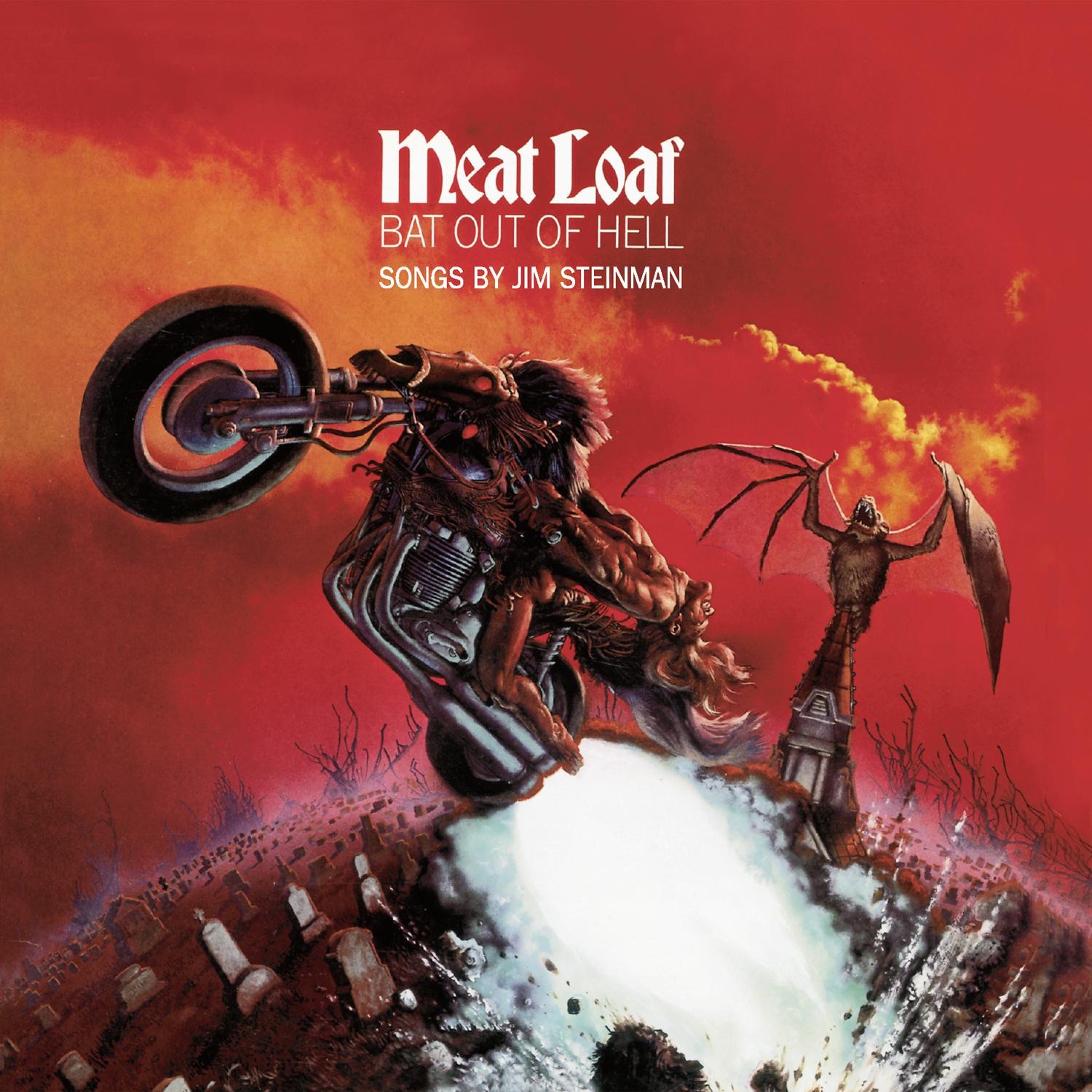
Meat Loaf's first solo album is Jim Steinman's teenage rock opera, produced by a man who heard a Springsteen parody. The playing is what lasts, and almost nothing followed it.
- Released
- 21 October 1977 (Cleveland International / Epic)
- Label
- Cleveland International / Epic: PE 34974 (US); EPC 82419 (UK and Europe); ELPS 3860 (Australia)
- Producer(s)
- Todd Rundgren (also engineer, mixer and co-arranger)
- Runtime
- 46:25 (7 tracks)
- Chart peak (US)
- #13 (Billboard 200, chart dated 5 February 2022); #14 in 1978
- Chart peak (UK)
- #3 (Official Albums Chart, 3 February 2022); 530 weeks on the chart
- Certifications
- RIAA 14× Platinum (April 2001); BPI 12× Platinum (January 2025); Music Canada 2× Diamond (August 1995)
- Awards & honours
- #343 on Rolling Stone's 500 Greatest Albums (2003); #71 in Q's 100 best record covers (2001); the biggest-selling debut album in UK history (National Album Day list, October 2022)
Bat Out of Hell is a comedy performed with complete conviction. The production and the playing, more than Jim Steinman's songs, are what make it last, and that same conviction explains why so few records followed it.
Phil Rizzuto's first take was flat. The Yankees broadcaster came to the Hit Factory in New York in 1976 to read a baseball call that Meat Loaf and Jim Steinman had written for him. They'd built it from Meat Loaf's notes on Rizzuto's television commentary that summer. In the studio, Rizzuto read it like a script, and it sounded like one. Meat Loaf's advice, as he told ESPN in 2007, was simple: “Just do it like it's a game”. The second take is the one on the record, in the middle of 'Paradise by the Dashboard Light'. It's a ballgame called in earnest, inside a song about a teenage boy trying to talk his girlfriend into sex.
That instruction is the best guide to the whole album. Bat Out of Hell is a comedy played with a straight face. Its producer, Todd Rundgren, told the Houston Chronicle's Andrew Dansby that he'd heard it as “a parody of Bruce Springsteen”, and that he was still chuckling. Robert Christgau, grading it in his Consumer Guide, suspected that some of the laughter was intended, and gave it a C− anyway. Both men were half right. The songs are absurd on purpose. The playing never lets on, and that's why the record has lasted. It's also why so few records have followed it.
None of it began as an album. Meat Loaf met Steinman around 1973, when he auditioned for Steinman's musical More Than You Deserve at the New York Shakespeare Festival. By the mid-1970s both were touring with the National Lampoon show, and Steinman was writing Neverland, a rock reworking of Peter Pan. Three of its songs became the core of a seven-song album: 'Bat Out of Hell', 'Heaven Can Wait' and the number that became 'All Revved Up with No Place to Go'. Steinman told Classic Rock in 2000 that he hadn't wanted “just a bunch of songs”. He wanted an album that sounded like a movie. The key word, he said, was “heightened”.
Record companies weren't persuaded. The pair auditioned the album as a live show, with Steinman at the piano playing every song in sequence and Meat Loaf singing. Sometimes Ellen Foley came along to sing the duet in 'Paradise'. Clive Davis turned it down. Todd Rundgren didn't. By his own account he rolled on the floor laughing when he first heard the songs, because they were “so out there”. He took the pair to Bearsville in New York State to record them. With the tapes made, Albert Grossman took them to Warner Bros., and that came to nothing too. In the end Steven Van Zandt of Springsteen's E Street Band got Steve Popovich of Cleveland International to front a deal. Cleveland International's parent label was Epic. The album came out on 21 October 1977, and Classic Rock later reported that almost everyone at Epic hated it.
The band came from two camps. Rundgren's group Utopia supplied Kasim Sulton on bass, Roger Powell on synthesizer and Willie Wilcox on drums. From Springsteen's band came Roy Bittan and Max Weinberg. The credits are worth reading closely. Weinberg drums on three tracks, and Wilcox on the other three that have drums. Bittan plays piano on all seven, the only musician apart from Meat Loaf who's on every track. Steinman chose to stay off the piano apart from a couple of overdubs. Meat Loaf said Bittan got the job because his style was so close to Steinman's. Rundgren himself is the only guitarist credited anywhere on the album, and he worked fast. Meat Loaf told Classic Rock that watching him record a lead solo in one take, then add the harmony guitars, was one of the most mind-blowing moments of his life. The whole job took no more than 45 minutes. The magazine doesn't say which song it was.
The title track shows what that band could do. It runs 9:48, and Meat Loaf doesn't sing until 1:54. Nearly 2 minutes of it belong to the players, and the sleeve gives Rundgren a separate “motorcycle guitar” credit on this song. He mixed the whole record in one night, Meat Loaf said, starting at six o'clock and finishing at about four in the morning. Even so, the sleeve credits John Jansen with remixes of three tracks, this one included, and Jimmy Iovine with a fourth.
Meat Loaf is the other half of the bargain. Dave Marsh, reviewing the album for Rolling Stone on 15 December 1977, found his phrasing “way too stage-struck”. That's the right observation and the wrong verdict, because these are stage songs. 'You Took the Words Right Out of My Mouth' opens with nearly 50 seconds of spoken scene, and the song proper starts at 1:03. From there Meat Loaf sings it as a character, and Marsh liked this one anyway, calling it “swell”. The other voices are cast rather than stacked. Foley sings the girl's part on 'Paradise' and backing vocals on three more tracks. Rory Dodd sings backing vocals on six.
'Paradise by the Dashboard Light' is where the theatre and the band meet. It runs 8:28 in three titled parts, and its title is sung for the last time at 2:54. After that comes plot. The second and third parts are called 'Let Me Sleep on It' and 'Praying for the End of Time', and the titles tell you how the evening goes. Steinman also takes a sleeve credit on the track for “lascivious” effects. It's the record in miniature: a private joke, carried by a performance that never smirks. 'Heaven Can Wait' is the opposite case. No drums or bass are credited on it, only Bittan's piano, Ken Ascher's strings and the voices. It's the one place the album stands still, and it's the better for it.
Not every song earns its length. 'Two Out of Three Ain't Bad' is the plainest writing on the record, and it became the biggest of its three US top-40 singles, reaching #11. It waits until 1:53 to sing its title, and the patience suits it. 'For Crying Out Loud' can't carry the same wait. It runs 8:45, and its title arrives at 2:45. Steve Margoshes's orchestra arrangement, played by members of the New York Philharmonic and the Philadelphia Orchestra, gives it size. It doesn't give it a reason to take so long. 'All Revved Up', at 4:19 the shortest song, is closer to an ordinary rock track than anything else here. To these ears it's the one Neverland song that sounds like filler.
Then there's Springsteen. Christgau called the effect “grotesquely grandiose” and laid the blame at Springsteen's door. Marsh named a different model, hearing Bob Seger's 'Night Moves' as an obvious influence. Steinman, asked by Gallery magazine in May 1978 about critics who traced everything to Springsteen, found the comparison “puzzling, musically”. Springsteen, he said, was “more an inspiration than an influence”. Elsewhere he named the Who, Phil Spector and the Beach Boys as the music that influenced him most. He and Springsteen, he said, came from the same influences, and he gave Del Shannon's 'Runaway' as one. He didn't hide his admiration either. Springsteen, he said, was the only recent artist who'd thrilled him. Bittan and Weinberg had played on Born to Run in 1975. Hiring them made the comparison impossible to escape, whatever Steinman intended.
The commercial story is often told wrong too. America didn't wait for Britain. The album entered the Billboard 200 at #185 on the chart dated 29 October 1977 and peaked at #14 in 1978. Before 2022 it had spent 82 weeks on that chart. Canada certified it Gold on 1 March 1978 and Diamond a year later. Britain came next. It entered the UK chart at #60 on 11 March 1978. About six months after release, The Old Grey Whistle Test aired a film of the band playing the title track. The response was strong enough that it ran again the following week. In Britain the album then kept coming back. It has spent 530 weeks on the Official Albums Chart. In October 2022 a list compiled for National Album Day, which the BPI organises, put it first among debut albums in UK history, with more than 3.5 million sales.
What it changed is harder to name than what it sold. We found no musician on record saying this album changed how they made music. Its clearest descendants are Steinman's own. The 1993 sequel, Bat Out of Hell II, spent a week at #1 in America. Classic Rock also credits him with later hits for Air Supply, Barbra Streisand and the Sisters of Mercy. The one tribute we found is a pun: Fantastic Cat's 2026 album Cat Out of Hell, whose title The Big Takeover called a nod to it. Rolling Stone, at least, came round. The magazine whose reviewer had called the songs “mannered and derivative” put it at #343 on its 500 Greatest Albums in 2003. When Meat Loaf died on 20 January 2022, aged 74, the album reached new peaks: #3 in Britain and #13 in America.
So the record has been misread in both directions. Its sales make it look like a summit, and its first critics heard stage-struck pastiche. It's better than the second and smaller than the first. What lasts is the production and the playing: Rundgren's guitars, Bittan's piano, Foley's half of 'Paradise' and Rizzuto's second take. The songs lean on Spector, the Who and Springsteen more than they move past them. 'For Crying Out Loud' outstays its idea, and 'All Revved Up' never quite has one. Outside Steinman's own work, almost nothing followed where it went. Admire it as a feat of casting and conviction, and enjoy the joke. Just don't mistake the conviction for depth.
Pressing guide — the one to own
There's no single prize, because almost every edition was made in quantity. The everyday original is the US Epic / Cleveland International PE 34974, with orange labels and a custom printed inner sleeve carrying the credits and lyrics. By October 2026 collectors had logged more than 18,000 copies of the Terre Haute pressing alone. Of the 1977 editions listed here, only one prints a run size: a Cleveland International picture disc, PBL 34974, marked 'limited edition of 1000' on the back of its sleeve. The retail picture disc, E99 34974, had 1,174 copies logged by October 2026, against 169 for the edition of 1,000.