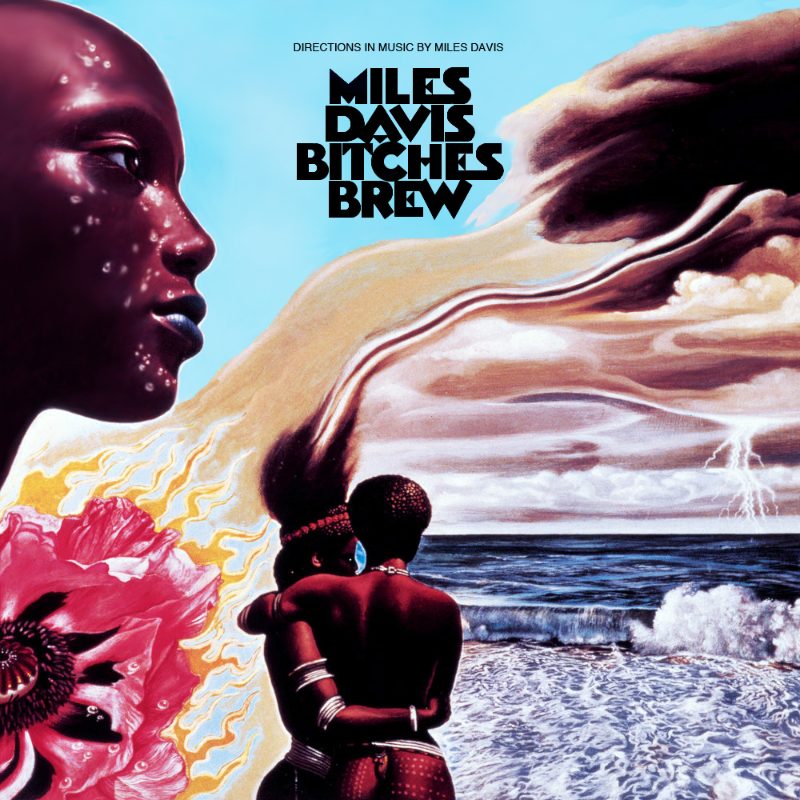
Miles Davis's 1970 double album, played by two drummers, two bassists and a bank of electric keyboards, then rebuilt by a producer with a tape machine. Its greatness and its sprawl share one cause.
- Released
- 30 March 1970 by Columbia's date (Paul Tingen gives April 1970)
- Label
- Columbia (US, GP 26); CBS (UK, 66236); CBS/Sony (Japan, SONP 50255~6)
- Producer(s)
- Teo Macero
- Runtime
- 93:57 (6 tracks on 2 LPs, sleeve timings)
- Chart peak (US)
- #35 (Billboard 200, chart dated 4 July 1970) · #1 (Billboard Best Selling Jazz LPs, 18 July 1970)
- Chart peak (UK)
- #71 (Official Albums Chart, 1 week, July 1970)
- Certifications
- RIAA Platinum (22 September 2003)
- Awards & honours
- Grammy, Best Jazz Performance – Large Group or Soloist with Large Group (1971); Grammy Hall of Fame (1999); National Recording Registry (2025); #87 in Rolling Stone's 500 Greatest Albums (2020)
Bitches Brew is two works on one record: three days of a 13-piece electric band in Columbia's Studio B, and Teo Macero's loops and splices afterwards. We'd argue the editing made it famous, and its best track is the one he left alone.
Joe Zawinul didn't like the Bitches Brew sessions. In Paul Tingen's 2001 history of the record for JazzTimes, the keyboard player recalls finding them unexciting while they happened. Then he heard the finished album at CBS and changed his mind. Lenny White, the 19-year-old second drummer, had a similar shock. The band heard the unedited tapes at Davis's house afterwards, he recalled. When the record came out about half a year later, it sounded totally different.
Those two reactions hold the argument. Bitches Brew is two works laid on top of each other. One is three days of playing by 13 musicians in August 1969. The other is what the producer Teo Macero made from the tapes, with loops, splices and echo. The record's fame rests on the second. Its best track is the one Macero left alone. And its real weakness sits between the two. The tunes are sketches, and the editing stretches them further than they can carry.
The electric turn didn't start here. Joe Beck played guitar on 'Circle in the Round' in December 1967, the session Tingen marks as the start of the new direction. In May 1968 Herbie Hancock played a Fender Rhodes and Ron Carter an electric bass on 'Stuff'. In a Silent Way, cut in one session on 18 February 1969, already had John McLaughlin's guitar, two electric pianos and Zawinul's organ. Macero had spliced that record too. Reviewing Bitches Brew for Rolling Stone in May 1970, Langdon Winner named Filles de Kilimanjaro and In a Silent Way as its foundations. He was right, and the new record's real novelty was scale.
What changed by 1969 was the company Davis kept and the band he toured with. He met Betty Mabry in late 1967 and married her in September 1968. She steered him towards Sly Stone and Hendrix, and introduced him to Hendrix in person. Tingen ties one title, 'Miles Runs the Voodoo Down', to Hendrix's 'Voodoo Chile'. Meanwhile his working band was testing new music on stage. From July 1969, Wayne Shorter, Chick Corea, Dave Holland and Jack DeJohnette played 'Spanish Key', 'Miles Runs the Voodoo Down' and 'Sanctuary' live. Three of the six tracks were road-tested before anyone reached the studio. The best of the record is a band playing tunes it already knew.
The sessions began at 10 a.m. on Tuesday 19 August 1969, in Columbia's Studio B at 49 East 52nd Street. White remembered everyone on headphones so they could hear each other, and everything recorded live, with no overdubs. The line-up was built for density, not for solos. There were two drummers, White and DeJohnette, and two electric pianists, Zawinul and Corea. Larry Young made a third on the last day. Harvey Brooks played Fender bass alongside Holland's acoustic. Holland later explained the split: Brooks held the line and he decorated it. White said he wanted the two drummers to sound like one drummer with eight arms.
Davis compared his own role to a conductor's, and the tapes catch him at it. About 7:50 into the title track, the band drifts. Davis says one word, 'John', and McLaughlin starts to solo. It's the clearest sound on the record of how Davis composed in 1969, by choosing who played and when. The written material was thin. Zawinul brought 10 tunes to Davis before the sessions, and Davis made sketches from them. Holland described the notation as a kind of collage.
Then came the second composition. Macero said he had a free hand and spent 4 or 5 weeks on the tapes, and that Davis approved the results. His tools were tape loops, echo, plate reverb and the Teo One, a tape-delay machine built at Columbia. 'Pharaoh's Dance', Zawinul's tune on side one, carries 17 edits by Tingen's 2001 count, which follows Enrico Merlin's analysis. His 1999 account counted 19. Its stop-start opening was built entirely from loops of two fragments, 15 and 31 seconds long. Around the nine-minute mark, a one-second fragment repeats five times. The title track has 15 edits, including a five-second bass vamp looped five times between about 3:00 and 3:30.
How audible is all this? Tingen says the edits aren't immediately apparent, and argues that they give the music a hidden sense of unrest and of structure. Pitchfork's Mark Richardson, reviewing the 2010 reissue, heard some of them as abrupt. Both are right about different moments. The editing also put Davis in front. Tingen hears him mixed like a singer, and his solo from about 3:34 of 'Pharaoh's Dance' wrestles the band. On the title track his theme arrives at about 0:41, wrapped in echo, after a bass vamp and a free-time introduction. In 1981 Robert Christgau heard a two-note motif on the title side repeated a dozen times, until one echoed trumpet blast resolves it. That's the method in small: a fragment with almost no tune, made tense by repetition and placement.
Yet the most satisfying track is the one Macero didn't touch. On 20 August the band played four takes of 'Miles Runs the Voodoo Down' in its live arrangement. Peter Losin's session log has Don Alias on White's drum kit from the fifth take, with a new pattern, and the tune changed around it. Alias later said he'd been practising the rhythm in New Orleans at Mardi Gras, and spoke up when the groove wasn't working. Take 9 is the one on the record, issued unedited at 14:03. Holland switched to electric bass for it, so both basses are electric. McLaughlin and Maupin open over Alias's beat, and Davis states the theme at about 0:34. Tingen calls it probably the album's most successful track, for its bass line, its groove and its tight structure. It's hard to disagree.
Set beside it, the two long sides show what the method costs. 'Pharaoh's Dance' runs 20:07 and the title track 27:00. Tingen, who admires the record, offers two ways to hear that length. Taken as an ambient space to roam in, it's part of the attraction. Judged on solos, themes and development, both tracks are too long and would work better cut substantially, and he notes that Davis played the title track live at about half the length. He'd also have ended 'Spanish Key' around 13 minutes, where the music seems to stop of its own accord. Even 'Sanctuary' loses by comparison. The quintet had first recorded Shorter's tune on 15 February 1968, and Tingen finds this version less subtle. Christgau's complaint was broader. In 1981 he called the album brilliant but unfocused, and found its layered rhythms less driving than Tony Williams's steadier pulse on In a Silent Way. Both complaints point at the same gap. The material is vamps and motifs, not tunes with a shape of their own. Editing can give a fragment drama, but it can't give 20 minutes of one a reason to end.
None of that stopped the record reaching people jazz rarely reached. Davis wasn't a cult figure trying to cross over. In May 1970 Christgau called him a commercial business, with probably the largest audience of any serious jazz musician since the 1930s. Davis's sextet opened for Neil Young & Crazy Horse at the Fillmore East on 6 and 7 March 1970, weeks before release. In April his band opened for the Grateful Dead at the Fillmore West, and Winner reported that fully a third of the audience there left after Davis's set, in stunned silence. Christgau's column has Davis passing off those Fillmore dates as a favour to Clive Davis, Columbia's president. The favour paid. The album reached #35 on the Billboard 200 on 4 July 1970, his highest peak on that chart. A fortnight later it was #1 on Billboard's jazz chart.
The players took the method with them. Zawinul and Shorter formed Weather Report, McLaughlin the Mahavishnu Orchestra, and Corea led Return to Forever with White on drums. Writing in Rolling Stone in 1978, Michael Segell reported that Clive Davis signed Weather Report after Bitches Brew succeeded. Still, the common shorthand, that this record started fusion, doesn't survive the dates. In a Silent Way came first, and so did Tony Williams's Emergency!, with McLaughlin on both. What Bitches Brew did was take Macero's splicing to a scale where the edit became part of the composition. It then put the result in front of rock crowds. Segell saw Davis's idea refined by Herbie Hancock's Head Hunters, which sold a million copies in 1974, and George Benson's Breezin', at nearly 3 million by the time he wrote. By 1978, he reported, Bitches Brew itself had sold more than a million copies.
Apart from Christgau's cooler verdict in 1981, its standing has mostly risen. Pitchfork gave the 2010 reissue 9.5, and the National Recording Registry added it in 2025. Even the sound has been argued over. The 1998 box set remixed the tapes, and Tingen reported a consensus, the musicians included, that the new mixes sounded excellent. Macero objected, saying Davis now sounded "one inch tall". That fight is the record's whole history in one exchange: who owns the shape of the music, the players or the man at the tape machine?
The reputation is right about the sound: two drummers, two basses and a crowd of electric keyboards, with Davis riding on top. It's right about what Macero proved a producer could build from tape. It overrates the album as a set of compositions, and the long sides ask for a patience the material doesn't always repay. Start with side four, where 'Voodoo Down' shows the band at its best, uncut. Then play the title track and wait for Davis to say 'John'. Bitches Brew is essential listening, and it's also 94 minutes that would be stronger at 60.
Pressing guide — the one to own
The original to own is the 1970 US Columbia GP 26, a stereo gatefold double LP with discs numbered CS 9995 and CS 9996. It carries Mati Klarwein's painting, John Berg's design and Ralph J. Gleason's notes, and the front reads 'Directions In Music By Miles Davis'. First pressings have red 'two-eye' labels with '360 Sound'. The matrix numbers are XSM 152412 to 152415, and an etched letter in the runout names the plant: S for Santa Maria, P for Pitman, T for Terre Haute. Most early labels credit 'Sanctuary' to Shorter and Davis; some name Shorter alone.