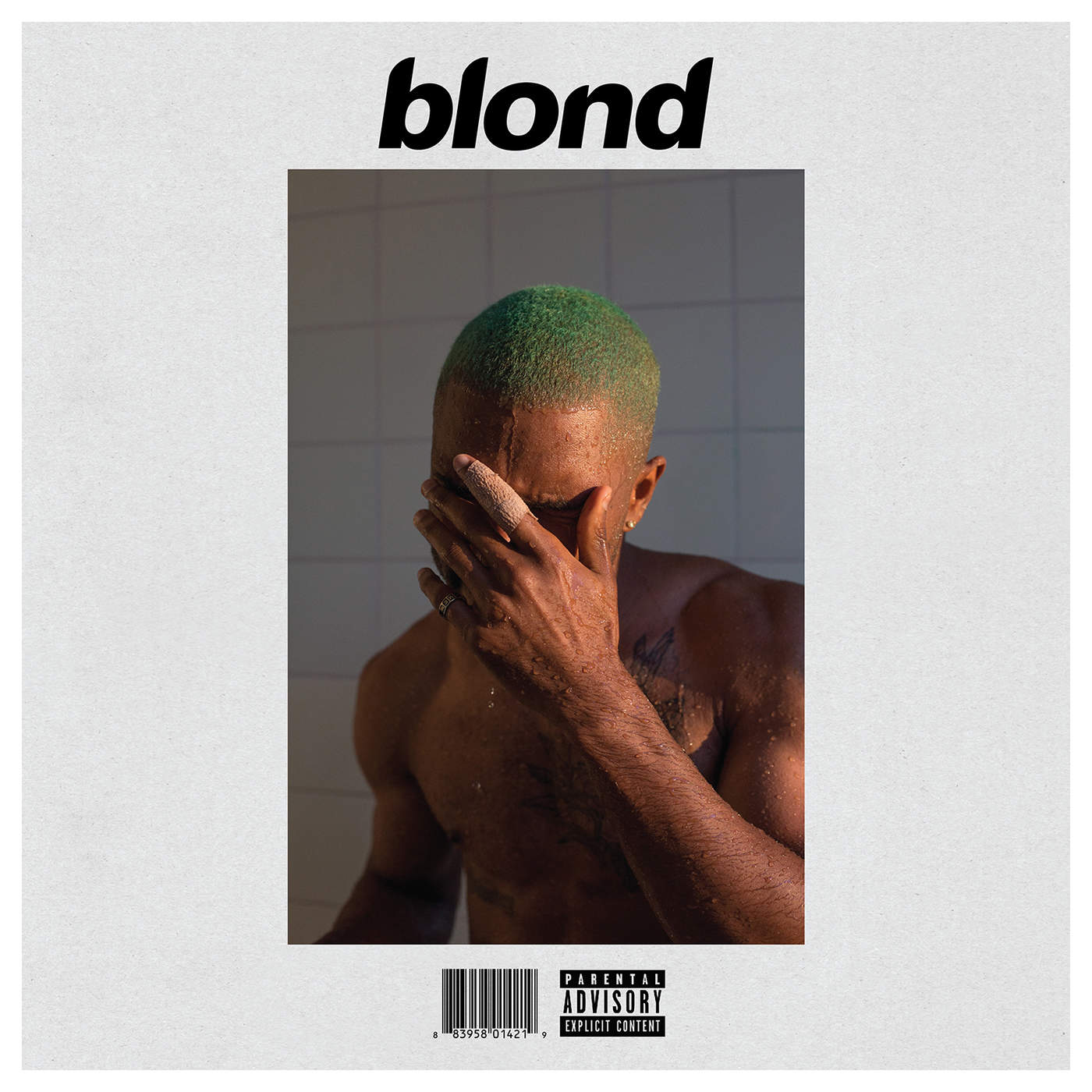
Frank Ocean's second album, released on his own label in August 2016 after he bought his way out of Def Jam. Its 17 tracks are about memory, and about how memory sounds.
- Released
- 20 August 2016 (digital, iTunes and Apple Music); CD and vinyl 25 November 2016
- Label
- Boys Don't Cry; 2016 CD distributed by XL Recordings; 2022 vinyl on Blonded
- Producer(s)
- Frank Ocean, with Malay, Om'Mas Keith, James Blake, Jon Brion, Buddy Ross, Rostam Batmanglij, Pharrell Williams, Vegyn, Michael Uzowuru and Francis Starlite
- Runtime
- 60:08 (17 tracks)
- Chart peak (US)
- #1 (Billboard 200, chart dated 10 September 2016), 276,000 equivalent units in its first week
- Chart peak (UK)
- #1 (Official Albums Chart, 26 August–1 September 2016)
- Certifications
- RIAA Platinum (9 July 2018); BPI 2× Platinum (10 April 2026)
- Awards & honours
- #1 on Pitchfork's 200 best albums of the 2010s (2019); in Rolling Stone's 500 Greatest Albums (2020)
Blonde sounds like a daydream and was built like a safe. Four years, three cities and a buyout from his label went into a record of tight control. That control makes its best songs, and in places it buries the singer.
Frank Ocean made 50 versions of 'White Ferrari'. He told the New York Times so in an interview published in November 2016, three months after Blonde came out. His 15-year-old brother heard one of them and told him to put it out. Ocean refused, because that version didn't yet give him peace. It's a small story. It explains the record better than its legend does.
The legend is about absence. Blonde took four years to arrive. The Guardian's Tim Jonze heard a record almost without percussion, and Pitchfork's Doreen St. Félix later wrote that its songs evaporate. All of that is true to the sound and false to the making. Blonde is a record of tight control that sounds like a record of drift. Ocean bought back his masters and carried his own hard drives onto planes. That control is why the album still holds up. It's also, at times, what's wrong with it. On a few tracks the treatments bury the singer, and the man who wrote the songs seems to step out of the room.
The four years began with a plan. In February 2013, with two Grammys just won, Ocean told Zane Lowe on BBC Radio 1 that he was 10 or 11 songs into the next record. He described it as another near-concept album, picking up from the beach scene that closes Channel Orange. Then he left Los Angeles. The Times reported that people there had stolen money from him. He'd also come to believe he was making the moves that brought success without taking most of the profit. He flew to London with a duffel bag of clothes and the hard drives that held his music. The escape shaped the record more than any studio did.
The writing didn't come easily. Recording had begun at Electric Lady in New York, the Times reported. After a break from the studio, he had writer's block for almost a year. What ended it was a conversation with a childhood friend from New Orleans who was going through a hard time. It made him want to write about the way he grew up. He set that against Channel Orange, which he said he'd written in 2 weeks. Meanwhile the dates slipped. The album had been expected in 2014. In April 2015 a July release was announced, with a magazine to go with it, and July came and went. People, he said, would yell at him in the street to ask where the album was.
He was rebuilding his business at the same time. He replaced his management, his lawyer and his publicist. He called what came next 'a seven-year chess game'. He bought himself out of his Def Jam contract and bought back his master recordings, with his own money. As a condition, he said, Def Jam distributed his next project. That was Endless, a visual album of Ocean building a staircase, which went up on Apple Music on 19 August 2016. Blonde followed the next day, on his own label, Boys Don't Cry. It's remembered as a free surprise. The surprise part is true, after more than a year of missed dates. The free part isn't. It went on sale through iTunes and Apple Music. The free copies were CD-Rs tucked inside a magazine, given away at pop-up shops in four cities.
The making was spread across three cities. Electric Lady was the start. In London he worked at Abbey Road, where he had the studio cleared of furniture and filled with flowers. The sleeve names only Henson Recording in Los Angeles, where the strings for three songs were recorded. Alex G recorded with him first in London, then in Los Angeles every couple of months. SebastiAn, whose voice tells 'Facebook Story', said there was no manual. Ocean was the architect, handed out parts one at a time, and sometimes recorded conversations without saying so. 'Facebook Story' came from one of them. That's a songwriter treating his own life as found material.
All that control went into a record about how memory sounds. On 'Ivy', the Times reported, he altered his voice to sound younger, to fit the time he was singing about. He called the overlapping stories in his songs his version of collage. Sometimes, he said, a song didn't have enough versions of him in it. You can hear the method from the first seconds. 'Nikes' arrives in a voice so treated that the Independent's Andy Gill said it made a cartoon of the song's feelings. He had a point. But 'Ivy' shows what the method can do. It's a plain guitar song sung by a younger Ocean, and after the last line, at 3:41, it breaks up into noise. St. Félix heard the ending as a clang. To us it sounds like a memory failing just as you reach for it.
The structure is sharper than it first sounds. 'Solo' carries its title in 19 lines, from 6 seconds in to 3:45. It's as catchy as anything on Channel Orange, and plainer. 'Nights' is the hinge. Just after the 3-minute mark the vocal stops for about 36 seconds, and at 3:30 the beat changes underneath it. Popdust's Eden Arielle Gordon pointed out in 2021 that the switch falls at the album's halfway point. By the album's track times, it lands within about 5 seconds of it. Nobody has shown that Ocean planned it. It works as if he did. Everything after it feels like the second side of something, and the second side holds its two best songs. Pitchfork's Ryan Dombal called 'Nights' the record's centrepiece in 2016, and he was right.
The first half has its own rewards. 'Pink + White' is the warmest song here. Pharrell co-wrote and co-produced it, and he also plays its bass and programs its drums. Beyoncé is credited with additional vocals, and you could miss her entirely. Its last seconds are birdsong. 'Self Control' is the saddest. Ocean said it was about a relationship that was mutual, where the two of them simply couldn't relate. Alex G and Austin Feinstein play its guitars, and its strings were recorded at Henson.
The emptiness is arranged. The sleeve credits drum programming on 9 of the 17 tracks, so the quiet comes from placement, not absence. Jon Brion arranged the strings on three songs. On 'Seigfried', Jonny Greenwood's string arrangement is played by the London Contemporary Orchestra, alongside words quoted from Elliott Smith's 'A Fond Farewell'. 'White Ferrari' borrows from the Beatles' 'Here, There and Everywhere', and Alex G says he played the guitar at its end. These two, back to back near the close, are the best things here. Both sound like someone talking himself out of the settled life he's describing. The production on them is close to perfect. Every part is audible, and none of them asks to be noticed.
The flaw is in the singing, or rather in what's done to it. The Independent headlined Gill's review 'a trickling bubblebath of an album'. He heard a half-spoken delivery that ducked the choice of a strong melody. He was wrong about the album and right about some of its minutes. On 'Nikes' and 'Close to You', the processing keeps you at arm's length from the thing you came for. Ocean is a fine singer. On too many tracks he sounds like a man deciding not to be one. It's telling that the album's biggest jolt comes from a guest. Gill thought André 3000's minute-long verse on 'Solo (Reprise)' was almost the only time the record came alive. The three spoken pieces are a smaller problem. 'Be Yourself', a voicemail from a friend's mother warning against drink and drugs, is touching once and skippable after that.
None of it slowed the record down. Blonde entered the Billboard 200 at #1 with 276,000 equivalent units, at the time the third-largest debut of 2016. It was Ocean's first American #1, and in Britain it went straight to #1 as well. He said it doubled Channel Orange's first week, and this time the masters were his. He didn't submit it for the Grammys, and called the decision 'my Colin Kaepernick moment'. Three years later Pitchfork named it the best album of the 2010s. In April 2026 the BPI certified it 2× Platinum, nearly a decade after release.
Its influence is harder to pin down than its standing. The documented case is Lorde. She credited Blonde in the making of Melodrama, and said that in a 'post-Blonde' landscape artists could do what they liked with instrumentation. Most of the rest is critics drawing family trees. The business effect is clearer. Within days, Vulture passed on reports that Universal was ending exclusive releases to streaming services. That's a legacy of the release, not of the music.
So what is it worth now? Blonde is a great record that asks for more patience than it always repays. Its control is both the point and the price. At its best, on 'Nights', 'White Ferrari' and 'Seigfried', it's as moving as anything from its decade, and the arrangements reward every replay. The heaviest vocal treatments and the spoken pieces haven't aged as well. They sound like a private language the listener was never taught. That's the flaw you can feel. For minutes at a time, Ocean seems to be making the record for himself. It keeps coming back anyway: it has re-entered the UK chart in 2021, 2023 and every year since 2024. People return to it for the minutes when he lets them in.
Pressing guide — the one to own
The original to own is the 2016 double LP, titled Blond, catalogued under XL Recordings (862160000302), with Boys Don't Cry as the copyright holder. It went on sale for 24 hours on 25 November 2016 on Ocean's website, boysdontcry.co. The first copies carry a 'Black Friday' sticker on the shrinkwrap, and the catalogue entry says they weren't part of the XL Recordings pressing. Later backorder copies have XL Recordings on the back of the sleeve. Optimal Media in Germany pressed it and cut the lacquers. The listed runouts read XLLP846 with BG55863. Bootlegs copy the catalogue number and the barcode.