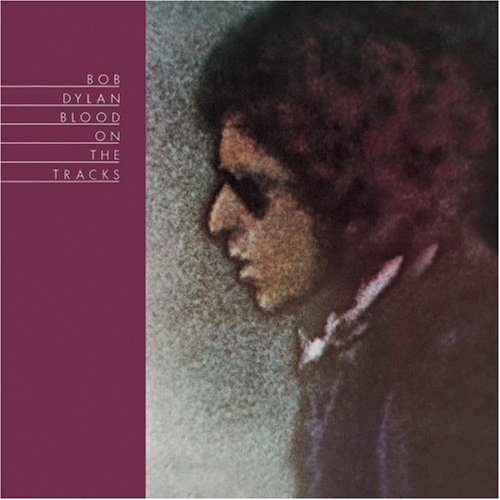
Bob Dylan's 1975 album, written in one summer and recorded twice, in New York and then in a hurry in Minneapolis. His best set of songs, in a record made faster than it deserved.
- Released
- 20 January 1975
- Label
- Columbia (US, PC 33235); CBS (UK, 69097)
- Producer(s)
- No producer credited on the sleeve. Bob Dylan; Phil Ramone engineered in New York, Paul Martinson in Minneapolis
- Runtime
- 51:40 (sleeve timings)
- Chart peak (US)
- #1 (Billboard Top LPs & Tape), 2 weeks, on the charts dated 1 and 8 March 1975
- Chart peak (UK)
- #4 (Official Albums Chart), on the chart dated 1 March 1975
- Certifications
- RIAA 2× Platinum; BPI Platinum (21 July 2013)
- Awards & honours
- Grammy Hall of Fame (2015). #9 in Rolling Stone's 500 Greatest Albums (2020), up from #16 in 2003
Blood on the Tracks holds the best songs Dylan put on one album, and he sings them superbly. The record around them was made in a hurry, twice, and half of it was remade by players the sleeve never named. The writing carries everything. The production only keeps up.
On 30 December 1974 Bob Dylan recorded 'Tangled Up in Blue' at Sound 80 in Minneapolis, in one take. The album it opens was already finished. Columbia had made test pressings by November, and Pete Hamill wrote the sleeve notes from one. Some of the words he quoted would change in the remake. In New York the song had been in an open tuning. In Minneapolis the band played it in A. Kevin Odegard says he urged the move, and Chris Weber, another of the Minneapolis guitarists, has also been credited with it. Across two nights and about 8 hours of work, five of the 10 songs were replaced. Weber says the band was told 100,000 jackets were already printed with the New York credits. Nobody from Minneapolis has been named on the sleeve since.
That rush is the record in miniature. No other Dylan album has a set of songs this strong, and they survive everything done to them. Two cities, two bands, a key change made on the night and a sleeve that names only the New York players: none of it gets in their way. Dylan sings them superbly. What the songs don't get is a record made with the same care. By Eric Weissberg's account, Dylan ran the first New York session without stopping to fix mistakes. His brother thought the result too stark for radio, so half of it was remade in two nights. The songs are strong enough that this rarely matters. It matters a little, though, and the record is easier to love once you admit it.
The trouble that produced it wasn't commercial. In February 1974 Planet Waves gave Dylan his first US #1 album, during a 32-date arena tour with The Band. But he told Rolling Stone's Jonathan Cott that he'd written by instinct up to Blonde on Blonde, and then lost the knack. That spring he spent about 2 months, five days a week, in Norman Raeben's studio on the 11th floor above Carnegie Hall. Raeben was a Russian-born painter and the son of Sholem Aleichem. Dylan said Raeben taught him less about drawing than about 'putting your head and mind and your eye together'. Rolling Stone wrote in 2015 that Dylan named Raeben's methods as the spur for time-jumping songs like 'Tangled Up in Blue'.
The other trouble was at home. Dylan had married Sara Lownds on 22 November 1965, and they separated in the summer of 1974. That summer Ellen Bernstein, who ran Columbia's A&R office in San Francisco, visited him on his Minnesota farm. She later told the biographer Clinton Heylin that 'You're Gonna Make Me Lonesome When You Go' was about the two of them. In 1978 Dylan told the Dallas Morning News that Raeben's classes changed him, and that his marriage started breaking up from then. Since then he has denied the obvious reading and half-conceded it. In 1985 he told Bill Flanagan the album was 'somewhat' about that, but that he wouldn't exploit a relationship. In his 2004 memoir, Chronicles, he wrote of making a whole album based on Chekhov's short stories. Readers took him to mean this one, though nobody is sure he was serious.
Raeben's lesson is what lets these songs be about a marriage without reading like a diary. Of 'Tangled Up in Blue', Dylan said there was 'a code in the lyrics' and 'no sense of time'. Its characters change from first person to third, he said, so you're never sure who's talking. That isn't a disguise for the facts. It's a way of holding years of a relationship in view at once. The Wallflowers' former manager, Andrew Slater, told the New York Times that Jakob Dylan once called the album 'about my parents'. But nothing in the songs needs the biography to work. That's why the record has outlasted the gossip, and why it still lands with listeners who know nothing about Sara.
He wrote about 17 songs that summer in a red notebook, on his farm by the Crow River. Not everyone was won over. On 22 July 1974 he played eight or nine of them to Stephen Stills in a St Paul hotel room. Stills was unimpressed, Graham Nash recalled. Mike Bloomfield, the guitarist on Highway 61 Revisited, couldn't follow a run-through with every song in the same open tuning. Recording began at A&R Studios in New York on 16 September. Dylan taped songs alone first, and at 6pm Weissberg's band, Deliverance, arrived. They worked until midnight. Weissberg remembered Dylan drinking wine and moving on without fixing what went wrong. Of that band, only the bassist, Tony Brown, was asked back the next day.
What survives from New York is mostly Dylan and Brown alone, and it's the best-made music on the record. 'Simple Twist of Fate' and 'Buckets of Rain' come from 19 September, a session that ran from 7pm to 3am with Brown the only other player. 'Shelter from the Storm' and 'You're Gonna Make Me Lonesome When You Go' were cut two nights earlier. Brown arrived meaning to play like Charlie McCoy on John Wesley Harding, and it suits these songs. He stays under the voice and lets the words lead. On 'Simple Twist' the voice doesn't arrive until 0:29, and an instrumental break at 1:47 runs for more than half a minute. On 'Buckets of Rain' the singing drops out four times, for about 20 seconds each. These songs work because there's almost nothing in them to go wrong.
David Zimmerman changed the record. In December Dylan played the test pressing for his brother in Minnesota, and David thought it too stark to get on the radio. Dylan himself recalled that, after a couple of months away from it, he thought the songs could sound better. David found the musicians, including Odegard, a singer-songwriter he managed. Odegard tracked down a 1937 Martin guitar for the sessions through Weber's music store. On 27 December they recorded 'Idiot Wind' in four takes, and Dylan then overdubbed Hammond organ himself. 'You're a Big Girl Now' took one take. On 30 December came 'Tangled Up in Blue', 'Lily, Rosemary and the Jack of Hearts' and 'If You See Her, Say Hello', one take each. Odegard said Dylan wanted the sound of Highway 61 Revisited.
He didn't get it, and it's as well he didn't. What he got was quick and plain. Rolling Stone wrote in 2015 that four of the five were essentially live, mixed to two-track on the spot. 'Tangled Up in Blue' gives the band about 10 seconds before Dylan comes in. After that his voice doesn't drop out until 4:54. The title line comes back 7 times, and the pace makes it sound like a story told many times over. 'Idiot Wind' is the remake that matters most. It's the album's angriest song, and Dylan told Flanagan he may have gone a little too far with it. He was right. Christgau, reviewing the album in the Village Voice that January, heard callow anger in places. 'Idiot Wind' is where that charge lands.
The rest of the Minneapolis work is competent, and that's the record's real flaw. Christgau liked the remake, and wrote that the unknown Minneapolis players imposed nothing beyond 'a certain anonymous brightness'. He meant it as praise. Heard now, that anonymity is the problem. Jon Landau, reviewing it for Rolling Stone, praised the singing but not the playing. The longest song shows the problem best. 'Lily, Rosemary and the Jack of Hearts' runs 8:50 and was cut in one take on the last night. Writing in Pitchfork in 2016, Jesse Jarnow called its story a chore and said it sits apart from the other nine songs. Rolling Stone noted that in the opening bars you can hear Dylan adjust to a harmonica in the wrong key. That take is the one on the album. Pitchfork also found 'You're a Big Girl Now' patronising towards women, and that charge sticks too.
None of this slowed it down. Released on 20 January 1975, it entered the Billboard chart at #15 and reached #1 on 1 March, just over a year after Planet Waves. In Britain it peaked at #4 that same week. Early reviews were mixed, but Christgau's A was the verdict that lasted. He called it the most mature and assured record Dylan had made. It then became the measure for what came after. Christgau called both Slow Train Coming in 1979 and Empire Burlesque in 1985 Dylan's best since Blood on the Tracks. Rolling Stone ranked it #16 among the 500 greatest albums in 2003, and #9 in 2020. Pitchfork gave it 10/10 in 2016.
Its documented descendants are an odd bunch. On 31 July 1975 Dylan recorded 'Sara' for Desire, with Sara in the studio: a song that names her, after an album that wouldn't. In 1995 Hootie & the Blowfish quoted several of its lines in 'Only Wanna Be with You' and settled out of court. 'Tangled Up in Blue' became a song Dylan keeps rewriting, most fully on Real Live in 1984. He'd sung it more than 1,400 times by 2015. The livelier argument is about the New York takes. Eight outtakes had come out before 2018, two of them songs that missed the album. That year More Blood, More Tracks gathered the sessions. Pitchfork rates the New York versions every bit as good. Most Dylan scholars, Rolling Stone said in 2015, back the remake.
The released album is the better record, for a reason that has little to do with which takes are purer. It alternates. No more than two songs from the same city ever run back to back. So the duets never settle into one hush, and the band never outstays its welcome. Five New York songs in a row would sound like a beautiful demo. Five Minneapolis songs in a row would sound like a decent bar band. Together they make a sequence with light and shade, and a record made in two rushed halves plays as one.
So the reputation is right about the songs and generous about the record. These are the best songs Dylan wrote in a single stretch, and the singing is equal to them. The time-shifting verses, more than the story of a marriage, are why it has lasted. But it was produced in a hurry, twice, and its sound broke no new ground. The novelty is all in the words. The Minneapolis band is anonymous where it should have had a character, and 'Lily' is nearly 9 minutes of story that rarely earns its length. Those flaws hold it just short of perfect. They don't stop it being the first Dylan album to own, in the version he chose.
Pressing guide — the one to own
The one to own is a 1975 US Columbia PC 33235 in its first jacket. That means a single sleeve with a coloured card inner, and Pete Hamill's notes printed in black on the back. Columbia dropped the notes in mid-1975, and from 1976 they came back in white. The document collectors chase is the November 1974 test pressing, side-1 matrix P AL 33235-1A, with the New York versions of all 10 songs. A New York acetate is a different object again: Pitchfork reported one offered at $12,000 in 2015.