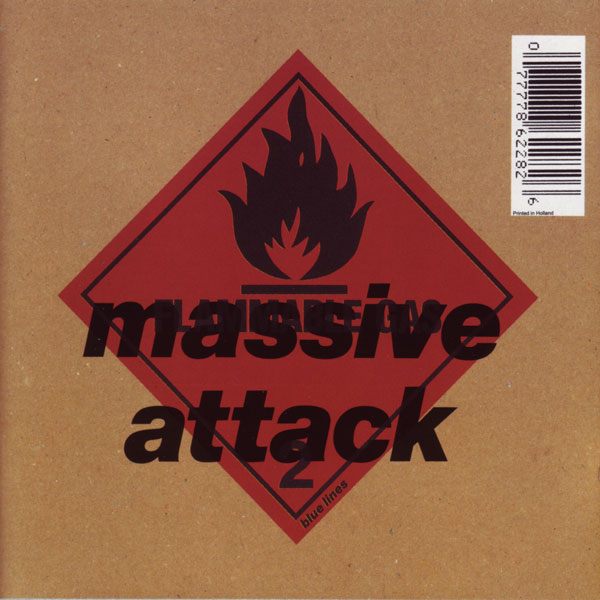
Massive Attack's 1991 debut: nine tracks in 45 minutes, made by a collective who played no instruments. It's remembered as the start of trip-hop. It's better heard as a British hip-hop record about borrowing.
- Released
- 8 April 1991 (UK and Europe, Wild Bunch / Circa); 6 August 1991 (US CD, Virgin)
- Label
- Wild Bunch Records / Circa, made and distributed by Virgin (UK LP WBRLP 1, CD WBRCD 1); Virgin 2-91685 (US CD)
- Producer(s)
- Massive Attack and Jonny Dollar; executive producer Booga Bear (Cameron McVey)
- Runtime
- 45:02 (9 tracks, by the LP label timings)
- Chart peak (US)
- Did not chart on the Billboard 200; 266,000 sold in the US by February 2010 (Nielsen SoundScan)
- Chart peak (UK)
- #13 (Official Albums Chart, 20 April 1991, its first week); 130 weeks in the Top 100
- Certifications
- BPI 3× Platinum (26 June 2026)
- Awards & honours
- Nominated for Best British Album at the 1992 BRIT Awards, which Seal won. #241 on Rolling Stone's 500 Greatest Albums (2020)
Blue Lines was built from other people's records, voices and rooms, and that's why it sounded like nothing before it. It's also where the album's one real weakness lies: when the borrowing goes in unchanged, the songs go thin.
Look at a Blue Lines LP from 1991 and it may not say Massive Attack. On the copies dated to release day, 8 April 1991, the sleeve and labels read simply 'massive'. The album's second single, 'Unfinished Sympathy', had been credited the same way. The name had been cut during the Gulf War. 3D said in 2014 that the group dropped 'Attack' themselves, because of tabloid talk of a massive attack on Iraq. Other accounts credit the label or the management. Either way, the record arrived missing half its makers' name. Who made it has been argued over ever since.
The genre it's said to have founded got its name 3 years later, from someone else. Andy Pemberton used 'trip-hop' in Mixmag in June 1994, writing about DJ Shadow and the Mo' Wax label. Massive Attack disliked the word and got it anyway. Shara Nelson and Tricky both later left, saying they hadn't been given enough credit. Names and credit keep slipping off this record, and that's a clue to how it was made. Blue Lines is a great British album of shared authorship, made by a group who played no instruments. Its strength is choosing: the right loop under the right voice. Its weakness is the same habit with the remaking left out. Twice, the group adds too little to a borrowed song, and the album goes slack.
The group came out of the Wild Bunch, a Bristol sound system whose parties, legal and illegal, made its members local names. 3D had joined in 1984, a graffiti artist who took up the microphone. In 1988 The Face ran a feature on the crew, and they split soon after, worn down by bickering. Nellee Hooper went on to produce Soul II Soul's Club Classics Vol. One. The three who stayed, 3D, Grant 'Daddy G' Marshall and Andrew 'Mushroom' Vowles, found patrons in Neneh Cherry and Cameron McVey. 3D dates that partnership to 1988, with the first demos made at McVey's house.
Cherry gave them more than encouragement. Pitchfork's Miles Raymer says her money bankrolled the album. She paid the group a salary and let them work in her child's bedroom. Vowles had programmed on her 1989 album Raw Like Sushi, and 3D co-wrote its song 'Manchild'. In the Observer in 2004, Daddy G called the group lazy, and said Cherry was the one who got them into the studio. In the same piece he said what they were after: "dance music for the head, rather than the feet". That phrase explains the record better than any genre name. Its beats drag and its samples sit far apart, as Alexis Petridis hears it. It's club music that asks you to listen rather than move.
It's filed as a Bristol album, and the booklet tells a more scattered story. Five of the nine tracks were recorded at least partly at the Coach House in Bristol. The other four were made at Eastcote in London and at Cherry Bear Studios. The strings for 'Unfinished Sympathy' were cut at Abbey Road, and 7 of the 9 tracks were mixed in London. 3D told Select in 1992 that they worked on it for about 8 months, with breaks for Christmas and the 1990 World Cup. Some of the ideas, he added, were up to 7 years old. The sleeve credits the group and Jonny Dollar as producers. McVey appears as executive producer, under the alias Booga Bear. Geoff Barrow, later of Portishead, was a tape operator.
Who did what is still argued over. Writing in the Observer in 2012, Sean O'Hagan said Mushroom and Dollar seem to have been the technicians. He credits Dollar with shaping the group's vague ideas into something whole. Hired hands filled the gaps the samples left. Paul Johnson plays bass guitar on the title track, and Wil Malone arranged and conducted the strings. The vocal credits read like a guest list. Nelson sings four tracks, Horace Andy three and Tony Bryan one. On three tracks the label also credits vocals to the group itself. O'Hagan says Tricky rapped on three songs, and the label gives him three writing credits. For much of the record, the group's own job was choosing. That isn't a criticism. Choosing well was the whole skill.
The opener shows the method whole. 'Safe from Harm' is built on the bassline of Billy Cobham's 'Stratus', from his 1973 album Spectrum, and Cobham shares the writing credit. Nobody sings for the first 31 seconds, and the loop has the room to itself. Then 3D's rap and Nelson's voice come in over it. Raymer hears every part of the group's sound already present in this one track. The reputation says it's slow, stoned music. Simon Reynolds put the album's tempos between 90 and 67 beats a minute, and called them spliff tempos. O'Hagan's answer is the right one. 'Safe from Harm' and 'Unfinished Sympathy' push far harder than that phrase allows.
'Unfinished Sympathy' is the proof that the group could do more than assemble. Nelson shares its writing credit with the three and with Dollar, and the song is hers in a way the beds around it aren't. The strings were recorded at Abbey Road. NME counted 40 players in 1991, and O'Hagan says 50. Nelson is in at 0:33. From about 3:18 the singing largely gives way, and the strings carry the track to its end. Petridis hears that swell as the one moment on the album that feels euphoric. He's right, and its rarity is why it lands. Baillie Walsh's video matched it, filming Nelson along West Pico Boulevard in Los Angeles in one continuous Steadicam shot. Credited to Massive, the single reached #13 in March 1991.
Horace Andy gives the record its other spine. On 'One Love' he's in at 0:23, over an Isaac Hayes sample that Petridis hears bent until it sounds queasy. On 'Five Man Army' he runs through his own old songs, 'Skylarking' and 'Money Money', in the background. Up front, NME heard a four-way rap. Petridis calls one of its voices, Claude 'Willy Wee' Williams, the track's forgotten rapper. The voices stop at 3:40, and the last 2 minutes and 24 seconds are dub. 'Daydreaming', released as a single in October 1990, is more plainly hip-hop than most of the album, by Raymer's ear. It's built on Wally Badarou's 'Mambo'. It's also the best place to hear Tricky. Raymer singles out his near-whisper, and Petridis hears in his West Country burr a new kind of British cool.
Here's the flaw. Shared authorship works when the group remakes what it borrows, and on two tracks it barely does. 'Be Thankful for What You've Got' is William DeVaughn's 1974 soul single, sung by Tony Bryan. Petridis calls it surprisingly faithful, the one track that could have come out on a retro-soul label. Placed fourth, it halts the album's argument for 4 minutes. 'Lately' reworks Lowrell's 'Mellow Mellow (Right On)', which NME heard in 1991 as a cheeky update. Nelson sings it well, but the track leans on its source more than it remakes it. Next to 'Safe from Harm', both sound like other people's records played back with little added. The scorecard marks songwriting lowest of its six, and these two tracks are why.
What it changed is easier to document than most. Barrow formed Portishead, whose Dummy won the Mercury Prize in 1995. Tricky's Maxinquaye came out the same year. O'Hagan says Blue Lines paved the way for both, and for politer acts like Morcheeba and Zero 7. His list of artists shaped by its songs runs from Radiohead and Moby to Burial and the xx. That's a critic's map, not a family tree, and it's a long one. The producer Labrinth, quoted in the same piece, said they'd influenced music everywhere, but the UK more than anywhere. The genre was less kind to it. Raymer says trip-hop was polished into music for fashionable hotel lobbies, and the chill-out label stuck to the album too. It shouldn't have. Petridis is right that Blue Lines is a restless record, closer to dread than to calm.
Its commercial story isn't the slow burn of legend. It entered the UK chart at #13 on 20 April 1991, in its first week, and never went higher. What followed was staying power: 130 weeks in the Top 100 across 26 separate runs up to 2005. The BPI certified it Gold and Platinum on the same day in March 1997, and 3× Platinum in June 2026. It never reached the Billboard 200, though it had sold 266,000 copies in America by 2010. At the 1992 BRIT Awards it was nominated for Best British Album and lost to Seal. Critics were warm rather than unanimous. NME's Dele Fadele gave it 10 out of 10, and Q gave it 4 out of 5. Robert Christgau's verdict, in a 2000 book, was only an honourable mention. Rolling Stone ranked it #241 in its 2020 list of the 500 greatest albums.
So what is it worth now? Its influence is real and well documented, but influence isn't why you'd play it. You'd play it for 'Safe from Harm', 'Unfinished Sympathy' and 'Five Man Army', and for most of what sits around them. They still sound unlike what came after, because what came after copied the mood and missed the method. The method was a few people with deep record collections, two great singers and a producer who could make it hold together. Where that turned borrowing into something new, Blue Lines is one of the best British records of its decade. Where it simply played the borrowing back, on the cover and on 'Lately', it's a very good mixtape. It's a great album with a flaw you can hear in about a fifth of its running time, and it's worth owning for the rest.
Pressing guide — the one to own
The original is the 1991 UK LP on Wild Bunch Records, WBRLP 1: a single sleeve with a printed inner sleeve, made and distributed by Virgin. The copies dated to release day credit the band as 'Massive'. Copies credited 'Massive Attack' carry a 0777 barcode sticker over the printed one, which suggests later stock, though no source documents a first state. Later UK represses in the original sleeve keep WBRLP 1, so check the runouts: the post-2010 repress carries 7862281.