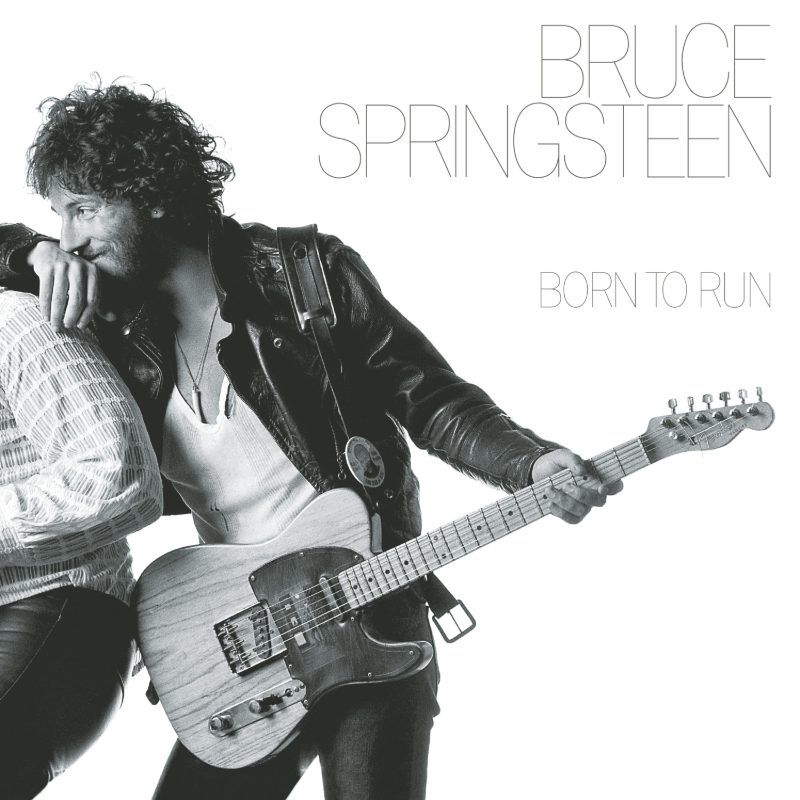
Bruce Springsteen's third album, made over 18 months as Columbia's last bet on him. Eight songs he pictured as one summer day and night, on a record that sometimes strains to sound this big.
- Released
- 25 August 1975 (US, Columbia PC 33795; some sources give 1 September); UK, CBS S 69170
- Label
- Columbia (US); CBS outside North America
- Producer(s)
- Bruce Springsteen and Mike Appel (all eight tracks); Jon Landau (seven, all but the title track)
- Runtime
- 39:20 (8 tracks, sleeve timings)
- Chart peak (US)
- #3 (Billboard Top LPs & Tape, charts dated 11 and 18 October 1975), 29 weeks on the chart
- Chart peak (UK)
- #17 (Official Albums Chart, 20 July 1985); #36 on its first run, in November 1975
- Certifications
- RIAA 7× Platinum (25 May 2022); BPI Platinum (1985)
- Awards & honours
- Library of Congress National Recording Registry (2003 list, announced 19 March 2004); #21 on Rolling Stone's 500 Greatest Albums (2020); #3 in the Village Voice Pazz & Jop critics' poll for 1975
Springsteen wanted Roy Orbison singing Bob Dylan, produced by Phil Spector, and spent 6 months on one song to get it. Born to Run invents almost nothing. Its genius is assembly, and its flaw is that sometimes you can hear the effort.
Bruce Springsteen hated it. When the first acetate of Born to Run arrived in the summer of 1975, he threw it into a hotel swimming pool. He thought about scrapping the album and recording it again, live. Jon Landau, his new co-producer, talked him round. Mixes followed him on tour, and he approved one in early August. The record he nearly threw away had been in the making since January 1974. Its title track alone had taken 6 months.
That disgust is a good place to start, because Born to Run is a feat of assembly. Springsteen later described the sound he was after as Roy Orbison singing Bob Dylan, with Phil Spector producing. None of those ingredients was his. What was his was the fit: eight songs in 39 minutes, which he pictured as one long summer day and night. The parts are old, and the fit is why the record has outlasted the hype that greeted it. The flaw comes from the same place. When you can hear the effort holding it together, the grandeur tips into pomp.
It was made under threat. Greetings from Asbury Park, N.J. and The Wild, the Innocent & the E Street Shuffle, both released in 1973, got good reviews and poor sales. By 1974 his following was confined to the East Coast, and Columbia's new management was more interested in Billy Joel. The label suggested he record in Nashville, with session players and an outside producer. He refused. Columbia agreed to pay for one more album, on the understanding that he'd be dropped if it failed. His manager and co-producer, Mike Appel, got a slightly bigger budget, but the work had to stay at 914 Sound Studios in Blauvelt, New York. No reliable figure for what it cost has surfaced.
The title song came first, and Springsteen later wrote that it was the key to his songwriting for the rest of the record. The phrase came to him in bed at his home in West Long Branch. He worked on the song at 914 through the spring and summer of 1974, with Louis Lahav engineering. The band on it isn't the band on the rest of the album. Ernest 'Boom' Carter plays drums, David Sancious keyboards and Danny Federici organ, Federici's only part on the record. Springsteen later wrote that 72 parts were squeezed onto its 16 tracks, and Rolling Stone counted a dozen guitar overdubs. The final mix was finished in August 1974, a year before the album it named.
Then the band changed under him. Vini Lopez had been fired in February 1974, and Carter replaced him. In August, Carter and Sancious left to form their own group, Tone. Roy Bittan, a pianist with a background in symphony orchestras, and the drummer Max Weinberg took their places. Springsteen wrote most of the songs on piano. Bittan largely replaced Federici, and Springsteen has said Bittan's piano defined the album's sound. It's hard to argue. Meanwhile 914 stalled. Through the autumn, attempts at 'Jungleland', 'She's the One' and 'Backstreets' went nowhere. On 3 November Ed Sciaky played 'Born to Run' on WMMR in Philadelphia, with Springsteen as his guest. Within weeks Appel had sent tapes to WNEW, WBCN and WMMS, and nearly two dozen more stations had it by the new year. CBS saw it as misconduct, but the leak also pushed Columbia into paying for more sessions.
Landau was the other change. He met Springsteen in Boston in April 1974. In May he wrote the Real Paper column that gave Columbia its slogan, 'rock and roll future', and the phrase ran in $40,000 of the label's pre-release ads. Landau first sat in on a session in February 1975. His first idea was structural. 'Wings for Wheels', the song that became 'Thunder Road', should move its saxophone solo to the end. By the spring he was co-producing, and he pushed for a better studio. The sessions moved to the Record Plant in Manhattan, with Jimmy Iovine engineering and mixing, and seven of the eight songs are credited there. Weinberg later called it the hardest project of his career.
The first song sets out the method. 'Thunder Road' opens with about 18 seconds of electric piano and harmonica before Springsteen sings, and its title doesn't arrive until 2:16. The last line is sung at 3:44, and then the band plays on for about a minute with no voice. The other long songs open the same patient way. 'Backstreets' holds the voice back for 1:08 behind Bittan's piano and organ. 'Jungleland' waits 41 seconds, through Suki Lahav's violin and then piano. Each song builds the room before anyone walks into it. It's Spector's method, slowed down and stretched to album length, and it's why the record plays as one night rather than eight singles.
The title track is the method at full pressure. Twice the voice drops out, at about 1:48 and again at about 2:40, and the band carries on alone for more than 20 seconds each time. Those breaks are where you can hear how much was packed onto 16 tracks. 'Tenth Avenue Freeze-Out' is lighter on its feet. Springsteen and Bittan had no horn parts ready, so Steven Van Zandt worked them out in the studio. The Brecker brothers, David Sanborn and Wayne Andre played them with Clarence Clemons, and Van Zandt joined the band soon after. It's the band's origin story, and the Big Man, Clemons, arrives in the third verse. 'Night', at 3:01 the shortest song, reaches its title 28 seconds in. Louis Masur hears it shifting between minor and major, and it's the album's most direct 3 minutes.
Side two is where the effort starts to show. 'She's the One' is a Bo Diddley beat with a wall of sound on top and not much underneath. Robert Christgau gave the album an A in the Village Voice on 22 September 1975. He still objected to its operatic pomp, and said 'She's the One' fell short of Phil Spector's innocent grandeur. Reviewing the 2005 reissue for Pitchfork, Mark Richardson found the song catchy and thin on its character. They're both right. It's the one place where the size of the production is bigger than anything the song has to say. Christgau's other complaint, about the record's romance of beautiful losers, is a matter of taste.
'Meeting Across the River' is the record's answer to its own excess. Bittan's piano and Randy Brecker's trumpet, over Richard Davis's double bass, give it a film-noir jazz feel. Philippe Margotin and Jean-Michel Guesdon think it clashes with the rest. Appel won the argument to keep it, over 'Linda Let Me Be the One' and 'Lonely Night in the Park'. He was right. After 3:16 of quiet, 'Jungleland' can afford to be huge. After a line sung at 3:48, nobody sings again until 6:58. That stretch holds the band section and Clemons's solo, which runs for more than 2 minutes. Springsteen dictated it almost note by note. Clemons spent 16 hours on it, and parts of several takes were edited together for him to play again.
The finish was a sprint. In Springsteen's account, the last 72 hours ran in three rooms at once. The 'Jungleland' saxophone was in one, the 'Thunder Road' mix in another and the 'Backstreets' vocal in a third. Mixing ended on the morning of 20 July 1975, and the tour began that day. You'd never guess it from the record, which sounds planned to the second.
The reception has become part of the record, and the usual story gets the order wrong. The album entered the Billboard chart at #84 and reached #3 on the charts dated 11 and 18 October 1975. Pink Floyd's Wish You Were Here and John Denver's Windsong held the top two places. Only after that did Springsteen appear on the covers of Time and Newsweek, in issues dated 27 October. Henry Edwards had already turned on him in the New York Times on 5 October, and Newsweek's Maureen Orth framed him as a manufactured star. On the Billboard chart dated 25 October the album was already down to #9. The covers didn't make it a hit. They made the hit look like a product. By Peter Ames Carlin's count it sold 700,000 copies by the end of 1975. In Britain it peaked at #36 in 1975, and reached #17 only in July 1985.
Critics rated it at once. The Village Voice's poll put it third for 1975, behind The Basement Tapes and Patti Smith's Horses. Its standing has barely moved since. It's on the Library of Congress's National Recording Registry list for 2003, and Rolling Stone ranked it #18 of the 500 greatest albums in 2003 and #21 in 2020. Its influence is easier to assert than to document. In 2006 two critics heard it in the Killers' Sam's Town. Dan Martin, in the Observer, said the band had studied Born to Run and rebuilt it, and Rob Sheffield, in Rolling Stone, heard them trying to rewrite its title song. Beyond that, the family tree is mostly assumed. And Greg Kot's judgement in the Chicago Tribune in 1992 still holds: Springsteen was more synthesist than innovator.
That's the record's shape, and it's the scorecard's too. The sequencing is close to faultless, and 'Jungleland' justifies the scale of everything before it. The production is the album's real feat, and the playing is the sound of a band becoming one. What the album lacks is novelty, and on 'She's the One' it lacks restraint. Writing in Blender in 2006, Christgau said its flaw was its self-declared greatness. He isn't wrong. Most of the time, the claim is also true. Born to Run is a great record with a show-off's flaw, and you can hear the flaw. Play it for 'Thunder Road', 'Backstreets' and 'Jungleland', and forgive it the moments when it tries too hard.
Pressing guide — the one to own
The original to own is the 1975 US Columbia PC 33795 in its gatefold. First-state jackets credit 'John Landau' on the back and leave Suki Lahav's violin off 'Jungleland'. Columbia printed corrective stickers for the misprint. Many US matrices begin 'P AL-33795' or 'P BL-33795' whatever the plant, so that P alone doesn't mean Pitman. The catalogue entries read the plant from a separate mark: a stamped P for Pitman, an etched T, T1 or 1T for Terre Haute, an etched S for Santa Maria. 'MCR' is Master Cutting Room, where the lacquers were cut. There's no printed inner sleeve.