
Deep Dive
Bridge Over Troubled Water
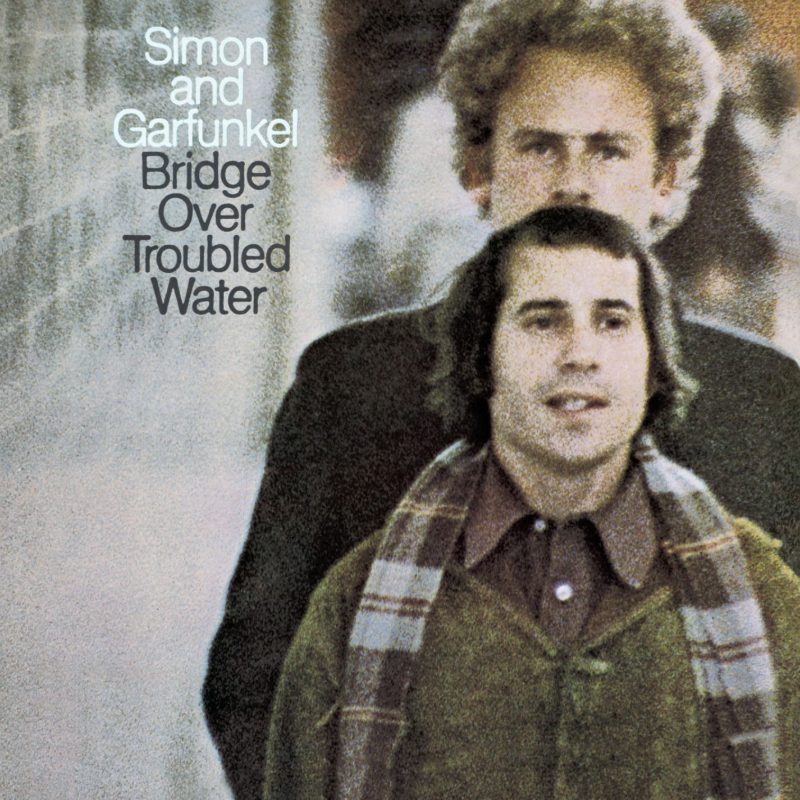
Bridge Over Troubled Water by Simon & Garfunkel (1970) — what a copy is worth and which pressing to own, in a full Lead-In dossier: Two school friends finishing their last album in separate rooms.
Bridge Over Troubled Water by Simon & Garfunkel (1970) — what a copy is worth and which pressing to own, in a full Lead-In dossier: Two school friends finishing their last album in separate rooms.
Simon & Garfunkel's last studio album, and Britain's best-selling record of 1970 and 1971. It was recorded in pieces over a year, while the partnership behind it was coming apart.
Paul Simon gave his best song to Art Garfunkel and spent years half sorry he had. That trade is the record in small: three superb songs, made enormous by Roy Halee, sequenced among sketches and filler.
In November 1969, in New York, Art Garfunkel recorded the lead vocal for 'Bridge Over Troubled Water' while Paul Simon stayed out of the room. Simon had written the song that spring, and the backing track had been cut in Hollywood in August. He told the people he worked with that it was his greatest song, his 'Yesterday', according to Dorian Lynskey's history of it. He gave it away because he thought only Garfunkel's choirboy voice could do it justice. The ovations went to the singer, and Simon spoke about them, with mixed feelings, on the BBC's Omnibus. Four years on, he told Rolling Stone that he was often sorry he hadn't sung it himself.
That gift, and the regret that followed, is the whole record in small. Bridge Over Troubled Water is the sound of a partnership finishing its work in separate rooms. Its best songs are as good as anything the two of them made, and Roy Halee's production is the peak of the duo's sound. The reviews of the 2011 reissue went further. Pitchfork heard 'a unified statement', and The Second Disc called it 'a beautifully-crafted album with no filler'. That overstates it. The record never becomes a whole: it's a handful of superb pieces and a handful of light ones, sequenced side by side. Admire it, and keep the reverence for the songs.
The separation was literal. After Bookends and The Graduate soundtrack both reached #1 in America in 1968, Garfunkel took the part of Nately in Mike Nichols's film of Catch-22. Filming began in Mexico in January 1969 and ran for about 8 months, and Simon's own part in it was written out. Garfunkel told SongTalk in 1990 that he went off expecting to be away for two or three months at most. Their habit, he said, was to wait for Simon to finish the songs before going into the studio. So the sessions were fitted around his absences. They began with 'The Boxer' in November 1968 and ran for a year, across New York, Nashville and Los Angeles. Giles Smith put the total at about 800 hours of studio time.
You can hear the distance in the songs. 'The Only Living Boy in New York' is Simon, singing lead himself, about being left behind in the city while his partner was away filming. 'So Long, Frank Lloyd Wright' says goodbye to the architect and, in Chris Charlesworth's reading, to Garfunkel, who spent three and a half years at architecture school. At its close, Halee calls out a farewell to Artie. Garfunkel agreed in SongTalk that Simon wrote these two songs to him rather than for him. They're the most personal writing on the record, and more than the title track, they're what the album is about.
The title song came from a church record. In spring 1969 Simon borrowed a Swan Silvertones album from Al Kooper. On its version of 'Oh Mary Don't You Weep', the singer Claude Jeter ad-libs a line that gave Simon his title image. Simon later paid Jeter for it. His demo, released on a 1993 box set, has two verses, his voice and a guitar, and he has called the song 'a tiny little, humble country church song'. He's right about the demo, and something was lost along with the humility. The gospel chords are his. What Halee and Garfunkel added on top was scale.
Scale is the story of the recording. In Hollywood that August, Halee gathered Hal Blaine, Joe Osborn and Larry Knechtel, the session players Lynskey calls the Hollywood Golden Trio. Knechtel's job was to turn Simon's guitar part into a piano part, and he recalled that 'Paul wanted it to be gospel but not gospel'. His piano plays alone for the first 23 seconds, and Smith judged it essential to the song. Garfunkel and Halee wanted something bigger, so Simon wrote a third verse in the studio, and Garfunkel compared the build he had in mind to a plane taking off. At about 2:51 the voice drops out and the arrangement starts to climb. When the third verse arrives, Smith hears distant crashes, low strings and a sliding bass. Listen, too, for the reverb that catches Garfunkel's sibilants and throws them back.
It's a magnificent recording of a slightly overbuilt song. The first two verses are a hymn of comfort, and they'd have been enough. The third turns the hymn into a spectacle. Kingston's 1996 biography of the duo says Simon felt the extra verse didn't sit as well with the rest. On that point the writer has a better case than his producers. But the spectacle is what the public bought, and the single spent 6 weeks at #1 on the Hot 100.
'The Boxer' is the better-made record, and it was made over months. It began in New York in November 1968, and the main part was cut at Columbia in Nashville that December, with Fred Carter Jr. playing a small Martin against Simon's guitar. Hal Blaine's snare was recorded beside a lift in Columbia's offices, and it hits once per refrain. In the break, from about 2:45, a pedal steel and a piccolo trumpet play the same line, though one book hears a piccolo flute. The song took more than 100 hours and came out as a single on 21 March 1969, 10 months before the album. By the time the LP arrived, one of its best-known songs was old news.
The album's most forward-looking moments are its smallest. 'Cecilia' began as a home tape of a party, made with Simon's brother Eddie, and Simon and Halee looped about a minute of it. Then they overdubbed drumsticks dropped on a parquet floor, and Simon on xylophone. 'El Cóndor Pasa' puts the duo's voices over a track by Los Incas, a Paris-based Andean group Simon had met in 1965. Pitchfork's Stephen M. Deusner hears in it the roots of Simon's later African and South American records. That's fair, but here it's a postcard. These are sketches of ideas Simon would work out alone.
The weakness is in between. On side two, the two best songs are split by 'Baby Driver', the B-side of 'The Boxer', all car noises and saxophone. After them come 'Why Don't You Write Me' and 'Bye Bye Love'. Browne's book Fire and Rain hears Simon's first try at reggae in the first of these, while Pitchfork hears skiffle. A song two careful listeners can't place hasn't decided what it is. 'Bye Bye Love' is an Everly Brothers cover with a crowd clapping along, and even the crowd is disputed. Pitchfork places it in Ames, Iowa, but Halee said in 2005 that the live takes were rejected, and that a studio take was played to audiences who clapped along. Either way, it's filler with applause. Charlesworth called the album's uptempo songs throwaways. He includes 'Cecilia', which is harsh, but on the others he has a point.
Some of the gaps were chosen. Simon wrote an anti-Nixon song, 'Cuba Sí, Nixon No', and Garfunkel vetoed it. Garfunkel brought a Bach-inspired piece, 'Feuilles-O', and Simon felt it didn't fit, so it waited for Garfunkel's Angel Clare in 1973. The record lost an angry song and a strange one, and kept the light ones. Robert Christgau caught the result in 1972, when he found the album funny, honest and alive but suspected its languid loveliness would finally send you to sleep. That's the case against in one line. The best of it is too even-tempered to bite, and the rest is too uneven to flow.
None of this held it back. It topped the Billboard chart dated 7 March 1970 and stayed there for 10 weeks. In Britain it went in at #1 on 21 February and spent 33 weeks at the top, in 8 separate runs. It was the country's best-selling album of 1970, and again of 1971. By the time it won six Grammys on 16 March 1971, including Album of the Year and Halee's award for engineering, the duo had gone. They played the last date of their tour at Forest Hills on 18 July 1970, and went their separate ways without telling anyone. Smith wrote in 1994 that they'd agreed to split before the album was even in the shops.
The title song outlived the partnership, partly because it was never tied to one moment. On 30 November 1969, before the song was even released, the duo's CBS special Songs of America played it under footage of Robert Kennedy's funeral train. Lynskey argues that the song carried the despair of late 1969 without a political word in it. That left it free for whoever needed it next, and Simon himself sang it at the benefit concerts after 9/11 and Hurricane Katrina. A song that names no trouble in particular can be lent to any trouble, and it has been, again and again.
So what is it worth now? A great deal, within limits. Its standing has slipped, from #51 on Rolling Stone's list of the greatest albums in 2003 to #172 in 2020. The songs deserve better than that, and the sequence doesn't. 'Bridge Over Troubled Water', 'The Boxer' and 'The Only Living Boy in New York' are as fine as anything Simon wrote for two voices. Halee made them enormous without losing the detail. The songwriting and the production carry the record. Pitchfork suggested in 2011 that the album tracks hold up better than the over-familiar singles. That's half right: 'The Only Living Boy in New York' does, and 'Baby Driver' doesn't. Bookends is the more complete record, but this one has the bigger songs. Play the best of it often, and admire the rest from a little further off.
The original to own is the 1970 US Columbia KCS 9914, in stereo, on Columbia's '360 Sound' stereo labels. The runouts carry XSM 150685 and XSM 150686, with a lacquer suffix and a plant mark: P for Pitman, S for Santa Maria, T for Terre Haute. No gatefold is listed for the US original. In Britain the first issue is CBS 63699, pressed at Aston Clinton.
© The Lead-In · an independent, reader-supported music publication.