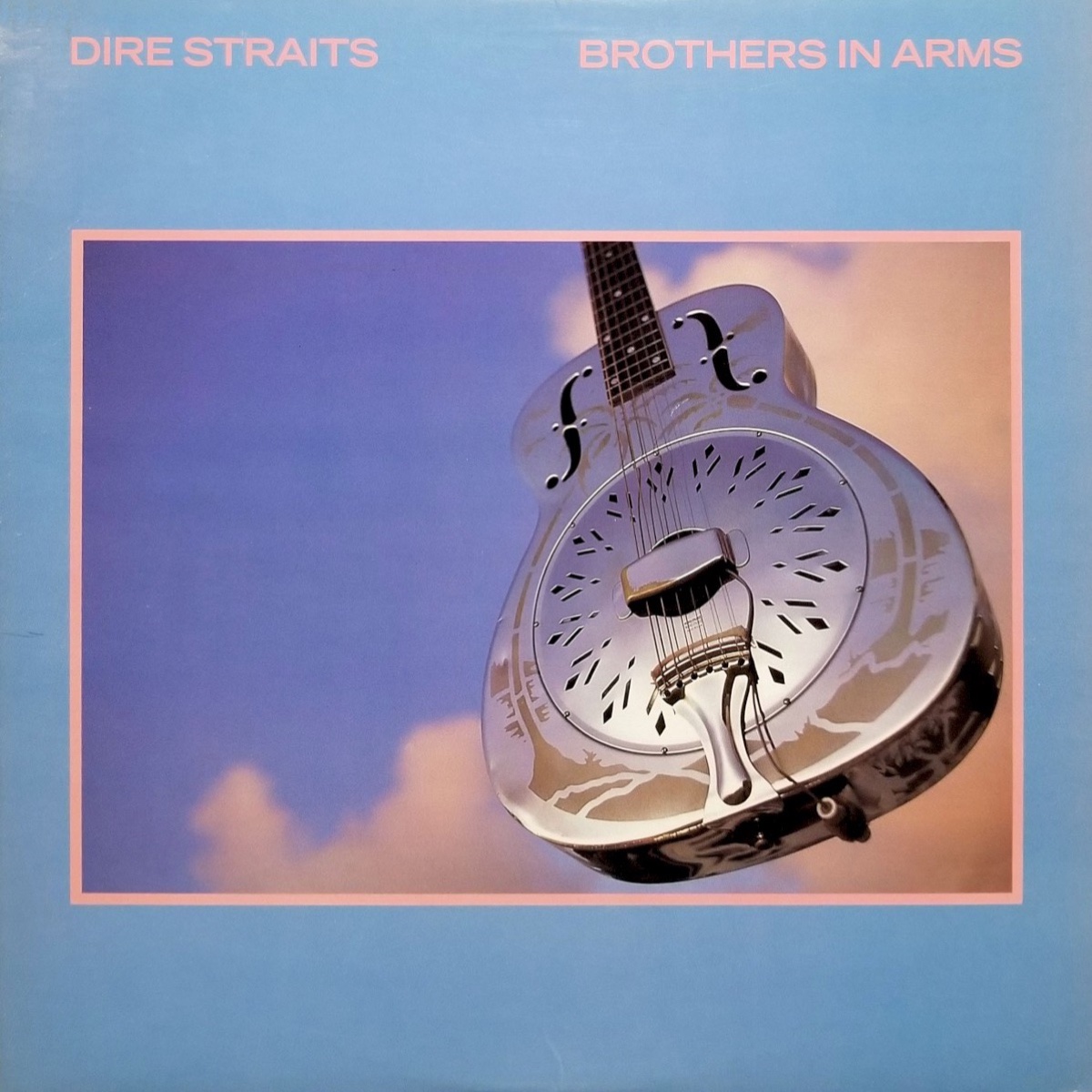
Dire Straits' fifth album, from 1985, was the first to sell a million copies on CD. It's an uneven set of songs with a near-faultless sound.
- Released
- 17 May 1985 (UK, Vertigo); May 1985 (US, Warner Bros.)
- Label
- Vertigo (UK and Europe) · Warner Bros. (US)
- Producer(s)
- Mark Knopfler and Neil Dorfsman
- Runtime
- 55:11 on CD · 47:27 on the 1985 UK LP, with 4 songs edited shorter
- Chart peak (US)
- #1 (Billboard Top Pop Albums), 9 weeks at #1
- Chart peak (UK)
- #1 (Official Albums Chart), 14 weeks at #1 and 273 weeks in the Top 100
- Certifications
- BPI 15× Platinum (January 2025); RIAA 9× Platinum (August 1996); Music Canada Diamond (April 1986); SNEP Diamant (August 1994)
- Awards & honours
- Grammys 1986: won Best Rock Performance by a Duo or Group with Vocal ('Money for Nothing') and Best Engineered Recording (Neil Dorfsman); nominated for Album and Record of the Year. Grammys 1987: Best Music Video, Short Form ('Brothers in Arms')
Brothers in Arms is remembered for selling the compact disc. What lasts is a sound, made in a small, dead room on Montserrat by an engineer who disliked working that way, and the slow songs show it off best.
Pick up a British copy of Brothers in Arms from 1985 and read the label. 'Why Worry' is listed at 5:16. On the compact disc it runs 8:31. Three other songs are edited on the record as well, and the whole LP lasts 47:27 against the CD's 55:11. Nearly 8 minutes of the album didn't fit on vinyl. The complete version was on the CD, a format that had been on sale since 1982, mostly to classical buyers.
That gap is the usual way into this record, and it points slightly the wrong way. Brothers in Arms is remembered as the album that sold the CD. It was the first to sell a million copies on the format, and shops played it to show off the players. All true. But nothing we found says the band made it with the CD in mind, and Knopfler has been quoted calling the link an accident of timing. What made it the perfect demonstration disc was a sound. That sound owed less to a plan than to a small, dead room on a Caribbean island, and to an engineer who didn't like what the room made him do. The production is the reason to hear it now, and the slow songs are where it pays off. The rest of the writing is uneven, and the running order sags.
The move to digital tape began with a problem rather than a prophecy. During the Love Over Gold sessions at the Power Station in New York, a piano sound for 'Private Investigations' got audibly worse each time the tape was played. Neil Dorfsman, who co-produced Brothers in Arms, says Knopfler resolved then to work another way. Dorfsman had already recorded Bob Dylan's Infidels digitally in 1983, with Knopfler producing. When the band reached AIR Montserrat in November 1984, the new album went onto a Sony 24-track digital machine. Dorfsman later told Sound on Sound it was among the first albums recorded on one. Among the first isn't the first, whatever the Guardian said in 2011.
Knopfler had also changed what kind of band he wanted. Between the two albums he'd scored three films, Local Hero among them. Dorfsman describes Love Over Gold as Knopfler's first step towards arranged, keyboard-heavy music. On Brothers in Arms, he says, Knopfler was casting musicians for a sound he could already hear. The line-up shows it. Guy Fletcher joined as a second keyboard player beside Alan Clark. The guitarist Hal Lindes went out to Montserrat and came home without a job. Before Christmas, the drummer would be gone from the sessions too.
The room decided the sound. AIR Montserrat had a superb Neve desk and an unremarkable recording room. Sound on Sound puts the room at about 20 feet by 25, with almost no isolation between the players. So Dorfsman close-miked everything and baffled heavily. Most of the ambience you hear was created later, in the mix. He has said he disliked working that way. It's still why the record sounds as it does. Each instrument sits in its own clean space, with nothing bleeding into anything else. On 'So Far Away' the drums are dry and close, and the guitar sits apart from them. The work won Dorfsman the Grammy for Best Engineered Recording. It also made the album exactly what a shop needed to sell a CD player.
The sessions' first casualty was Terry Williams, the band's drummer since 1982. About a month into the sessions, with the backing tracks done, Knopfler and Dorfsman decided the drums were wrong. Dorfsman also blamed the island. In both his accounts it was so relaxing that the band lost its energy, and in one the early tracks sounded like a demo. Omar Hakim was flown in from New York. What he did next is told two ways, both by Dorfsman. In 1999 he told Mix that Hakim replaced about three-quarters of the drums in 1½ to 2 days. In 2006 he told Sound on Sound it was every track, in about 2½ days. Either way, Williams is still there in the tom crescendo that opens 'Money for Nothing'. He stayed in the band and played these songs on tour.
'Money for Nothing' is the exception that made the album huge, and the one place its clean sound gets dirty. Knopfler wrote it in a New York appliance store, on borrowed paper, from the remarks of an employee watching MTV on the display sets. Guy Fletcher came up with the long intro. Dorfsman told him to play it like a science-fiction monster coming to life. Then Williams's toms build and the riff lands. It's a Les Paul Junior, played with the fingers. Dorfsman told Mix he miked it with two SM57s, one of them in an odd spot. A month later in New York, Dorfsman says, they tried for the same tone with the same models of amp and microphone, and never got it. Sting was on holiday on the island and did his part in about an hour. He sings MTV's own slogan to the tune of the Police's 'Don't Stand So Close to Me', and he shares the writing credit. The first British LP leaves him off.
The hits aren't the whole album, though, and the gap between them and the rest is the record's real weakness. 'Walk of Life' comes next: a bright keyboard riff over a bar-band shuffle, and a #2 single in Britain in early 1986. Then the floor drops away. 'Your Latest Trick' takes 1:40 to reach its first line, and its centrepiece is a Michael Brecker saxophone solo. That solo nearly didn't survive. The Power Station's digital machine lost it to an error-correction fault, and it had to be retrieved. 'Why Worry' reaches its last line at 3:58, then spends another 4½ minutes on a slow instrumental coda. These are patient, lovely pieces of work. They also belong to a different record from the one the singles sell.
Side two pushes further that way. 'Ride Across the River' is sung in a soldier's voice over a slow, loping groove, with nearly 80 seconds of instruments in the middle. Dorfsman called the feel "white-boy reggae". He'd doubted the drums from the start, and says this song confirmed it. 'The Man's Too Strong' starts quietly and opens out. 'One World' is the odd one out: short, tight and funky, with a session player on bass, because John Illsley had sprained his wrist jogging in Central Park. Then the title song closes the album, slow and grave. Knopfler's last line comes at 4:44, and his guitar carries the closing 2:16. Most of these songs are good one at a time. In this order, after 'Walk of Life', they make the album feel like two short records sharing a sleeve.
Critics heard the split at the time. Debby Bull, reviewing it for Rolling Stone in July 1985, praised the production and found the stories weaker than those on Making Movies. She preferred the mood of Knopfler's film music. Robert Christgau gave it a B−. Buyers didn't mind. It entered the UK chart at #1 on 25 May 1985 and spent 14 weeks at the top in all, 10 of them in a row in early 1986. In America it was #1 for 9 weeks, and 'Money for Nothing' became the band's only #1 single there. Sound on Sound put worldwide sales above 25 million in 2006. In the Netherlands it had logged 567 weeks on the albums chart by October 2026.
Its effect on the format is well documented. It was the first album to sell a million CDs. Rob Simonds, looking back on Rykodisc's early years, recalled that demand for this one rock title overwhelmed the world's CD factories. It became the disc shop staff reached for to show what a player could do. The irony is on vinyl. Every 1985 single LP carries the edits, and the full-length album didn't reach vinyl until a Warner Bros. double LP in 2006. In October 2026, 21,874 collectors owned the British original and 38,404 the American. Only 2,731 owned that 2006 set.
What has dated is the part everybody knows. 'Money for Nothing' and 'Walk of Life' are the album's two biggest hits, and both sound like 1985. The slow songs have aged better, because nothing in them leans on the moment. That's the reverse of the album's reputation, which rests on the singles, the sales and the format. 'Why Worry' and the title track are spare and almost still. They're also the songs other singers took up. The Everly Brothers cut 'Why Worry' the same year, and Joan Baez opened her 1987 album Recently with 'Brothers in Arms'.
So it's a very good record with clear limits, and its fame rests on the wrong half. As songwriting it's uneven. There are two huge singles near the start. Its best work is in three slow songs: 'Your Latest Trick', 'Why Worry' and the title track. The rest of side two falls short of both. 'One World' is the one track it could lose. As engineering it's close to faultless. Dorfsman took a cramped room he didn't like and made a sound with nothing in the way, and that sound helped sell a format. Bull was right in 1985 that Making Movies has the better stories. This is the better-made record. Play the CD, start with 'Why Worry' and the title song, and admire the craft without mistaking it for the band's peak.
Pressing guide — the one to own
The 1985 originals are easy to find: in October 2026, 21,874 collectors owned the UK Vertigo VERH 25 and 38,404 the US Warner Bros. 1-25264. The real choice is between an original and the whole album. Every 1985 single LP edits four songs. For the full length on vinyl, start with Warner's 2006 half-speed double LP, Vertigo's 3752907 double LP or the 45 RPM sets from Mobile Fidelity and Abbey Road. Both Anglo-American originals were cut at Masterdisk. Bob Ludwig's RL is on both sides of the US pressing and only side A of the UK one.