
Deep Dive
Curtis
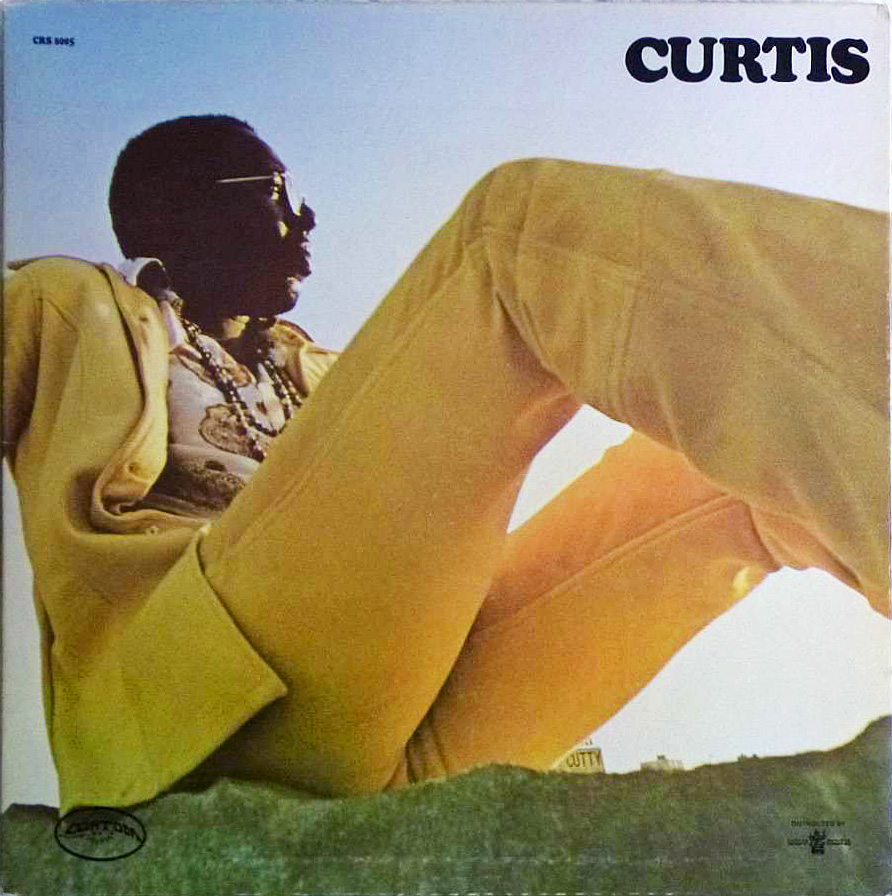
Curtis by Curtis Mayfield (1970) — what a copy is worth and which pressing to own, in a full Lead-In dossier: Curtis Mayfield's first solo album, made in 1970 before he'd left the Impressions.
Curtis by Curtis Mayfield (1970) — what a copy is worth and which pressing to own, in a full Lead-In dossier: Curtis Mayfield's first solo album, made in 1970 before he'd left the Impressions.
Curtis Mayfield's first solo album, recorded in Chicago in 1970 before he'd left the Impressions. Its best ideas are in the arrangements: songs built to keep going for minutes after the singer stops.
On 'Move On Up' the singing is over by 2:27, and the band plays on for more than 6 minutes. That choice is the whole record. Curtis is at its best when it makes room for the band, and it falters only when it stops.
Every line Curtis Mayfield sings on 'Move On Up' falls between 0:14 and 2:27. The album version runs 8:50. That leaves more than 6 minutes in which the man who wrote, sang and produced the song simply lets the band play. Rolling Stone's reviewer heard this as a fault in November 1970. The song had life, he wrote, but not 8:50 worth of it. Half a century later, the Guardian's Alexis Petridis said the full version still sounded undimmed. The 1970 review had found exactly the right place to look. Those 6 minutes are where the album keeps its argument.
Curtis is usually praised for something else. It gets filed as a statement. For Petridis, it was the first of the great auteur soul albums of the 1970s. It came before Marvin Gaye and Stevie Wonder won control of their work from Motown. As a matter of dates, that's fair. It's also the least interesting thing about the record. Curtis is a producer's album more than a manifesto. Its best ideas live in the arrangements: in how long the voice stays away, and in what fills the gap. When it stops giving the band that room, late on side two, it's at its weakest.
It was made in an awkward in-between. Mayfield had been with the Impressions for 12 years and had come to lead them. By 1970 the group were on Curtom, which had started in 1960 as his publishing company and became a label in 1968. Their records had turned political. Check Out Your Mind, released that year, was his last album with them. Mojo's Andrew Male says Mayfield announced he was quitting midway through making it. Yet he recorded Curtis while still 'ostensibly' in the group, the BBC's Chris Jones wrote in 2008, and left for good the following year. Jones also says that his manager encouraged the album. Mayfield's own explanation, as the BBC quotes him, was that people had dropped the formal dress and were loosening up. He was 28 when the record came out. And the sound kept a foot in the old group: Male hears much of it as low-key psychedelic soul, still rooted in the late Impressions.
The sleeve tells you less than you'd like about how it was built. It was recorded at RCA Studios in Chicago, with the vocals overdubbed at the Record Plant in New York. Roger Anfinsen engineered. Tom Flye has an engineering credit too, and the UK sleeve names him for the overdubs. Mayfield wrote and produced every song. Riley Hampton and Gary Slabo share the arranging credit, with no split by track. The sleeve names 21 musicians, Henry Gibson and Phil Upchurch among them, but gives no instruments. So nobody can say from the record itself who played bass or drums. Mayfield isn't credited with an instrument at all. He taught himself guitar in a tuning taken from the black keys of the piano. Which guitar parts here are his isn't documented. What the credits can't tell you, the running times can.
The opening track shows the method at once. '(Don't Worry) If There's a Hell Below, We're All Going to Go' starts with a spoken passage that runs through racial slurs. Rolling Stone's reviewer noted them in 1970, and they still land hard. Mayfield shouts the title at 0:46, and then he steps back. The band plays for 50 seconds before the first verse arrives at 1:39. He leaves the band alone twice more, from 3:59 and from 5:50, for more than half a minute each time. After his last line, at 6:50, it plays out the closing minute by itself. The title is a warning that nobody gets out. Mayfield states it, then lets the groove carry it.
The rest of side one keeps doing this. 'The Other Side of Town' runs for 53 seconds before the voice comes in. What follows is the grim view of a black man's life in the ghetto that the 1970 review heard in it. 'The Makings of You', the gentlest song here, lets the arrangement play on after the last line at 2:55. 'We the People Who Are Darker Than Blue' goes furthest. The voice drops out at 1:27 and doesn't come back until 3:03. Then it leaves again for almost a minute. Rolling Stone heard it as the one song on the album that changes gear. Petridis hears it lurch between strings and conga-driven funk. Either way, it's a political song in which the band does part of the arguing.
This is where Curtis is strongest. Writing for the BBC, Jones heard strings and harps set against a backbeat, and found the results startling. Nobody is credited with the harp, and the sleeve doesn't say who wrote which string part. What the timings show is the design. Mayfield builds songs that can survive their singer leaving the room, and the record gives them the time to prove it. 'Move On Up' is the same idea at full length. Even inside its sung section, the band gets two breaks of about 20 seconds, from 0:34 and from 1:43. After 2:27 it has more than 6 minutes to itself. Christgau, who distrusted the album's messages in 1970, still found the long cuts better than he'd expected.
The singles make the same case from the other side. The opener was out as a single by November 1970 and became a US hit. In January 1971 it reached #29 on Billboard's Hot 100 and #3 on the soul singles chart. The 2000 Rhino CD adds its edited single version, at 3:26, less than half the album's 7:46. The same CD has a 9:34 track of the opener's first two backing takes, and a backing track of 'The Makings of You' marked take 32. The LP version sits between the jam and the edit. The edit keeps less than half of the groove, and it's the groove that makes the case. In Britain, 'Move On Up' came out as a single and reached #12 in August 1971, with 10 weeks on the chart.
The trouble starts when the band is kept on a short lead. After 'Move On Up', side two has three songs in 9:52, and they're the slightest on the record. None of them gives the band as much as half a minute alone. Christgau wrote in 2000 that 'Miss Black America' features one of Mayfield's many children. Rolling Stone's review puts 'Sam and Fred', the Impressions' Sam Gooden and Fred Cash, on the choruses. The title comes round 11 times in under 3 minutes, and 'Give It Up' circles its title 14 times in 3:45. These are slogans with a beat under them, thin next to side one. Christgau first distrusted the album's black-pride songs and named this one. By 1981 he'd raised his grade and found the song had its charms, but he still named vagueness as the album's chief flaw. Here you can hear what he meant.
The reputation can hide how mixed the start was. The Rolling Stone review was a pan. It even called the arrangements half-hearted, the opposite of the case made here. Yet the same review heard where the energy was: a few songs move well, it said, 'mainly on the backs of the conga, bass and guitar men'. Christgau gave it a B in the Village Voice, with a caveat: black listeners had embraced it, whatever his doubts. He measured Mayfield against Isaac Hayes, and still preferred the old Impressions. On Billboard's pop chart it peaked early, at #19 on 28 November 1970. On the soul LP chart it spent 5 weeks at #1 between February and May 1971. In Britain it managed a single week at #30, in March 1971. It didn't go gold until 6 June 1973. Super Fly, from 1972, had got there 9 months earlier.
Its standing has risen since, but unevenly. Christgau moved it up to B+ in 1981, and by 2000 he rated it song for song above Super Fly. Rolling Stone, which had panned it, placed it #275 in its 2020 list of the 500 greatest albums. But Mojo's ranking of Mayfield's albums, as updated in June 2025, puts it only #6, with There's No Place Like America Today first. Male's point is that the stronger solo records were still to come. Claims for its influence need the same care. Petridis's case for it as the decade's first auteur soul album is a point about sequence. Nobody has shown that Gaye or Wonder was answering Mayfield. The documented line runs through 'Move On Up', which Kanye West's 'Touch the Sky' sampled in 2005. In 1974 Gladys Knight & the Pips recorded 'The Makings of You' for Claudine, a soundtrack Mayfield wrote and produced.
So the usual case for Curtis has the reason slightly wrong. Coming first was a matter of the calendar, and the politics came with him from the Impressions. What lasts is the producer's ear. Here's a singer sure enough of his songs to leave them for minutes at a time. And here are arrangements strong enough to fill the space he leaves. Side one, more than 21 minutes of it, barely puts a foot wrong. 'Move On Up' earns every second of its 8:50. The reservation is real, though. When the band is kept short, the words have to carry the song, and in the last three songs they're often slogans. It's a great record with a thin last quarter. Play side one, play 'Move On Up' to the very end, and accept the three songs after it as the price.
The original is the 1970 US Curtom CRS 8005, a stereo LP in a gatefold jacket. Its labels carry the line 'Exclusively distributed by Buddah Records 1650 Broadway, N.Y.C.', and the front of the jacket has a small Buddah logo. Gatefolds and Buddah credits turn up on later issues too, so check the runouts. Originals are etched CR8005A and CR8005B, with lacquer numbers Z3R5-3756 and Z3R5-3757 (sometimes Z3RS-) and usually Don Holden's 'dh'. Three plants pressed copies from those lacquers: Monarch (MR), American Record Pressing (ARP) and the plant marked SON. No source says which came first. A Columbia Terre Haute pressing, from different lacquers cut by Randy Kling and marked '1T', also exists, but when it was made isn't established.
© The Lead-In · an independent, reader-supported music publication.