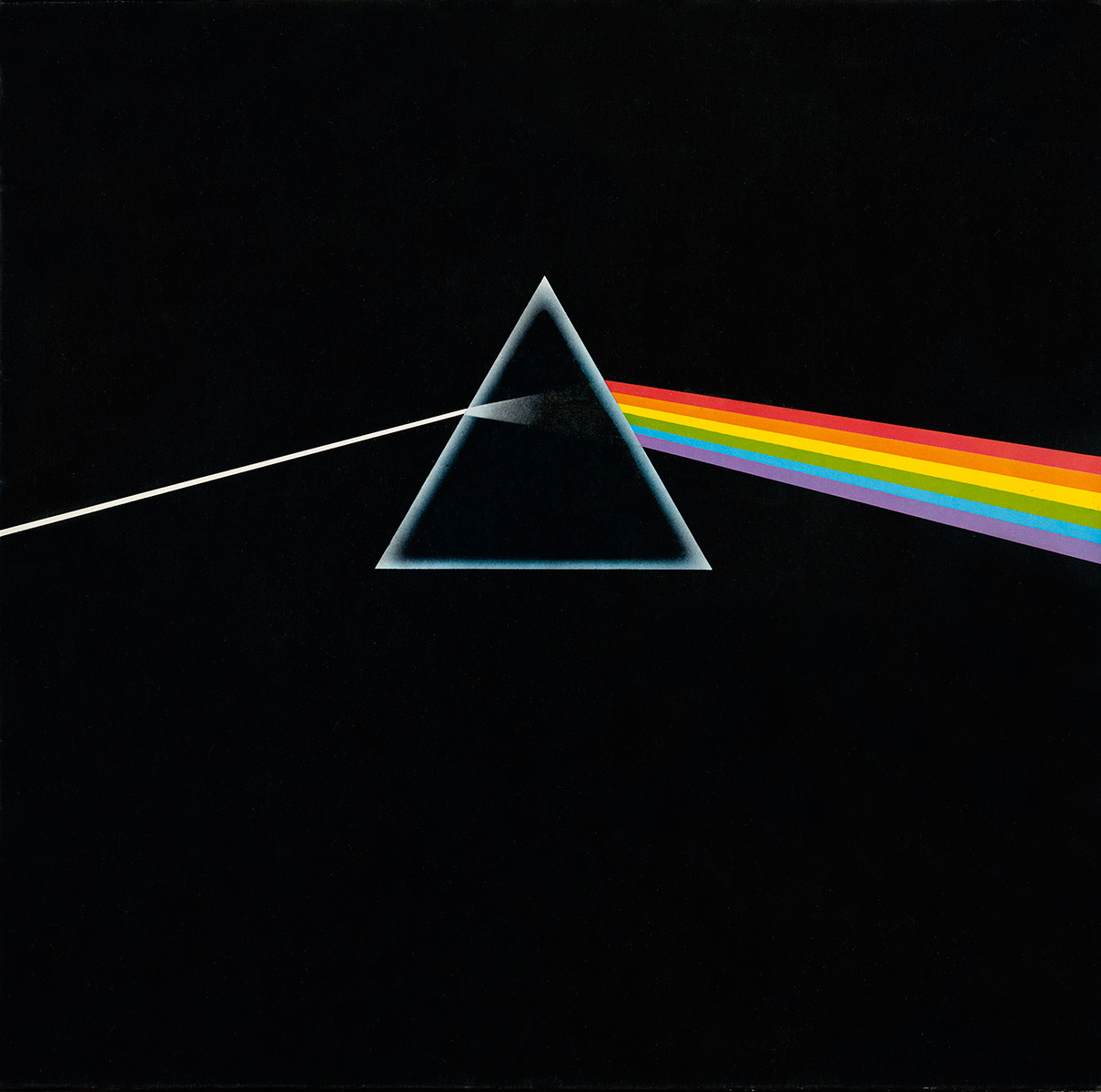
Pink Floyd's eighth album, built at Abbey Road in 1972 and 1973 as two unbroken sides. Its songs are good. What makes it great is the joins, and the outsiders it let in.
- Released
- 1 March 1973 (US, Harvest SMAS-11163, made by Capitol); March 1973 (UK, Harvest SHVL 804)
- Label
- Harvest (UK and US; the US issue made and distributed by Capitol)
- Producer(s)
- Pink Floyd (engineer Alan Parsons; mixing supervised by Chris Thomas)
- Runtime
- 42:58 (2023 remaster)
- Chart peak (US)
- #1 (Billboard 200, chart dated 28 April 1973, 1 week); 996 weeks on the chart by early 2026, a Billboard 200 record
- Chart peak (UK)
- #2 (Official Albums Chart, 25–31 March 1973), behind K-Tel's 20 Flash Back Greats of the Sixties. It never reached #1
- Certifications
- RIAA Diamond, 15× Platinum (4 June 1998); BPI 16× Platinum (16 January 2025); Music Canada Double Diamond (14 March 2003)
- Awards & honours
- Grammy Hall of Fame (1999); added to the US National Recording Registry in March 2013; the UK's 7th best-selling album of all time (Official Charts Company, 2019)
The songs on The Dark Side of the Moon are good rather than great, and the singing is its weakest part. It's one of rock's best albums anyway, because of the frame: two continuous sides with room for a doorman, a road manager and a £30 session singer.
The last voice on The Dark Side of the Moon belongs to Gerry O'Driscoll, the doorman at Abbey Road. He wasn't in the band and he wasn't a musician. He was answering a question Roger Waters had written on a card. Waters wrote a stack of them, in sequence, and whoever was in the building read the top card and answered it alone. The laughter belongs to the road manager, Peter Watts. Henry McCullough, the guitarist in Paul McCartney's Wings, gives one of the answers. Paul and Linda McCartney sat for the cards too, and neither made the record. People with no writing credit close the album, and they're scattered all through it.
Start there, because that's where the record's strength is. It's tempting to hear Dark Side as 10 great songs, but one of its writers never did. David Gilmour, who shares the credit on four of them, told Rolling Stone in 2003 that during the writing sessions he "wasn't running on all cylinders". He was right, and it matters less than you'd expect. What's extraordinary is the frame. Alan Parsons kept the whole album assembled on the multitrack, so each side could play straight through. Inside that frame there was room for a doorman, a session singer and a saxophonist Gilmour had known since childhood. The band's real achievement was knowing what to leave room for.
The idea came first, and it came from Waters. Late in 1971, at a band meeting in Nick Mason's kitchen, he proposed an album about the things that drive people mad. What had happened to Syd Barrett was in it from the start, he said in 2003. Gilmour remembers him arriving with one idea to run through the whole record, rather than a batch of separate lyrics. They shared a feeling that their old words had been too indirect. Asked about John Lennon's Plastic Ono Band, Waters called it one of the truly great moments in rock. Pitchfork's Eric Harvey writes that Waters wanted a drier sound in that record's spirit, and lost the argument. Gilmour points to two precedents of the band's own: 'Echoes', which filled a side of Meddle, and their 1969 suite, The Man and the Journey. Dark Side took that habit of long forms and gave it a subject.
It was also made on stage. The band first played the suite at Brighton Dome on 20 January 1972, more than 13 months before the album came out. 'Money' needed them to play in time with a taped collage of coins, and with a power-hungry sound and lighting rig the show ground to a halt. Waters told the crowd they'd do something else. The next night, at Portsmouth Guildhall, they played it complete. By the first Abbey Road session on 30 May they'd been performing it for 4 months. It would be easy to conclude the album was finished before a note was taped. It wasn't. On stage, 'On the Run' was a guitar piece called 'The Travel Sequence'. 'The Great Gig in the Sky' was 'The Mortality Sequence', built on taped Bible readings and the voice of the broadcaster Malcolm Muggeridge. Both survive on the 2011 Immersion box. The road tested the songs. The studio rebuilt two of the best of them.
The sessions ran from 30 May 1972 to 9 February 1973, mostly in Studio Three, with the larger Studio Two used at times. Reverb's Tony Bacon counts about 38 days of studio time across those 8 months. Parsons was an in-house engineer, paid £35 a week. He has said you'd expect the songs to be connected at the mix, but they weren't. The joins were already on the master tracks, so the last stage was finishing rather than assembly. On 1 February 1973 Parsons and the assistant engineer Peter James dubbed the side-one effects and finished its crossfades in Studio Three's control room. Side two's last crossfades and edits were done in Room 4 on 6 February. Three days later the edits went into a new master, copied for the band and for Harvest. That's why the sides flow like one long take.
Side one makes the case for sound before song. It opens on a heartbeat and a run of voices and effects, with a fragment of Clare Torry's voice among them. Then 'Breathe' brings in the first song. Its signature is Gilmour's Fender 1000 double-neck pedal steel, tuned to open G. 'On the Run' grew from Gilmour playing with an EMS Synthi AKS. Waters entered a new sequence slowly, then sped it up, and the track's panic rides on that one machine's pulse. Next come the clocks at the start of 'Time', which Parsons had first recorded as a test for quadraphonic sound. Mason's roto-toms had been hired by another band, who hadn't yet collected them. Parsons retuned the drums and dropped in each change. Nobody sings on 'Time' until 2:31. It's a side built from borrowed and found things, and its discipline is in how long it waits to sing.
The side ends on its best idea, and the band didn't supply it. On Sunday 21 January 1973, from 7pm to 10pm, Clare Torry came to Studio Three. Parsons knew her voice from a covers album. She was told there were no words. Gilmour ran the session and asked her for more emotion. She decided to "pretend I'm an instrument". How many takes she did depends on who you ask. Asked in 2005 whether she'd finished in two and a half, she said it couldn't have been much more. Gilmour remembers maybe half a dozen, compiled into one, and Waters recalls a single take. She was paid £30, at Sunday double time. Between 0:54 and 3:33 nobody speaks, and her wordless voice carries Richard Wright's chords through the album's long look at death. Loyd Grossman, reviewing the album for Rolling Stone in 1973, thought the track could probably have been shortened or dropped. That's the judgement in his review that has aged worst. Torry sued in 2004, and since a settlement the song has been credited to Wright and Torry.
Side two opens on the hit. Waters wrote 'Money' on acoustic guitar, in 7/4. He made the coin loop in his garden shed, throwing coins into his wife's clay-mixing bowl and splicing the tape. Asked about the R&B in it, Gilmour pointed to his teenage love of Booker T. & the M.G.'s, whose Green Onions album he owned. Wright plays a Wurlitzer electric piano through a wah pedal. Gilmour's solo comes in three parts, the last on a Bill Lewis 24-fret guitar. In America 'Money' reached #13 on the Hot 100. Then the album does its finest thing. 'Us and Them' began as a piece Wright wrote for Antonioni's Zabriskie Point, which the director turned down for a riot scene. Waters gave it new words. Gilmour asked for a long repeat on his vocal, and Parsons built it on a 3M eight-track running at 7½ inches per second. In Pitchfork in 2023, Eric Harvey called it the album's best song. He's right. It's the one place where the song and the studio are the same idea.
The weaknesses are real, and they're in the material, not the making. 'Any Colour You Like' is a jam, and it sounds like one. It opens on a synthesiser pattern, Gilmour's solo runs through a Uni-Vibe, and the track waits politely for the next song. 'Brain Damage' asks more of its tune than the tune can give. Waters wrote it about Barrett, and he sings it himself. Grossman found Gilmour's vocals sometimes weak and lacklustre, though he called that a minor quibble beside the album's grandeur. Robert Christgau, in his 1981 Record Guide, went after the ideas. He heard "conventional wisdom once-removed" and called the record a "kitsch masterpiece". What saves it, he said, is the studio work on Gilmour's solos and Dick Parry's sax. Put the two critics together and you have the case against: the thinking is second-hand and the singing is ordinary. The making isn't.
Its chart history carries a myth of its own. Dark Side was #1 in America for a single week, on the chart dated 28 April 1973. In Britain it stalled at #2, behind a K-Tel compilation, yet the Official Charts Company ranks it the UK's 7th best-selling album. The famous American number is 741 consecutive weeks on the Billboard 200, and Pitchfork repeated it in 2023. It isn't true. A first run of 84 weeks ended in October 1974. The longest unbroken run came later, 593 weeks from December 1976 to April 1988, and the album charted in shorter spells around the two. By early 2026, counting every return, it had 996 weeks on the chart, a Billboard record. The legend gets the number wrong and the point right. People kept buying it for 15 years.
Its influence shows up most plainly in people remaking the whole thing. Phish played it in full at a show in Utah in 1998. The Easy Star All-Stars turned it into dub as Dub Side of the Moon in 2003, and the Flaming Lips re-recorded it in 2009. Waters remade it himself in 2023. Its sounds travelled too. Milli Vanilli sampled 'Money' for their own 'Money' in 1989, and Marky Mark and the Funky Bunch sampled it on 'I Need Money' in 1991. The biggest claim is a critic's, and it's a good one. Harvey argues that Dark Side is the high point of rock's turn to the album as a totem, something to be decoded. He also calls it rock's most overdetermined album. Rolling Stone's lists have drifted it down, from #35 in 1987 to #55 in 2020. The legend now arrives before the music does.
So the reputation is right about the record and wrong about the reason. The Dark Side of the Moon is one of the best albums rock has produced. It isn't great because of its songs, and its singing is often only adequate. It's great because four musicians and their engineer built a frame strong enough to hold a doorman's answer, a £30 improvisation and a bowl of coins. The production and the sequencing are as good as anything in the form. 'Us and Them' and 'The Great Gig in the Sky' would stand out on any record. 'Any Colour You Like' wouldn't. After 53 years it still plays as one piece, from the opening heartbeat to the closing one, and that's rarer than a good song.
Pressing guide — the one to own
The first UK pressing, Harvest SHVL 804 from 1973. It has a solid light-blue prism label with silver text and 'The Gramophone Co.' in the rim text, a gatefold sleeve, two posters and two stickers. The runouts read SHVL 804 A-2 and B-2. Later issues moved to a black label with a blue-outline prism, so the label colour and the rim text date a copy faster than the sleeve does.