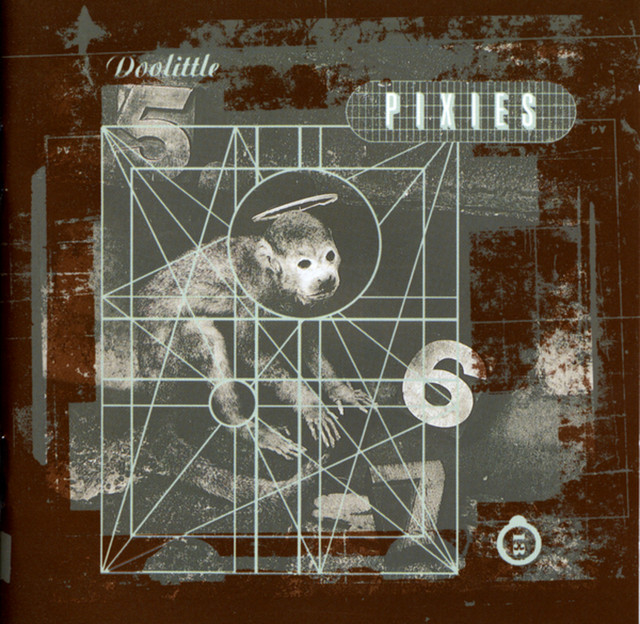
The Pixies' second album packs 15 songs into 38 minutes, recorded at about a song a day for a producer who wanted them longer. You can hear the argument.
- Released
- 17 April 1989 (UK, 4AD); 18 April 1989 (US, Elektra)
- Label
- 4AD (UK, CAD 905); Elektra/4AD (US, 9 60856-1)
- Producer(s)
- Gil Norton (producer and engineer); mixed by Steven Haigler
- Runtime
- 38:37 (15 tracks), the sum of the timings printed on the 1989 UK CD and US LP
- Chart peak (US)
- #98 (Billboard 200, 2 September 1989), 27 weeks on the chart
- Chart peak (UK)
- #8 (Official Albums Chart, 29 April 1989, its first week)
- Certifications
- BPI Platinum (7 February 2015); RIAA Platinum (10 December 2018)
- Awards & honours
- #4 in NME's albums of 1989; #10 in the Village Voice Pazz & Jop critics' poll for 1989; #141 on Rolling Stone's 500 Greatest Albums (2020)
Doolittle is the sound of a songwriter and a producer pulling in opposite directions, Black Francis towards noise and brevity, Gil Norton towards polish. That pull gave its best songs their shape. In the second half the sequence loosens, and slight songs crowd the strong ones.
Black Francis once won an argument with Gil Norton by handing him a copy of Buddy Holly's Greatest Hits. Norton had been making the Pixies' songs longer, doubling a verse here and a chorus there. Holly's songs were mostly under 2 minutes, and that was Francis's point. Norton let it drop. Doolittle fits 15 songs into 38:37, and only three of them pass 3 minutes.
That exchange is the whole record in small. Norton wanted something cleaner and more commercial, and Francis has said he knew it. He wanted to keep the rawer sound of Surfer Rosa. Neither man got all he wanted, and the songs are better for the tug of war. Doolittle puts its sweetest tunes and its ugliest stories side by side, and the polish is what lets the ugliness travel. The same pull has a cost, though. In the second half, brevity stops being a discipline and becomes a habit, and a run of slight songs loosens the sequence.
Surfer Rosa had been made fast and cheap. Steve Albini took a flat fee of $1,500, and 10 working days were booked at Q Division in Somerville. The album did better in Britain than at home. It was a hit on the UK indie charts but never reached the main albums chart. 4AD wanted a single from it. Norton had seen the band supporting Throwing Muses at the Rat, and in May 1988 he re-recorded 'Gigantic' with them. It reached #93. For the next album, their manager Ken Goes proposed Norton or Ed Stasium. 4AD's Ivo Watts-Russell chose Norton.
The usual story is that the band fired Albini after he insulted them. The dates don't fit. Francis says the label put Albini forward again, but Albini called himself an engineer. When 4AD suggested Norton, "an actual record producer", the band were happy to agree. Albini's dismissal of the Pixies as blandly entertaining college rock came in 1991, two years after Doolittle, and he apologised in 2005. What had changed was the money. 4AD's budget was $40,000 before the producer's fee, four times Surfer Rosa's, by Ben Sisario's account. And from October 1988 American labels were bidding for the band. Elektra won.
Norton reached Boston in mid-October 1988. He spent 2 days with Francis and an acoustic guitar, then about 2 weeks rehearsing the band. Tracking at Downtown Recorders ran from 31 October to 23 November, roughly a song a day. The four played together in one room, with few overdubs beyond the vocals. The songs weren't new to them. They'd demoed songs for the album at Eden Sound in Newtonville that September, and played 'Dead', 'Tame' and 'There Goes My Gun' on a John Peel session in October. Norton's rule was that every song had to be portable: bass, drums, two guitars and a voice, all playable on stage. He engineered it himself, because Al Clay, who'd engineered 'Gigantic', was busy on the Rain Man soundtrack. The mix, with Steven Haigler on an SSL desk at Carriage House in Stamford, Connecticut, was done by 12 December.
Listen to how the songs are built and you hear Kim Deal and David Lovering first. 'Debaser' opens on Deal's bass, and Francis doesn't arrive until 22 seconds in, singing about Buñuel and Dalí's 1929 film Un Chien Andalou. The coda was Norton's idea. The last line comes at 2:01, and the band keep going for most of a minute. 'Tame' is a three-note bass line under a whispered verse, until the chorus turns the whisper into a scream. The loud-quiet trick the Pixies are famous for isn't a production effect here. It's the arrangement, and Deal and Lovering hold it together. Chris Mundy singled out the rhythm section in his Rolling Stone review in 1989.
'Monkey Gone to Heaven' is the one place Norton stepped outside the portable rule, and he made sure the song still worked without the strings. Deal had been plucking the strings inside a grand piano with a plectrum, and the sound gave Norton the idea for a string part. It was recorded at Carriage House during the mix. Nobody wrote an arrangement. Norton sang the line to the cellist Arthur Fiacco, who sketched it out, and the four players finished in about 2 hours. They'd come straight from a concert, still in evening dress. Norton says he wanted the strings plucked, for texture. So the most elaborate sound on the record was made up on the spot, which is the album's method in miniature. Lovering, meanwhile, is playing a 5-inch toy snare.
The record's best trick is the company its songs keep. Francis wrote 'Here Comes Your Man' at 14 or 15 and was embarrassed by it. Norton liked it, and Francis said in 2004 that he let it on the record as a favour to his producer. The album take was the third time they'd recorded it, and it's as sweet as anything they made. One track later comes 'Dead', which retells David and Bathsheba over what Alexis Petridis called a one-note riff. 'Wave of Mutilation' is about Japanese businessmen driving into the sea. 'Crackity Jones', at 1:24, is a burst of partly Spanish panic about a disturbed roommate Francis had in Puerto Rico. 'Gouge Away', the closer, goes back to the Old Testament for Samson and Delilah. The album's working title was Whore, until Francis worried that the word beside a haloed monkey would read as anti-Catholic. Norton's compression and reverb don't soften any of this. If anything, they make every odd detail easier to hear.
Not everyone in the room was easy about it. Joey Santiago worried there was too much reverb on his guitars, and one day he covered his Marshall cabinets with blankets to make the point. Francis, for his part, says that once he'd won the argument about length he was happy to let Norton lead. In Classic Rock he called the sound "cold and icy rather than fat and messy", and he meant it as praise. Petridis hears the whole switch from Albini to Norton as a push for the big time. Pitchfork's Mike Powell, who gave both albums 10 in 2014, heard Norton's sound as almost folksy. That push is real, and it doesn't hurt the songs. Without the polish, it's hard to see both singles reaching the top 5 of Billboard's new Modern Rock chart. Under it, the songs are as odd as anything on Surfer Rosa.
The trouble starts after 'Monkey Gone to Heaven'. Reviewing the 25th-anniversary set in 2014, Petridis gave it four stars but found a "scant handful" of longueurs. His clearest case is 'There Goes My Gun', "pleasantly inconsequential" beside the frantic take on the band's Peel session. Norton had asked for it slowed down, and slowed down it loses its reason to exist. 'La La Love You' is a joke: Lovering croons it Ringo-style at Francis's request, with vodka to get him through. It's funny once. 'Silver', Deal's one co-write on the album, has a mood and little else. Petridis's point was that every minute of Surfer Rosa is essential. Doolittle has three or four songs it could lose.
Two songs do the most to pull the second half back. 'Hey' was cut live, vocal and all, with Francis singing from a cupboard to keep his voice off the band's microphones. Norton says Santiago got through his solo without a mistake, and it's the second half's best performance. 'Gouge Away' closes the album on Samson and Delilah, and its build to the loud part is more gradual than on 'Debaser' or 'Tame'.
Commercially, it was a British record first. Doolittle entered the UK chart at #8 in its first week, the band's first appearance on the main albums chart. In the US it crept to #98 on 2 September 1989 and sold 100,000 copies in 6 months. Bossanova went higher in both countries in 1990. NME made Doolittle its #4 album of 1989, and the Village Voice's critics' poll had it at #10. Robert Christgau gave it a B+ and later rated the next two albums higher. Then it kept selling. Sisario counts about 1,200 copies a week in America in mid-1993, after the band had split. The RIAA certified it Gold in 1995 and Platinum in 2018.
Its influence is real, and usually told too neatly. Kurt Cobain told Rolling Stone in 1994 that he'd been trying to rip off the Pixies when he wrote 'Smells Like Teen Spirit'. He didn't name a song, let alone this album. Tying 'Teen Spirit' to 'Tame' is the critic Mark Beaumont's reading, a fair one, but not Cobain's. The band's oral history records PJ Harvey's awe at 'I Bleed' and 'Tame'. That's admiration on the record, not a stated debt. Slowdive, a band built on texture rather than shock, have named Doolittle as an influence too. Rob Hughes, writing in Classic Rock, suggests the quiet-loud dynamic was the album's furthest-reaching legacy, and it certainly travelled. The odder parts of Doolittle, the Spanish, the Bible stories and the jokes, mostly stayed at home.
So Doolittle is a great record with a loose middle, and both halves of that matter. Its first seven songs are as strong a run as any guitar band managed in the 1980s. Its reach, from Nirvana down, is larger than its sales ever suggested. But the case that every track is essential doesn't survive the stretch from 'Mr. Grieves' to 'Silver'. 'Crackity Jones', the coda of 'No. 13 Baby' and 'Hey' still land there. Around them, 'Mr. Grieves', 'La La Love You', 'There Goes My Gun' and 'Silver' are sketches, and a band that had been so concentrated sounds as if it's emptying the notebook. It took nearly 26 years to go Platinum in Britain, and it earned that slowly, on the strength of its best songs rather than its running order. Play it from 'Debaser' and don't stop before 'Gouge Away'. Just don't pretend the middle is as good as the ends.
Pressing guide — the one to own
The first UK edition of CAD 905 came with a 16-page album-sized booklet of lyrics and extra artwork. Early copies sold through Chain With No Name also came in a plastic carrier bag printed with the sleeve design. Otherwise it's the standard UK LP: a single sleeve with a printed inner, pressed by MPO from lacquers cut by Jack Adams. Both read MPO CAD 905 A1 JA and MPO CAD 905 B1 in the runouts, so the booklet is what tells them apart. In October 2026 more collectors wanted the booklet edition than owned one.