Portishead played their own pastiches of old records, cut them to vinyl and scratched them back into their 1994 debut. The sound is close to flawless. The songs inside it are less even.
- Released
- 22 August 1994 (UK and Europe, Go! Beat)
- Label
- Go! Beat, an imprint of Go! Discs (UK and Europe); Go! Discs/London (US)
- Producer(s)
- Portishead, produced with Adrian Utley; engineered by Dave McDonald
- Runtime
- 48:45 by the booklet of the 11-track CD (828 553-2), about 49:20 measured. The original LP and the 10-track CD (828 522-2) run about 45:30
- Chart peak (US)
- #79 (Billboard 200, issue dated 11 March 1995)
- Chart peak (UK)
- #2 (Official Albums Chart, chart dated 6 May 1995)
- Certifications
- BPI 3× Platinum (1 February 2019); RIAA Gold (21 August 1997)
- Awards & honours
- Mercury Music Prize, 12 September 1995. #131 on Rolling Stone's 500 Greatest Albums of All Time (2020). #14 in the Village Voice Pazz & Jop critics' poll for 1994
Dummy sounds as if it was built from old records, and mostly it wasn't. The band made their own, then aged them. That method gave Portishead a sound nobody could match, and one mood the songs don't always fill.
Dummy sounds as if it was built from old records, and mostly it wasn't. Philip Sherburne set out the method in Pitchfork in 2017. Clive Deamer, Geoff Barrow and Adrian Utley jammed their own versions of 1960s records onto 24-track tape. They fed the results back into samplers, or cut them to vinyl dubplates and scratched them back in, the way a hip-hop producer works a record. NME's review in August 1994 had already heard it. Most of the noises, it said, had been played onto vinyl and scratched back into the mix. Only five of the 11 tracks carry a credited sample. The rest of the dust is homemade.
That's the record's real achievement, and it's a producer's achievement. Portishead found a way to make new music sound found. The result was so complete that it ended up with a reputation as dinner-party music. Sherburne's review argues against that, and Barrow told the Observer in 2019 that Dummy had more in common with Nirvana than with chillout. He's right about the intent. But the evenness that let people mishear it is also the record's limit. Dummy holds one mood from the first track to the last, and the mood is stronger than most of the songs inside it. The sound is close to flawless. The songwriting, a few tracks aside, is the weakest thing about it.
Barrow was 22 when it came out. He'd worked at Coach House Studios in Bristol as a tape operator and tea boy on £60 a week. While Massive Attack were recording Blue Lines there, they gave him spare studio time. Cameron McVey spotted him and took him on for Neneh Cherry's Homebrew, where he co-wrote and co-produced 'Somedays'. By Jude Rogers's account in the Observer, his first ideas with Beth Gibbons were recorded in Cherry's kitchen in London. NME's 2013 feature on the band's roots names three hip-hop records as crucial. They're The Low End Theory, It Takes a Nation of Millions to Hold Us Back and A Wolf in Sheep's Clothing. Beside them sat the film scores of John Barry, Lalo Schifrin and Ennio Morricone. Dummy is what those two shelves sound like played at once.
Gibbons was 29, a farmer's daughter who'd sung covers in Bristol pubs. She and Barrow met on an Enterprise Allowance training day, in 1990 by the Observer's account and 1991 by NME's. Barrow has said she seemed a grown-up to him. Utley was 37, a jazz session guitarist. He heard 'It Could Be Sweet' through a door at Coach House and asked Barrow to teach him to sample. He brought the theremins and cimbaloms of the spy films he'd taped. He co-wrote eight of the 11 songs, and the sleeve says the record was produced with him. Even so, Pitchfork says they were barely a band. They didn't play live until the album started selling.
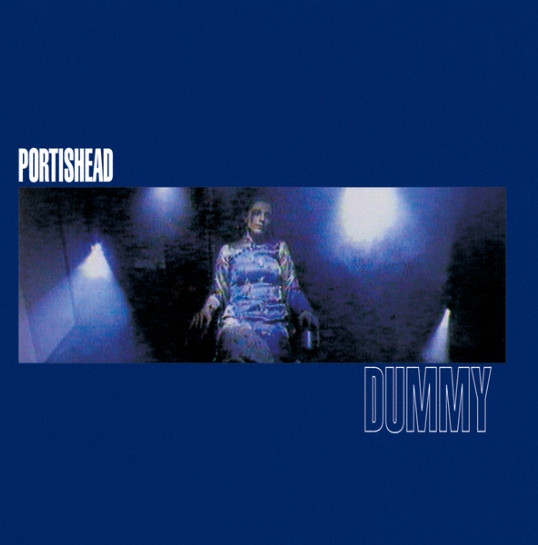
The sleeve credits two Bristol studios, State of Art and Coach House, with extra mixing at Moles in Bath. Rogers adds a move to Easton, in Bristol, which Barrow remembers as grim. No session log or budget has surfaced. What survives is the aim. Barrow told The Wire it was about the air between the hi-hat and the snare. That's a producer's creed, and the record keeps it: the gaps are as worked on as the sounds. Before the album, the band made a short film, To Kill a Dead Man. A still from it, showing Gibbons, became the cover.
Start with 'Mysterons', which opens the record. Utley is credited on theremin, Barrow on Rhodes and Deamer on live drums. Gibbons's last line arrives at 3:11, and the track runs almost 2 minutes past it. That's the album's habit: the track outlasts the song. 'Sour Times' sings its title once, at 1:43. It doesn't need to sing it more, because the hook is the loop. That's Lalo Schifrin's 'Danube Incident', from one of his 1960s Mission: Impossible albums. 'Strangers' tells you most about Barrow's priorities. Gibbons's vocal is her home demo, kept on the finished record. Behind it, Sherburne hears clean jazz guitar turn into something like a dial tone. On this evidence the band would rough up a guitar part but keep a demo vocal rather than sing it again.
Gibbons is the other half of the case. Sherburne and NME's 1994 review both reached for Billie Holiday, and NME later reported that Nina Simone was one of her favourites. She gave the press little, and Rogers points to two short interviews in the mid-1990s as the rare glimpses of a chattier side. The conventional songs show what she could do with a tune when she was given one. 'It Could Be Sweet' was her song, and Barrow remodelled it, NME says. Only two players are credited beside her: Barrow on Rhodes and Richard Newell on drum programming. 'Wandering Star' comes round to its title 6 times, more than any other song here. It's built on Eric Burdon & War's 'Magic Mountain', which De La Soul had used too, Pitchfork notes. Robert Christgau, lukewarm on the album as a whole, picked this one out.
'Roads' is where the voice wins. It's the only track with a string section, arranged by Barrow and Utley and played by Strings Unlimited. Gibbons comes in at 0:50, later than anywhere else on the record, and her one long pause lasts about 27 seconds. It's the best vocal on the album. 'Glory Box' closes the record on Isaac Hayes's 'Ike's Rap II'. Tricky built 'Hell Is Round the Corner' on the same record, but Maxinquaye came out 6 months after Dummy. 'Biscuit' takes a Johnnie Ray record slowed, Sherburne says, to 16 rpm. It's the method at its most extreme, and the place where it most plainly outruns the song.
That's the reservation, and one critic heard something like it at the time. Christgau's praise was faint: a one-star honourable mention in his Consumer Guide. He called it "Sade for androids" and picked out only 'Sour Times' and 'Wandering Star'. He was wrong about the sound and right about something else. Take away the production and only a few of these songs hold up on their own: 'Strangers', 'Roads' and 'Glory Box', with 'Sour Times' and 'It Could Be Sweet' close behind. 'Pedestal' gives about a minute of its 3:39 to a stretch with no vocal, and the song around it is thin. 'It's A Fire', added to the 11-track CD, is the one the album could lose. Even 'Numb', released as a single, has a mood where its tune should be.
Critics were quicker than buyers. NME gave it 9/10 in August 1994 and set it beside Blue Lines, Selected Ambient Works and Debut. The Village Voice's Pazz & Jop poll had it at #14 for the year. Britain caught on more slowly. Dummy entered the chart at #32 in September 1994 and dropped out after 6 weeks. It came back in late November, reached #3 in January 1995 and peaked at #2 in May, more than 8 months after release. In America it reached #79 on the Billboard 200 in March 1995. Then, on 12 September 1995, it won the Mercury Music Prize at the Savoy Hotel in London. One judge told Billboard that Tricky's Maxinquaye had run it close, with PJ Harvey third. Oasis's Definitely Maybe had gone out early. Barrow used his moment to say that music shouldn't be judged. The next chart had the album up from #24 to #9.
What it changed shows most clearly in the copies. Sherburne lists Lamb, Morcheeba, Hooverphonic and Sneaker Pimps among the acts that took the mood and missed the point. That's fair, and it explains the dinner-party reputation. The mood was the part anyone could copy: a slow beat and a sad voice. Making your own records old enough to sample was much harder. Rogers draws the more interesting line, from Dummy to what got called hauntology, and names Boards of Canada, Burial and the Ghost Box label. Those are records about the grain of memory, and that's the part of Dummy that has lasted.
Its reputation has kept rising. Rolling Stone ranked it #419 among the 500 greatest albums in 2012, and #131 in 2020. Pitchfork gave it 9.5 in 2017. By 2020 the Official Charts Company counted 920,000 UK chart sales, fifth among Mercury winners. The BPI certified it 3× Platinum in February 2019, almost 25 years after release. The BBC later said the win gave the Mercury renewed credibility. The prize needed Dummy more than Dummy needed the prize.
So Dummy is a great record with fewer great songs than its reputation suggests. The production is the case for it, and the case is overwhelming: a whole sound played by hand, aged on purpose, then left alone wherever it worked. Gibbons gives that sound a voice it couldn't have built for itself. The songwriting is where it falls short. Too many tracks let the texture stand in for a tune, and the album's evenness hides how few would survive on their own. Keep 'Strangers', 'Roads' and 'Glory Box' close. Play the rest for the sound, which three decades of imitators haven't matched. It still sounds like nobody else.
Pressing guide — the one to own
The original is the 1994 Go! Beat LP, 828 522-1, pressed by DFI. Its runouts read 828-522-1-A-1 DFI 94 6 and 828-522-1-B-1 DFI 94 6, and its spine reads GO! BEAT. The label has curly quote marks round 'Dummy', and the inner sleeve is thick paper or thin card with a thumb cut-out. The earliest copies misprint the sample credits, giving 'Glory Box' to 'Isaac Moods'. The catalogue number and barcode prove nothing: the 2000 and 2017 reissues reuse both, and unofficial copies print them too.