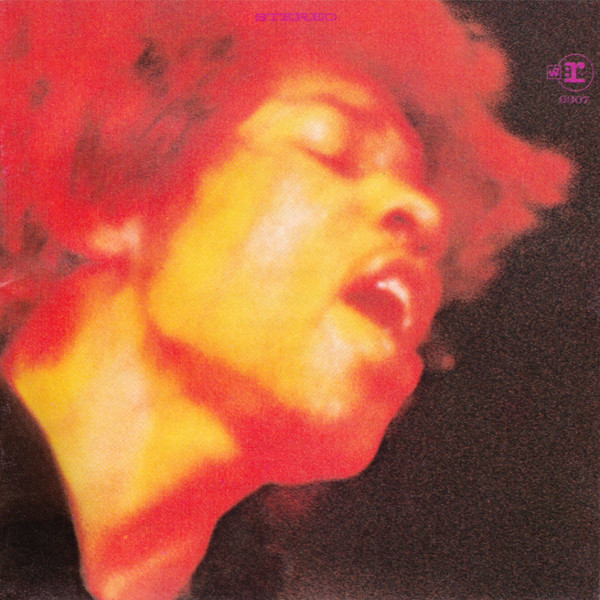
The Experience's 1968 double album and Hendrix's only US #1. It's the first record he produced himself, made at New York's Record Plant with the door open to the club crowd.
- Released
- 16 October 1968 (US, Reprise); 25 October 1968 (UK, Track Record)
- Label
- Reprise (US, Canada); Track Record (UK); Polydor (Germany, Japan); Barclay (France)
- Producer(s)
- Jimi Hendrix (sleeve credit: “produced and directed by”); Chas Chandler produced the early sessions, uncredited
- Runtime
- 75:29 (16 tracks, standard CD master)
- Chart peak (US)
- #1 (Billboard 200), 2 weeks: the charts of 16 and 23 November 1968
- Chart peak (UK)
- #6 (Official Albums Chart, 7 December 1968)
- Certifications
- RIAA 3× Platinum (11 December 2025); Gold on 18 November 1968
- Awards & honours
- Grammy Hall of Fame (1999); #53 on Rolling Stone's 500 Greatest Albums of All Time (2020)
Electric Ladyland is two records running at once: Hendrix's club nights let into the studio, and Hendrix alone at the desk building sound. Together they produced his greatest playing. They also left nobody to say when a side was finished.
On the night of 2 May 1968, Noel Redding walked out of the Record Plant in New York. He'd argued with Jimi Hendrix about how many people were in the studio. “It was a party not a session,” he wrote later in his autobiography. Hendrix took the party to the Scene, a club around the corner, where Traffic were playing. After the show he invited more or less the whole room back to the studio. Jack Casady of Jefferson Airplane got there between 2 and 3am. At about 6am, Casady recalled, Hendrix said they should play a blues. Steve Winwood sat down at the Hammond organ, Mitch Mitchell at the drums, and Casady took the bass. A string broke on the first take. Casady remembers the recording at about 7:30 that morning. It became 'Voodoo Chile', all 15 minutes of it. “We just thought it was a jam,” he said.
That night explains the album better than any summary of its making. Electric Ladyland is two records running at once. One is an open house, where whoever came back from the club got on tape. The other is Hendrix alone with his engineers in a new studio, building songs a layer at a time. The first gave it the greatest playing of his career. The second gave it its best constructions. Neither had much use for an editor. That's why a record this good is also the loosest of the 3 studio albums he finished.
The change was about control. Chas Chandler had found Hendrix and produced his first two albums. On 8 May, 5 days after 'Voodoo Chile', the estate's session log records him stepping down as producer. He later gave John McDermott his reasons. “Both I and the group were exhausted,” he said. The last thing he wanted was to fight Hendrix in the studio and then Michael Jeffery in the office. “I just walked away.” Casady thought Hendrix had already taken over by the night of the jam. The sleeve reads “produced and directed by Jimi Hendrix”. Richie Unterberger writes that the sole credit upset Chandler, who'd produced some of the tracks. The pace had changed too. On 28 April alone, 'Gypsy Eyes' ran to 41 takes.
It's tempting to blame the sprawl on that freedom. The dates make it less simple. 'Burning of the Midnight Lamp' was cut at Mayfair Studio in New York in July 1967, and was a UK single that summer. 'All Along the Watchtower' was begun at Olympic in London on 21 January 1968. That spring, in his room at the Drake Hotel, Hendrix recorded 36 minutes of solo demos. Among them are '1983…', 'Gypsy Eyes' and an early 'Voodoo Chile'. The estate's session log dates them to 8 April. The notes to its own 2018 box say March. Either way, the Record Plant sessions didn't start until 18 April. Several of the songs, then, existed before the sessions did. What the new room changed was who decided when a track was finished.
'All Along the Watchtower' shows what that could do. The basic track came from Olympic, with Dave Mason on 12-string guitar and Brian Jones on percussion. Redding walked out of that session partway through as well, and Hendrix later overdubbed the bass himself. Then, through June, July and August, Hendrix kept adding guitars at the Record Plant. The engineer Tony Bongiovi described the master moving from a 4-track tape to a 12-track and then a 16-track. The solo runs from 1:41 to 2:49. Guitar World, drawing on Kramer in 2008, counts 4 distinct sections in it, each recorded separately. Kramer remembered a different tone for each, and a slide part played with a cigarette lighter. Tony Glover, reviewing the album for Rolling Stone in November 1968, made the useful point. On Hendrix's own songs, he wrote, “it's sometimes hard to see the structure at first.” Here Dylan's song held the frame, and Hendrix could hang everything on it.
Dylan accepted the result. In his Biograph booklet in 1985 he said he'd liked Hendrix's record, and had done the song that way since Hendrix died. Clinton Heylin dates the change to the first show of Dylan's 1974 tour. The single reached #20 on the Billboard Hot 100 in October 1968, and #5 in Britain. It's the album's best track. It's also the strongest case for Hendrix as an arranger and producer, and he made it on somebody else's song.
'Voodoo Chile' is the other pole. Hendrix doesn't sing until 1:07. Then the song opens into 2 long instrumental stretches, from 4:41 to 7:10 and from 7:53 to 11:17. Robert Christgau, writing in Stereo Review in March 1969, called its improvising among the few in rock “worthy of the name”. Glover thought it sounded like a late-night recording in a small club. It wasn't quite. It was cut in a studio at dawn, and the crowd noise went on afterwards. Casady remembers the crowd being marched in about 10 minutes after the take. McDermott's account puts the overdub between 9:00 and 9:45. Even the album's one live jam was finished at the desk. Then, by McDermott's dating, Hendrix cut 'Voodoo Child (Slight Return)' for an ABC film crew, in 8 takes. At 5:13, it's about a third the length of the jam. A scratched wah-wah rhythm opens it, and the vocal waits until 1:04. Released in Britain after Hendrix's death as 'Voodoo Chile', it went to #1 on the chart of 21 November 1970. He kept both versions on the album. That's its method in miniature: he wouldn't choose.
Side three is where the producer earns his credit. '1983… (A Merman I Should Turn to Be)' was a band take at Sound Center in March and a hotel demo that spring. On 22 April came 5 takes with Chris Wood on flute. Hendrix added edit sections on 8 May and finished it on 10 June, playing the bass himself. Backward guitar and flute run through it, with seagull cries made from microphone feedback. These are sounds made for tape, not a stage. Rolling Stone in 2020 called the record “a fever dream of underwater electric soul”, and this is the track that earns the phrase. Christgau in 1969 called the production “the best job of stereo for its own sake I know”. Glover told readers to use earphones and “watch the guitar swoop back and forth through your head.” He also heard a flaw. Hendrix builds “a beautiful undersea mood”, Glover wrote, “only to destroy it with some heavy handed guitar.” Glover still sounds half right.
The album's real weakness is written down in its own session log. On the last night, 27 August, it was one track short. The band cut Earl King's 'Come On' in 14 takes and used the last. That night Kramer and Gary Kellgren made the flanging on 'Gypsy Eyes' by pressing on the tape reel by hand. Redding, meanwhile, recorded 12 takes of a song that ended up on the debut of his new band, Fat Mattress. Elsewhere the seams show too. 'Rainy Day, Dream Away' and 'Still Raining, Still Dreaming' are one jam from 10 June, split in two at the mix. 'Burning of the Midnight Lamp' was more than a year old, and Glover said it “goes nowhere”. One UK sleeve even carries a rejected running order, printed under the final one.
Its champions hear a whole, and they deserve an answer. Glover found no concept but “a unity, an energy flow”. Christgau, giving it five stars in Blender in 2005, wrote that no previous rock album “had flowed like this”, while conceding it isn't perfect. In the same piece Christgau quotes Hendrix: “every little thing you hear there means something.” Within a side that's often true. On 7 July Kramer worked on the crossfades that run 'Have You Ever Been' into 'Crosstown Traffic' and 'Voodoo Chile'. Glover called side three “the sea or water side”, and it plays as one long tide. Across four sides, though, the record keeps starting again. 'Come On' has a fine guitar break, which Glover rated among the nicest things Hendrix had done. It's still on the album because a slot was empty. 'Little Miss Strange' is a pleasant Redding song with no reason to be here.
Its commercial standing came fast. It entered the Billboard 200 at #179 on the chart of 19 October 1968 and reached #1 on 16 November, his only American #1. It held the top for 2 weeks, interrupting the run of Cheap Thrills. The RIAA certified it Gold on 18 November 1968 and 3× Platinum on 11 December 2025. Its influence is easiest to trace song by song, and the strongest case is Dylan's. The writer of 'All Along the Watchtower' took the cover's arrangement as his own. Guitarists took up 'Slight Return'. Stevie Ray Vaughan recorded it on Couldn't Stand the Weather in 1984, and told Guitar World it was important for people to hear Hendrix. MusicRadar in 2012 quoted Joe Satriani calling it “the greatest piece of electric guitar work ever recorded”. The sessions left a building too. The studio bills helped push Hendrix towards a studio of his own, and Electric Lady held its opening party on 26 August 1970. He died on 18 September, 3 weeks later.
So Electric Ladyland is a great record with its flaw built in. Its best stretches, 'Voodoo Chile', '1983…', 'Watchtower' and 'Slight Return', are the fullest account on tape of Hendrix as a player and as a builder of sound. Mitchell, Winwood and Casady meet him at his own level. But the album never decided what shape it was, and its producer had nobody to argue with. Little on it is bad. Several things are simply there because there was room. Play it a side at a time and it's one of the essential rock records of 1968. Ask it to be the single, finished statement its reputation describes, and the seams show.
Pressing guide — the one to own
The original to own in Britain is Track Record 613008/9, a stereo gatefold double LP in David Montgomery's naked-women sleeve. It was mixed only in stereo, so there's no genuine UK mono. White-text and blue-text sleeves were made at the same time, with the same inner-sleeve codes, so neither is simply 'the first'. In America the original is Reprise 2RS 6307, with Karl Ferris's photograph of Hendrix's head on the front; the nudes were never issued there in 1968.